BY ROYAUME
OCTOBER 2026
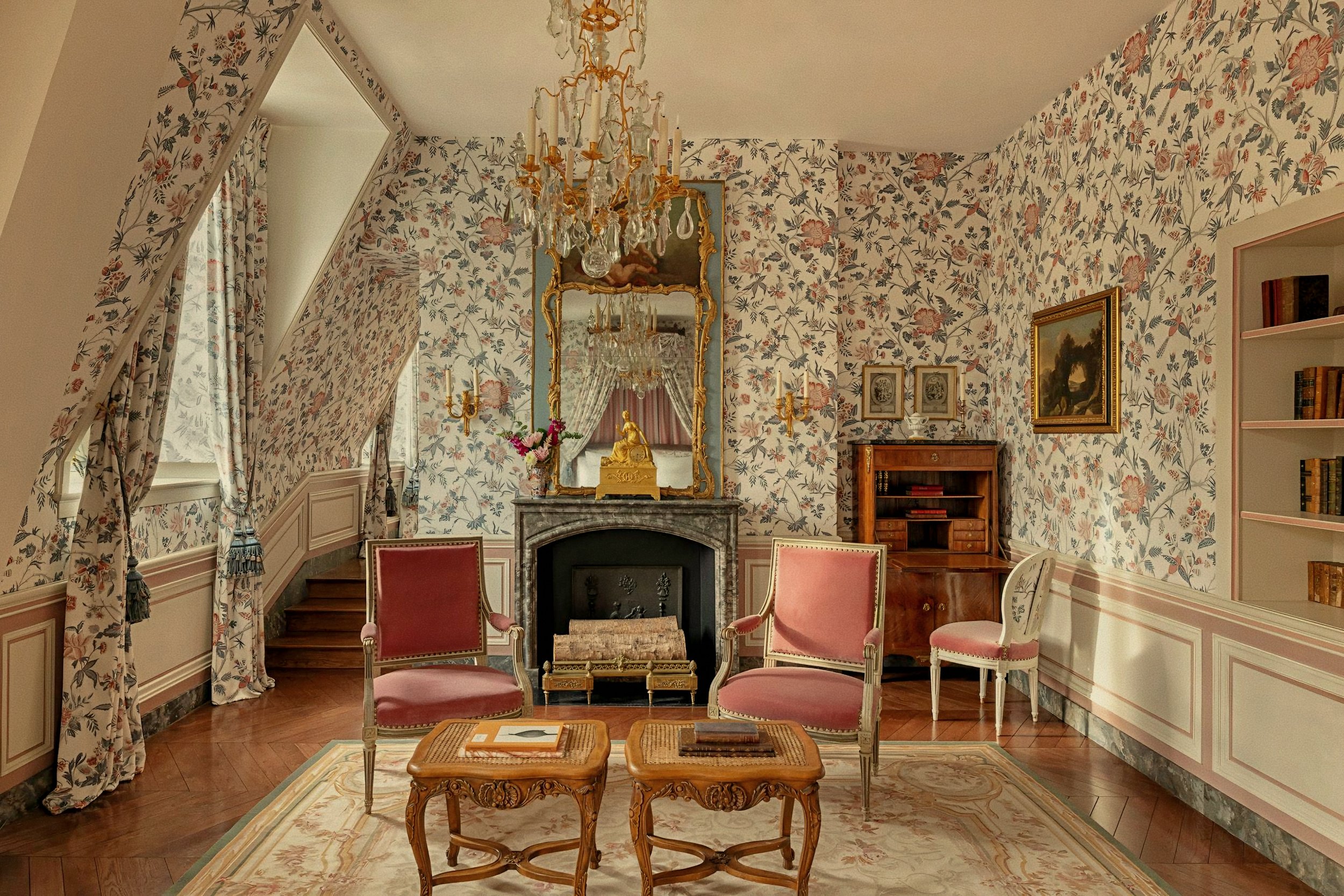
Floral motif wall coverings and gilded wood armchairs set around a carved marble fireplace face. Photo: Courtesy of Airelles Château de Versailles, Le Grand Contrôle
Nestled directly within the gates of the world’s most celebrated royal domain, Airelles Château de Versailles, Le Grand Contrôle unfolds not merely as a hotel, but as a breathtaking exercise in living history and absolute French sovereignty. Built in 1681 by Jules Hardouin-Mansart—the legendary architect of the Hall of Mirrors and the Grand Trianon—the estate originally comprised two grand ducal pavilions commissioned by King Louis XIV to anchor the southern flank of the palace grounds. By 1723, Louis XV designated the property as the official ministry for the Controller-General of Finances, transforming these gilded salons into the absolute administrative and social heart of the kingdom. It was within these very walls, under the tenure of historic figures like Jacques Necker, that crucial global history was written—from hosting the leading minds of the Enlightenment to signing the monumental financing for the American War of Independence.
Following centuries of political upheaval and a long stint as a French military officers' mess hall, the buildings sat abandoned for over a decade, decaying silently alongside the bustling estate. Its miraculous resurrection began in 2016 when the Public Institution of the Palace of Versailles awarded a historic lease to Airelles and legendary multi-Michelin-starred Chef Alain Ducasse. Driven by entrepreneur Stéphane Courbit’s vision of total historical immersion, a meticulous $50 million-plus restoration was launched to transform the crumbling structure into an uncompromising 18th-century time capsule. Every euro spent within its gates directly funds the ongoing restoration of the main Palace of Versailles, bridging private luxury with national heritage preservation.
Masterminded by French architect and interior designer Christophe Tollemer alongside Pierre Bortolussi, Chief Architect of French Historical Monuments, the four-year restoration bypassed modern guesswork in favor of absolute archival truth. Using a room-by-room inventory compiled for the Crown in 1788, Tollemer partnered with legendary textile house Maison Pierre Frey to manually recreate historical block prints, brocades, and wall damasks directly from the Versailles archives. Team members spent years scouring European auction houses to curate over 900 genuine Louis XVI-era antiques, while modern technology was rendered entirely invisible—its low-hanging crystal chandeliers engineered to cast the precise, flickering amber glow of authentic candlelight across regional limestone floors and historic marble hearths gifted back by the conservation team.
Today, the estate operates as an ultra-exclusive sanctuary of just fourteen keys, where arrival feels less like checking into a resort and more like being granted a private royal audience. Vehicles slip past guarded iron gates along the rue de l'Indépendance-Américaine into a private cobblestone courtyard, where heavy double timber doors swing open into a quiet, candlelit sanctuary. Bypassing commercial front desks entirely, guests are welcomed into the gold-leafed Salon des Audiences with glasses of Alain Ducasse champagne or Marie Antoinette’s favorite hot chocolate, greeted by the delicate signature scent of orange blossom and amber. Offering private, crowd-free access to the empty Hall of Mirrors and royal apartments after the public gates close, the property stands as the ultimate portal to the golden age of French court life.
The Trianon Boudoir
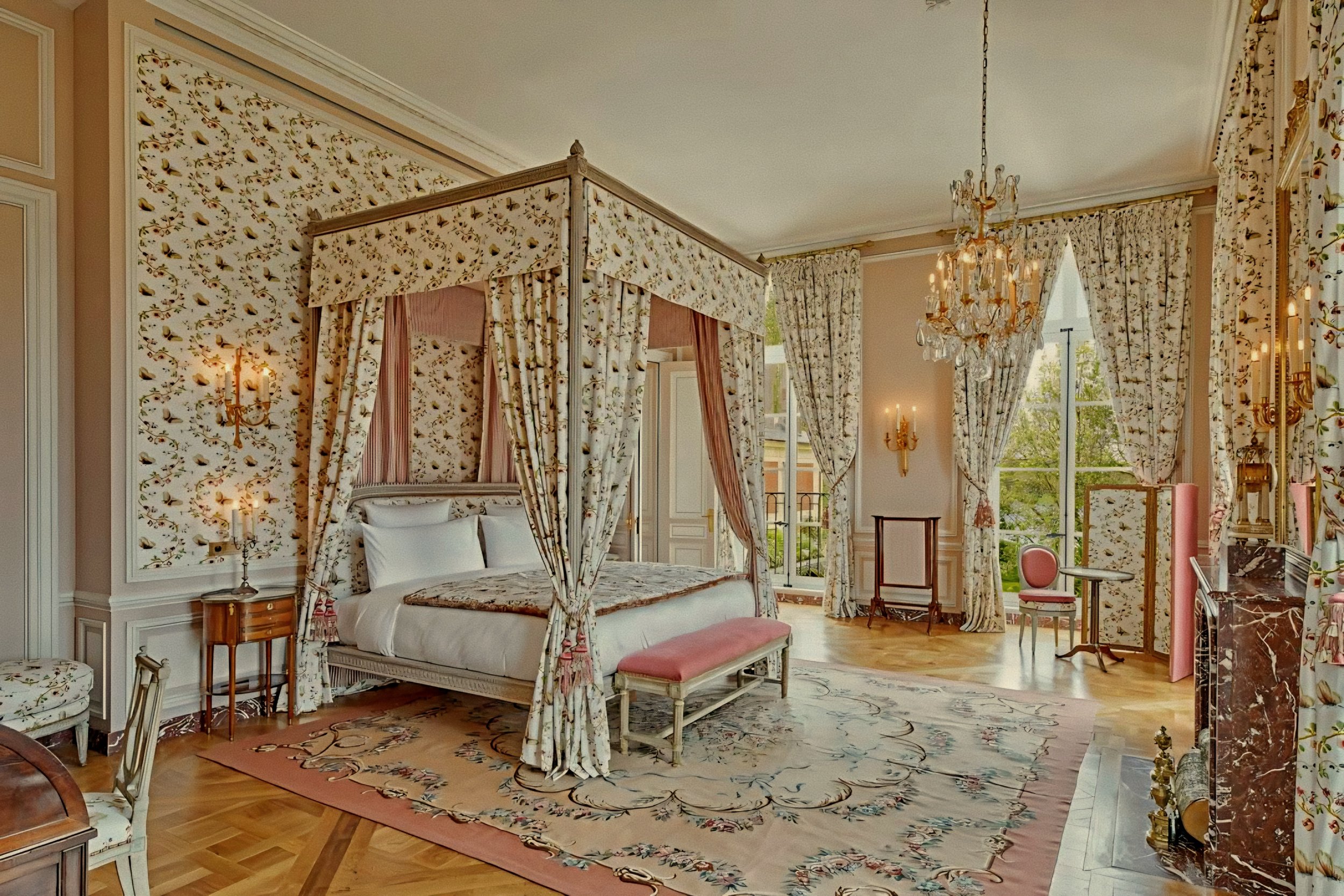
A floral damask canopy bed and gilded trumeau mirror anchored by polished parquet de Versailles flooring. Photo: Courtesy of Airelles Château de Versailles, Le Grand Contrôle
Across fourteen ultra-exclusive keys, every accommodation at Airelles Château de Versailles, Le Grand Contrôle acts as a living link to the pre-revolutionary French Court. Dictated entirely by the 17th-century architectural bones of Jules Hardouin-Mansart's original structure, there are no standardized layouts; each room functions as an independent, private royal apartment. Sleeping quarters are dominated by period-accurate Polish canopy beds and four-poster frames dressed in bespoke Treca mattresses and crisp Egyptian cotton linens.
Walls are padded and wrapped in heavy fabric tapestries custom-recreated by Maison Pierre Frey, featuring floral and royal motifs copied directly from historical archives found at Marie Antoinette’s Petit Trianon, set above original chevron and Versailles-pattern parquet flooring.
To preserve the 18th-century illusion without sacrificing modern comfort, technology is rendered completely invisible. Television screens are absent, while modern necessities—charging ports, climate controls, and service pads—are concealed within custom-crafted "21st-century boxes". Audio is delivered through discreetly integrated Marshall speakers, and lighting filters softly through restored crystal chandeliers engineered to cast the ambient glow of authentic candle flame. Every room preserves genuine historical ephemera, ranging from original oil portraits to frame-mounted love letters written by Madame de Staël.
At the antique writing desks, guests encounter bespoke letter-writing kits equipped with heavy parchment, calligraphy tools, and custom Airelles wax sealing kits. This attention to historical authenticity extends across suites named after court icons—such as the Marquis de Fouquet Suite, with its striking four-poster drapery, and the Jules Hardouin-Mansart Suite, which honors the building’s architect through refined French classicism.
The Porcelain Haven
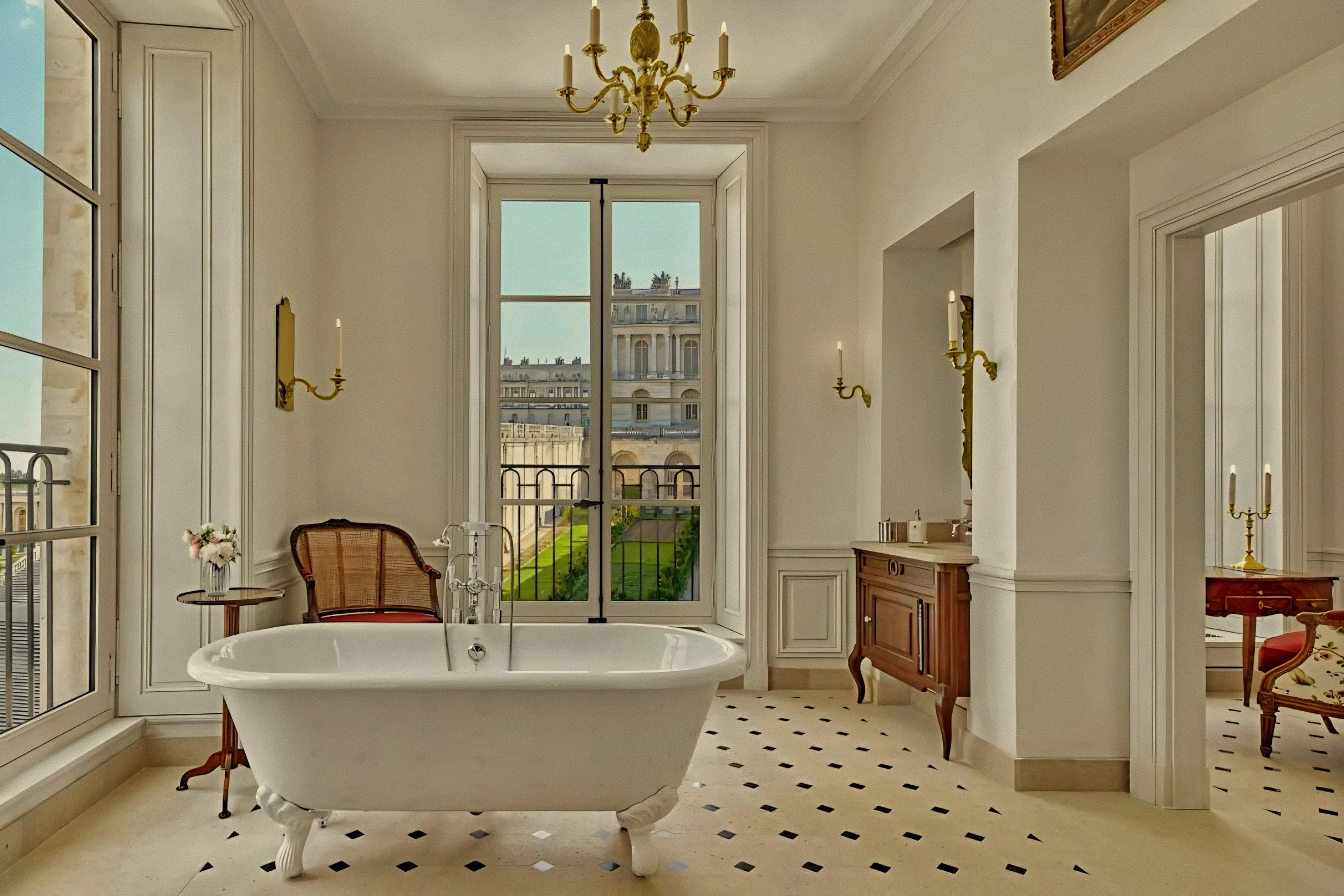
A clawfoot porcelain tub set on cabochon limestone tiling before soaring sash windows overlooking the Orangerie. Photo: Courtesy of Airelles Château de Versailles, Le Grand Contrôle
Conceived as dual-room sanctuaries, the bathrooms prioritize soaring vertical proportions and an abundance of natural light. Clad in cut stonework and cabochon limestone flooring, these light-filled spaces center around massive, deep-soaking porcelain or marble claw-foot bathtubs. Positioned directly before floor-to-ceiling French windows, the tubs allow guests to bathe while gazing out across the manicured boxwoods of the Orangerie or the still waters of the Lake of the Swiss Guards.
Seamless glass walk-in rain showers are complemented by restored brassware, gilded wall sconces, and historic "Queen’s bath" rituals utilizing floating fresh flower petals and bespoke botanical elixirs. These spaces balance monumental stone architecture with delicate residential details, creating an atmosphere of pure aristocratic privacy.
The Gilded Alcove
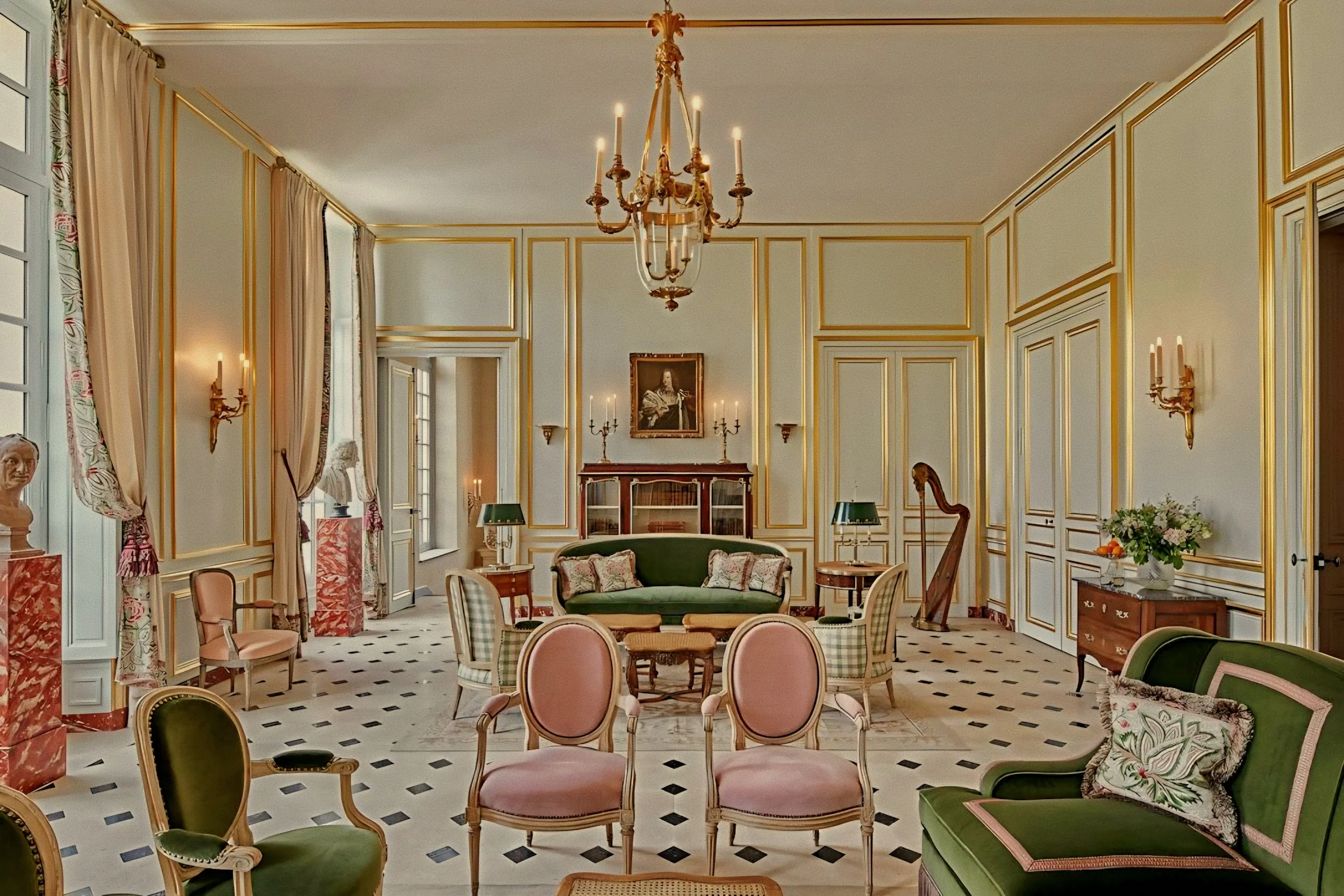
Gilded boiserie paneling in Trianon gray framing velvet banquettes and a crystal tier chandelier. Photo: Courtesy of Airelles Château de Versailles, Le Grand Contrôle
The suite living quarters unfold as grand
reception salons designed for diplomatic privacy and quiet contemplation. Walls are dressed in museum-quality 18th-century boiseries painted in soft Trianon gray and embellished with hand-applied gold leaf trimmings. Anchoring these spaces are genuine marble fireplaces gifted directly by the Palace of Versailles conservation team, surrounded by plush silk-upholstered sofas, armchairs custom-crafted by Pierre Frey, and period writing tables selected by heritage art historians.
The pinnacle of this interior layout is realized within the 120-square-meter Necker Suite—the former private apartment of Louis XVI's finance minister—boasting four-meter-high ceilings, giant French windows, and sweeping garden views. For ultimate opulence, Le Grand Appartement connects the Necker Suite, the Madame de Fouquet Suite, the Turgot Room, and the original Grand Library into a 350-square-meter royal wing featuring private outdoor terraces and full butler service.
"Our mandate was to resurrect the spirit of 1788 without creating a museum piece; every fabric, antique, and shadow had to feel alive," notes architect and interior designer Christophe Tollemer on the suite restoration. "By sourcing over nine hundred genuine Louis XVI antiques and pairing them with Pierre Frey fabrics woven directly from Versailles archives, we created salons where guests do not merely observe history—they inhabit it".
The Cabochon Vestibule
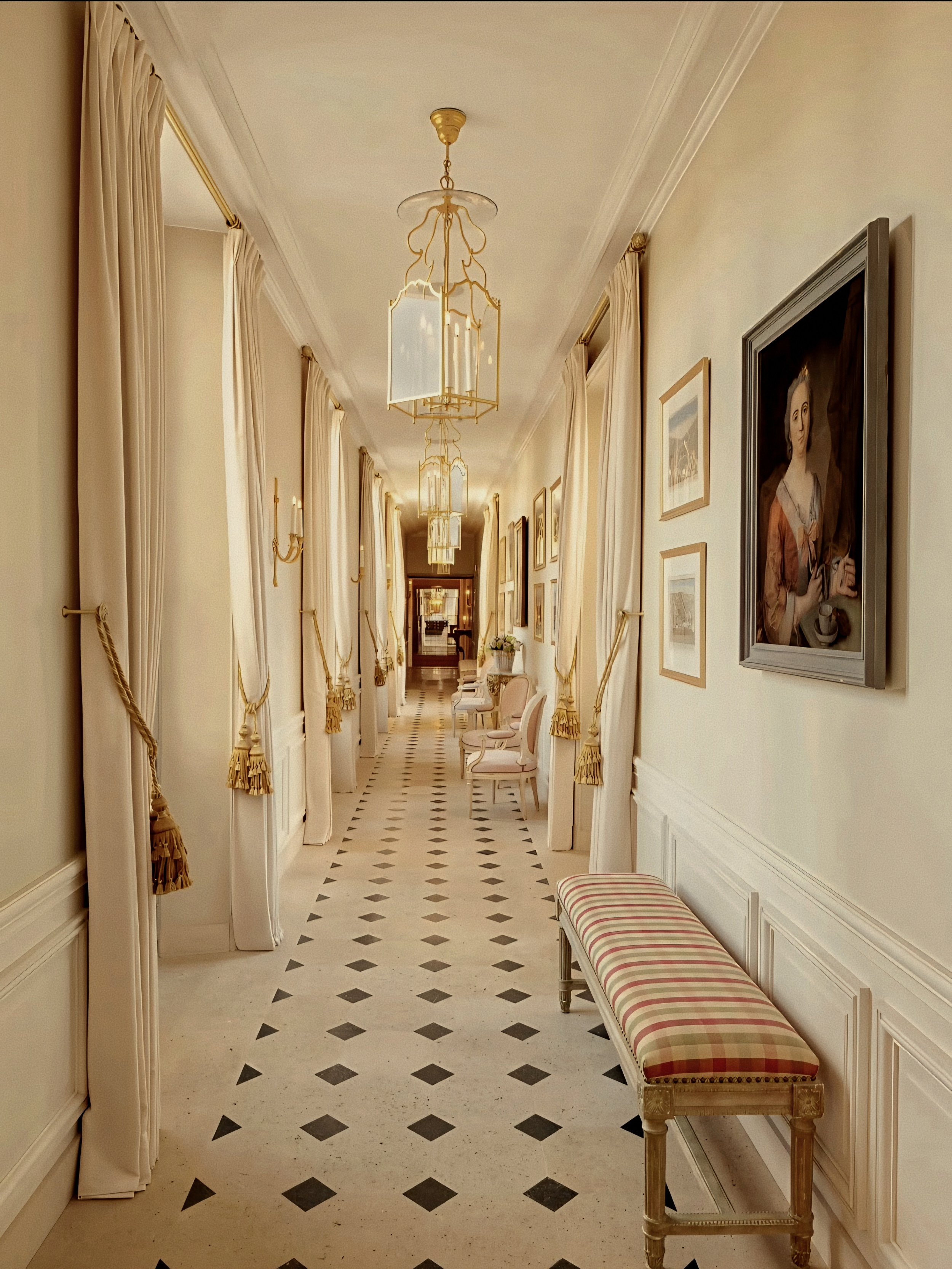
A cabochon stone gallery lined with silk-draped French doors and brass lantern sconces. Photo: Courtesy of Airelles Château de Versailles, Le Grand Contrôle
Connecting the private suites to the public salons, the property’s sweeping stone corridors function as quiet galleries of architectural rhythm. Underfoot, black-and-white cabochon stone floors reflect warm ambient light casting through glass lantern chandeliers and floor-to-ceiling windows framed by heavy cream silk draperies with gilded tassels. The walls—finished in pristine white wainscoting—are lined with 18th-century oil portraits, antique engravings, and upholstered period benches, creating an atmosphere of hushed, gallery-like intimacy.
As dusk falls across the red-brick and limestone facades of Jules Hardouin-Mansart's architecture, a profound stillness settles over the Orangerie Gardens. The lingering scent of orange blossom drifts along the empty stone terraces, echoing an era when time was measured by courtly rituals and artistic perfection. Here, behind gated stone arches where monarchs once shaped the destiny of Europe, Le Grand Contrôle delivers the ultimate luxury: not merely a glimpse into history, but the rare privilege of inhabiting its sovereign heart.
The Gastronomic Atelier
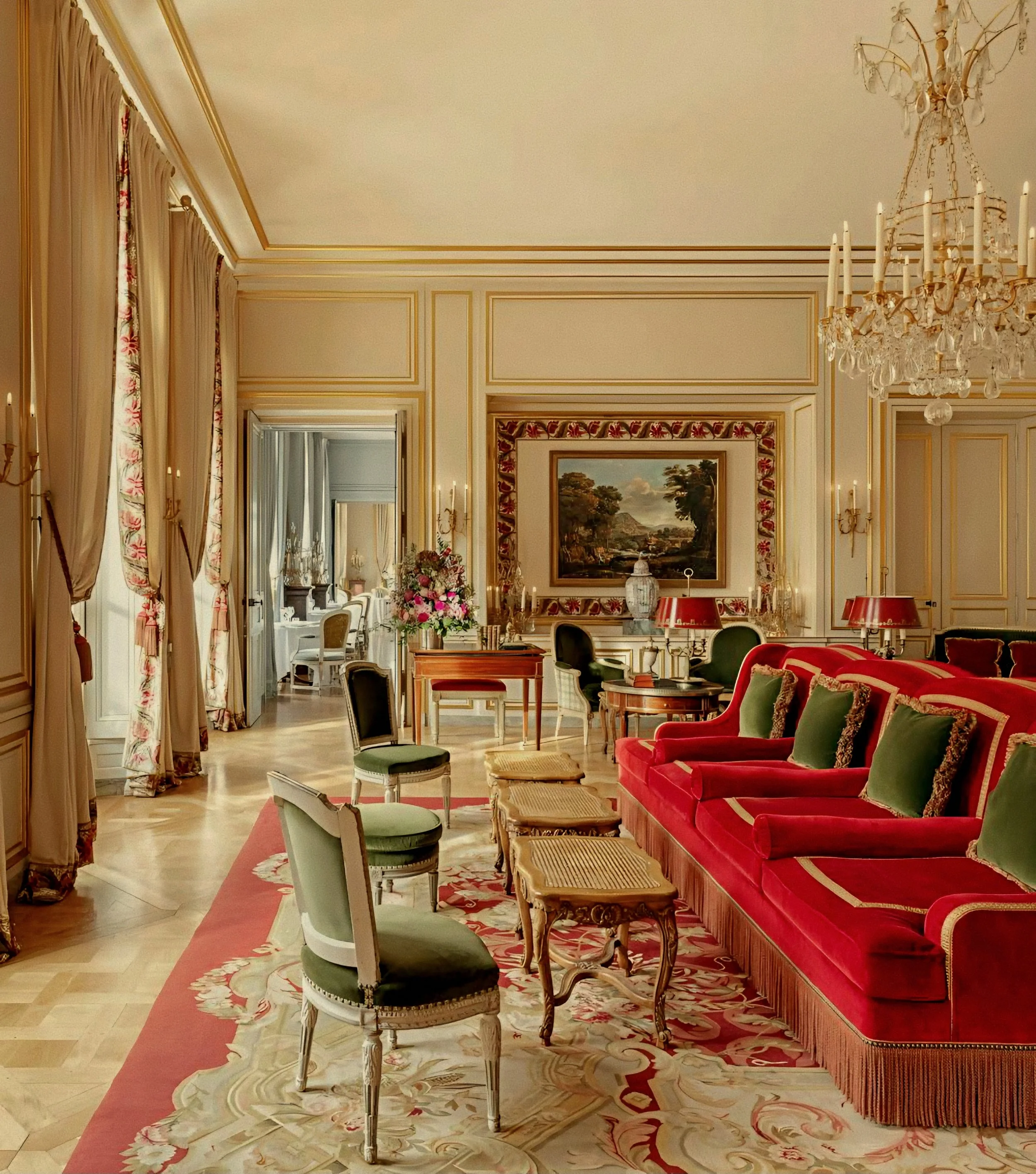
Deep crimson velvet banquettes and gilded mirror trumeaus reflecting a central crystal chandelier. Photo: Courtesy of Airelles Château de Versailles, Le Grand Contrôle
Gastronomy at Le Grand Contrôle unfolds as a multi-sensory journey through three centuries of French culinary heritage, masterminded by 18-Michelin-starred Chef Alain Ducasse. Drawing directly from court archives, the dining experience revives the opulence of the Grand Siècle, where meals are executed à la française across candlelight-drenched salons. At night, The Royal Feast and seasonal Grand Banquets transform the dining room into a theatrical spectacle; a valet strikes the parquet floor with a traditional wooden staff to announce each course, serving seasonal game, fine wines, and delicate reductions on exact porcelain replicas of Louis XV’s tableware. On weekends, the property revives the weekly court tradition of the "Great Meal" through a lavish Sunday Royal Brunch in the Grand Cabinet, while La Table des Jardiniers offers a relaxed, conviviality-focused menu inspired by classic French terroir.
Anchoring this royal table is an extraordinary agricultural relationship with Le Potager du Roi—the historic nine-hectare King’s Kitchen Garden created in 1683 by Jean-Baptiste de La Quintinie for Louis XIV. Practicing Ducasse's signature naturalité philosophy, the estate kitchens source heirloom vegetables, rare aromatics, and orchard fruits harvested directly from this historic royal soil. Cultivating over four hundred vegetable varieties and four hundred and fifty historic fruit strains—many saved from oblivion—the garden provides a hyper-local matrix of produce that elevates modern interpretations of 18th-century court recipes. For ultimate privacy, guests can reserve Marie-Antoinette’s intimate parlour for bespoke four-course lunches, or order a private gourmet Alain Ducasse picnic laid out directly upon the palace garden lawns overlooking the Orangerie.
"To cook at Versailles is to engage in a continuous conversation with history, where every seasonal ingredient from the King's garden must be honored with architectural precision," reflects Chef Alain Ducasse on the hotel's culinary manifesto. "We do not simply imitate the past; we reinterpret the grandeur of royal feasting through modern technique, transforming historical memory into an unforgettable contemporary emotion".
The Nocturne Crimson
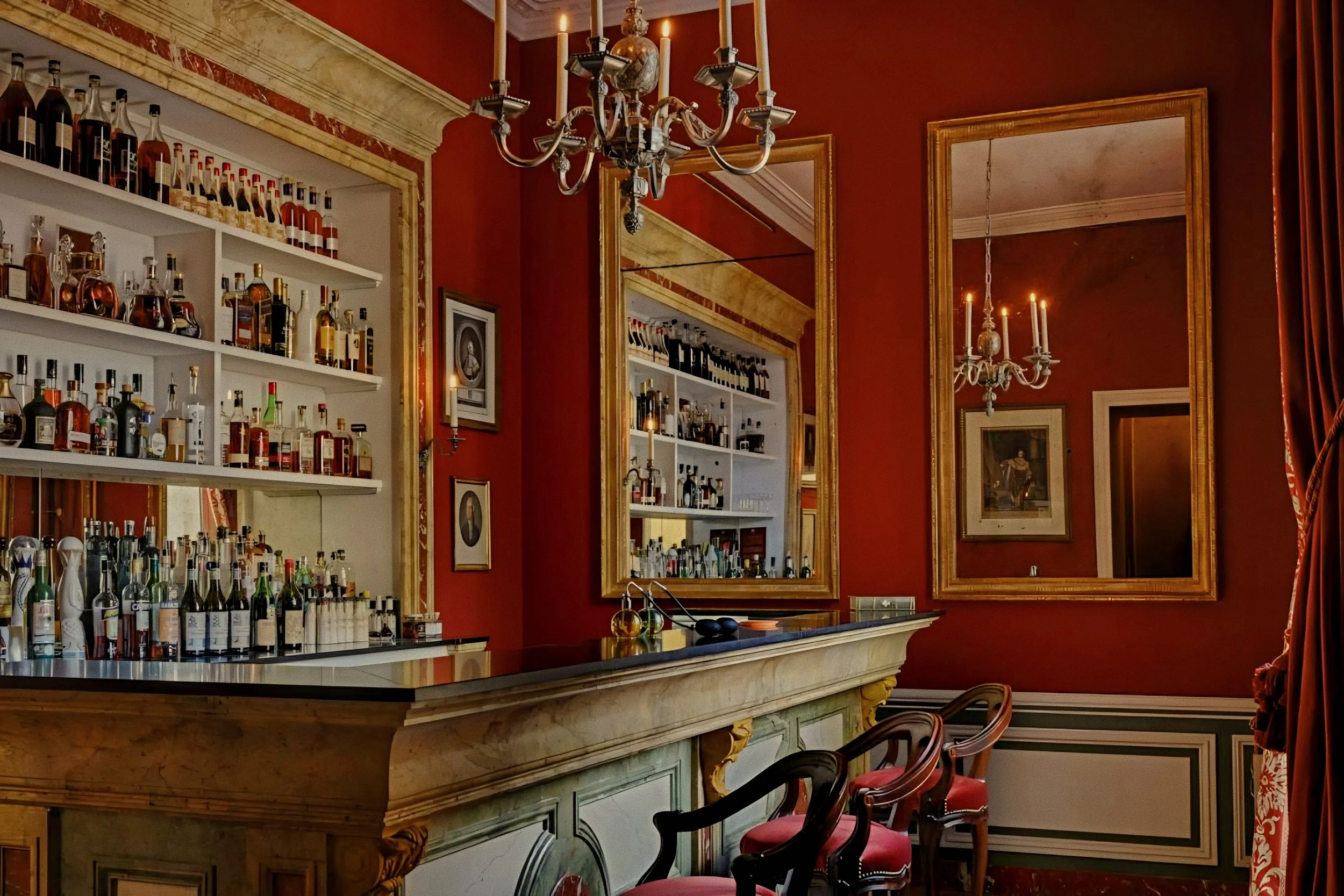
Polished mahogany millwork and tall gilded mirrors set against rich carmine walls. Photo: Courtesy of Airelles Château de Versailles, Le Grand Contrôle
Tucked within the Salon d’Audience, Le Bar de La Chapelle serves as a discreet, candlelit haven for socialites and connoisseurs. Enclosed by deep crimson walls, monumental carved marble bar counters, and towering antique gilded mirrors, the space balances 18th-century grandeur with modern mixology. As night falls, the bar is illuminated entirely by flickering candles, where mixologists craft bespoke botanical cocktails infused with garden elixirs alongside rare single-estate Cognacs, vintage Champagnes, and savory small plates designed by Chef Ducasse. Outside, guests can take their glasses onto the terrace to enjoy uninterrupted evening views over the Orangerie Gardens in complete privacy.
During the afternoon, the salon transitions into French-Style Tea Time, a sweet ritual curated by Executive Pastry Chef Aymeric Pinard in homage to Marie-Antoinette's legendary court gatherings. Drawing inspiration from historical archives, the tea service presents proprietary hot chocolate recipes found in court records alongside reinvented French classics, including browned-butter madeleines infused with lemon zest and Le Petit Versaillais chocolate sablés stamped with the estate’s key medallion. Served on silver platters alongside seasonal raspberry-pesto tarts and strawberry brioche, the ritual offers a serene, indulgent bridge between morning strolls through the palace gardens and the candlelit drama of the evening feast.
The Imperial Basin
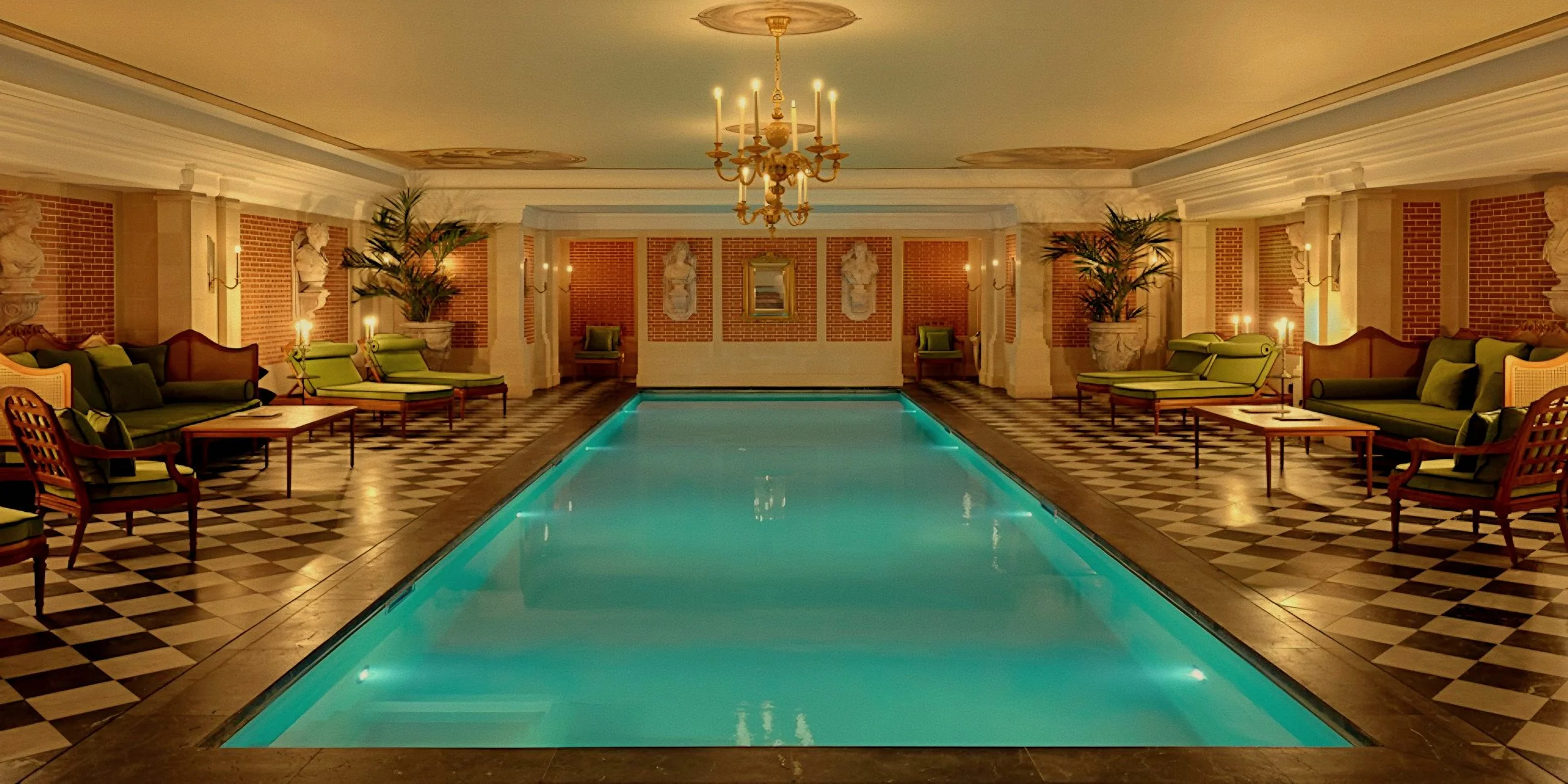
Black-and-white cabochon marble flooring framing a subterranean lap pool under vaulted stone arches. Photo: Courtesy of Airelles Château de Versailles, Le Grand Contrôle
Hidden entirely within the building’s original 17th-century vaulted stone cellars, Le Spa Airelles par Valmont is designed to evoke the quiet sanctuary of a private royal bathhouse. Bypassing modern spa layouts, the subterranean space contrasts raw, light-colored historic masonry with dramatic black-and-white checkerboard marble floors and low-glow, candle-mimicking illumination. The centerpiece of this subterranean haven is an imperial 15-meter heated indoor swimming pool, framed by stone archways and classical busts that mirror the architectural proportions of the nearby Orangerie. Plush, oversized daybeds and loungers line the checkerboard deck, where dedicated spa butlers serve chilled champagne, delicate macarons, and custom-infused herbal teas directly to guests.
Skincare treatments unfold across just two hyper-exclusive treatment cabins—the single Gabrielle de Polignac room and the expansive Marie-Antoinette suite. Partnering with Swiss cellular beauty brand Valmont and Laboratoires Botanique Avancée (LBA), the spa marries advanced plant stem-cell biotechnology with historical court rituals. Signature protocols include the bespoke "Majestic Mirror" facial, engineered to impart a porcelain, illuminated radiance reminiscent of the aesthetic standards required for court appearances, and the deeply restorative "Sun King" body ritual, which utilizes botanical oils to dissolve travel fatigue.
The wellness suite is completed by a Carrara marble Finnish sauna, a mosaic-tiled eucalyptus steam hammam, and the Swiss Guard Gym—a state-of-the-art fitness space equipped with Technogym gear positioned directly before views of the historic Lake of the Swiss Guards. Here, where subterranean stone quietude meets cutting-edge regenerative science, the spa offers an intimate retreat designed for absolute physical restoration.
The Versailles Porte-Cochère
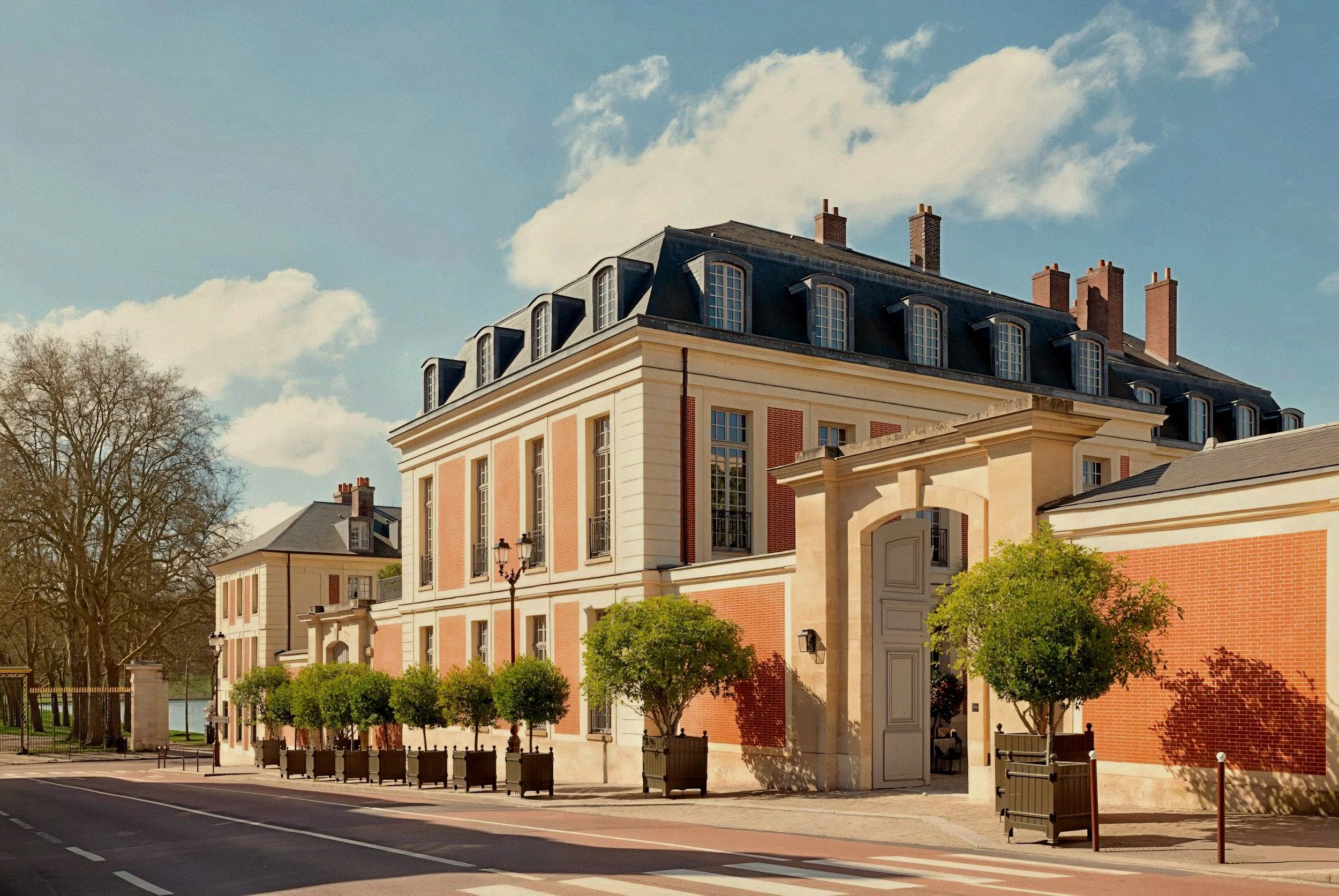
Classic French classical limestone facades and Mansard roofs rising above an entry courtyard and clipped topiary. Photo: Courtesy of Airelles Château de Versailles, Le Grand Contrôle
To reside within Le Grand Contrôle is to inherit unprecedented keys to the entire 2,000-acre estate of Versailles. After the daily public crowds disperse, guests enjoy private, crowd-free access to the Palace of Versailles, exploring the silent Hall of Mirrors, the candle-lit wooden Royal Opera House built for Louis XV, and the upper galleries of the Royal Chapel. In the Royal Library, guests can view historic correspondence between George Washington and Marie-Antoinette, or wander alone through Le Hameau de la Reine as sunset settles over the rustic village. At dawn, golf carts and electric bicycles allow residents to traverse the manicured mazes and fountains in complete, solitary quietude.
Beyond the palace gates, bespoke estate pursuits celebrate France's equestrian and outdoor traditions—from horseback riding across royal trails and falconry demonstrations in the Forest of Rambouillet to aerial tours aboard light aircraft. On the water, guests can embark on private 18th-century wooden rowboats along the one-mile Grand Canal for an Alain Ducasse picnic, floating along the same waters where Louis XIV hosted Venetian gondola fetes. Throughout the warmer months, front-row privileges grant access to Les Grandes Eaux Nocturnes, where the gardens come alive with Baroque music by Lully and Charpentier, illuminated fountains, and fireworks reflecting over the estate.
As dusk falls across the red-brick and limestone facades of Jules Hardouin-Mansart's architecture, a profound stillness settles over the Orangerie Gardens. The lingering scent of orange blossom drifts along the empty stone terraces, echoing an era when time was measured by courtly rituals and artistic perfection. Here, behind gated stone arches where monarchs once shaped the destiny of Europe, Le Grand Contrôle delivers the ultimate luxury: not merely a glimpse into history, but the rare privilege of inhabiting its sovereign heart.
ROYAUME RECOMMENDED
ESSENTIAL INFORMATION
To preserve your personal privacy, secure direct guest privileges, and ensure end-to-end data safety, luxury travelers are advised to book directly through the property's official portal.
(Note: Royaume maintains zero affiliate partnerships or booking commissions. We link exclusively to official brand channels for property verification and reader security.)