BY ROYAUME
November 2026
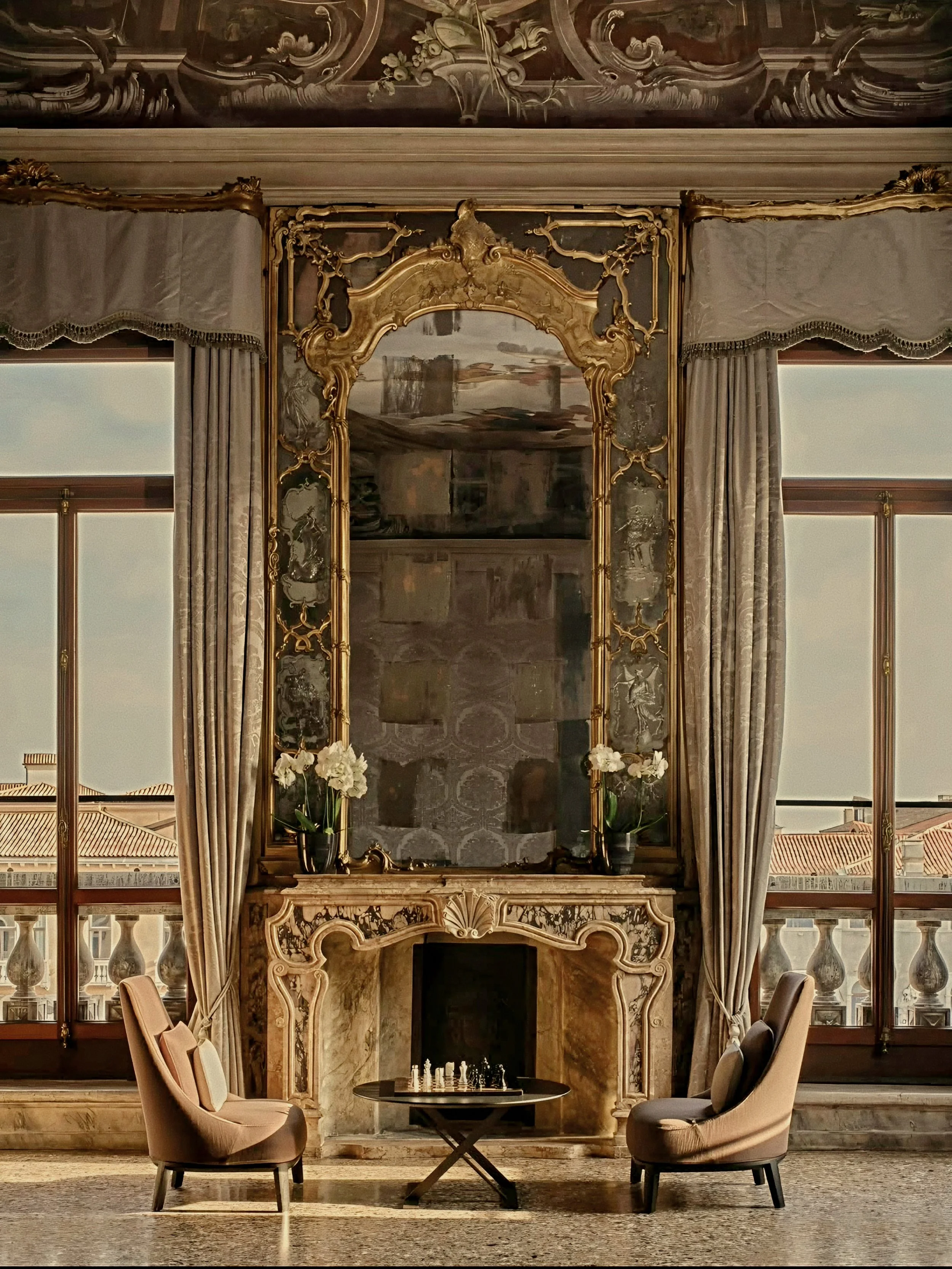
A gilded Rococo trumeau mirror, carved marble mantel, and polychrome frescoes anchoring terrazzo floors and tailored seating. Photo: Courtesy of Aman Venice
Rising straight from the Grand Canal in Venice’s San Polo district—a short stroll from the Rialto Bridge and Piazza San Marco, tucked along Calle Tiepolo—the sixteenth-century Palazzo Papadopoli (historically Palazzo Coccina Tiepolo Papadopoli) holds nearly five centuries of Venetian aristocratic life within its Istrian stone walls. Commissioned around 1560 and completed by 1570 for the Bergamo merchant family Coccina, architect Giangiacomo dei Grigi—working in the classical Renaissance lineage of Jacopo Sansovino and Michele Sanmicheli—composed a symmetrical waterfront façade of stacked orders, serlian loggias, pedimented windows, and twin rooftop obelisks reserved for Venice’s foremost noble houses. In 1748 the palazzo passed to the Tiepolo family, who enlisted Venetian Rococo master Giambattista Tiepolo and his son Giandomenico to paint allegorical ceilings and social scenes such as The Minuet and The Charlatan—masterworks that still endure in situ across the grand salons and suites, echoing an era when the Coccina family commissioned Paolo Veronese’s The Family Coccina Presented to the Virgin and, more than a century later in 1896, the Lumière brothers filmed early motion-picture footage from its canal vantage point.
Following brief nineteenth-century ownerships by Valentino Comello and Austrian diplomat Baron Bartholomäus von Stürmer, brothers Niccolò and Angelo Papadopoli—wealthy counts and bankers descended from Corfu patricians and the Aldobrandini lineage of Pope Clement VIII—acquired the residence in 1864 and endowed it with its enduring name. Between 1874 and 1875, Venetian architect Girolamo Levi modernized the palazzo and demolished two neighboring buildings to carve out two private water-facing gardens spanning roughly 2,800 square feet—an extraordinary rarity along the Grand Canal, making Aman Venice the only hotel on the waterway with private waterfront gardens. Simultaneously, antiquarian and decorative arts designer Moises Michelangelo Guggenheim, alongside academic painter Cesare Rotta, orchestrated a lavish multi-style redecoration—installing gilded Rococo stucco rooms, nineteenth-century Murano glass chandeliers, silk wall coverings, gilded Cordova leather panels, and themed salons including the Hall of Four Doors, the Stucco Room, the Chinese Room, and a fourth-floor library.
Since 1922, when the palazzo passed by marriage to the Arrivabene Valenti Gonzaga dynasty, the residence has remained an inhabited noble home—today Count Gilberto and Countess Bianca Arrivabene Valenti Gonzaga still live in private top-floor apartments, partnering with Aman Group (initiated under founder Adrian Zecha and led since 2014 by Chairman and CEO Vladislav Doronin) so the building would endure as a living residence rather than a static museum. Beginning in 2011 and opening in 2013—reportedly the last historic Grand Canal palazzo permitted by the city to become a hotel, and later the celebrated setting for George Clooney and Amal Alamuddin’s September 2014 wedding—the UNESCO-listed monument underwent a meticulous restoration led by Italian heritage specialists Dottor Group under strict Belle Arti oversight, winning Italy’s national heritage prize for Best Restoration in 2014. Architect Jean-Michel Gathy of Denniston introduced clean-lined, low-profile furnishings in taupe, cream, and warm wood alongside freestanding cabinetry so the frescoed ceilings remain undisputed protagonists, while Milanese lighting master Piero Castiglioni re-lamped antique Murano chandeliers and concealed warm indirect LEDs in cornices, Elastic Architects shaped tailored culinary spaces, historic weavers Luigi Bevilacqua and Rubelli replicated silk brocades on antique looms, Barovier & Toso restored Murano crystal, and local master boatbuilders crafted a custom twelve-meter replica of a 1930s royal motor launch.
Whether arriving by water at the private landing pier—stepping beneath the arched porta d'acqua directly into the grand ground-floor androne—or ringing a discreet bell at a tucked-away garden gate along Calle Tiepolo, entering Aman Venice feels like crossing the threshold of a private patrician home with only twenty-four suites. Inside the androne, gleaming geometric-inlaid Venetian terrazzo and marble floors reflect lagoon light beneath dark coffered wooden beams framing gilded decorative panels, smooth marmorino plaster walls, carved stone portals, antique mirrors, classical busts, and Jean-Michel Gathy’s low-slung cream and charcoal seating clusters. From there, Moises Michelangelo Guggenheim’s monumental 1874 Quattrocento-style grand staircase sweeps upward—its broad, runner-softened stone and marble steps bordered by carved stone and turned-wood balustrades, wrought-iron and bronze torchères, trompe-l'oeil architectural frescoes, mythological medallions, and double-tiered leaded and stained-glass windows—ascending two levels to the piano nobile Ballroom and dining salons before a second historic stair rises to the fourth-floor Salon, library, and upper suites.
The Stucco Boudoir
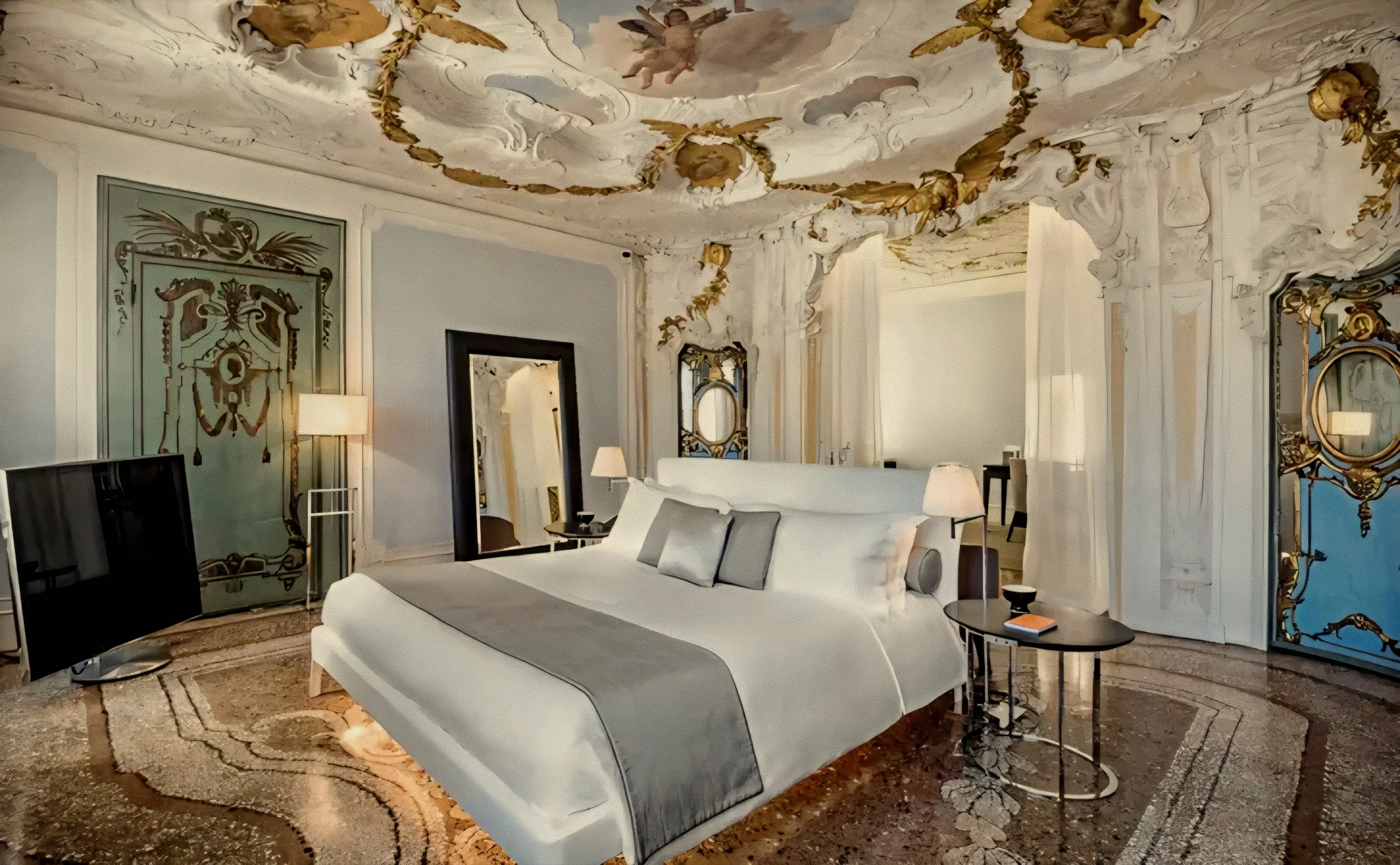
Gilded Rococo stucco relief, Tiepolo-era ceiling frescoes, and inlaid terrazzo grounding a divan. Photo: Courtesy of Aman Venice
Within the sixteenth-century walls of Palazzo Papadopoli, Aman Venice shelters twenty-four individually proportioned rooms and suites—alongside two multi-bedroom apartments uniting private wings of the palace, and the rare option to claim the entire noble residence in private seclusion. Shaped faithfully around the existing sixteenth- to nineteenth-century room volumes so that no two floor plans ever repeat, the quarters unfold across intimate bedchambers—some frescoed, others flooded with light toward San Polo rooftops or the private gardens—followed by named canal-facing and heritage chambers, flagship suites, and expansive multi-bedroom apartments.
Above each sleeping chamber, high timber-beamed, coffered, or hand-painted ceilings hover over walls dressed in smooth marmorino plaster, warm wood paneling, or silk damasks woven on historic looms by Venetian houses Rubelli and Luigi Bevilacqua. At the center of the room rests a low-profile king-size bed layered in crisp white and muted taupe linens, deliberately styled with quiet contemporary restraint so the eye travels naturally upward to gilded stucco scrollwork and Rococo frescoes rather than competing reproduction antiques.
Because heritage protections forbid piercing historic frescoes or silk wall coverings, modern conveniences are tucked discreetly out of sight behind custom dark-timber cabinetry and architectural dividers rather than named like a hotel brochure. Every bedroom preserves the unhurried poise of a private aristocratic bedchamber—a hushed sanctuary where five centuries of Venetian artistry frame the quiet ritual of rest.
The Parquetry Lavatorium
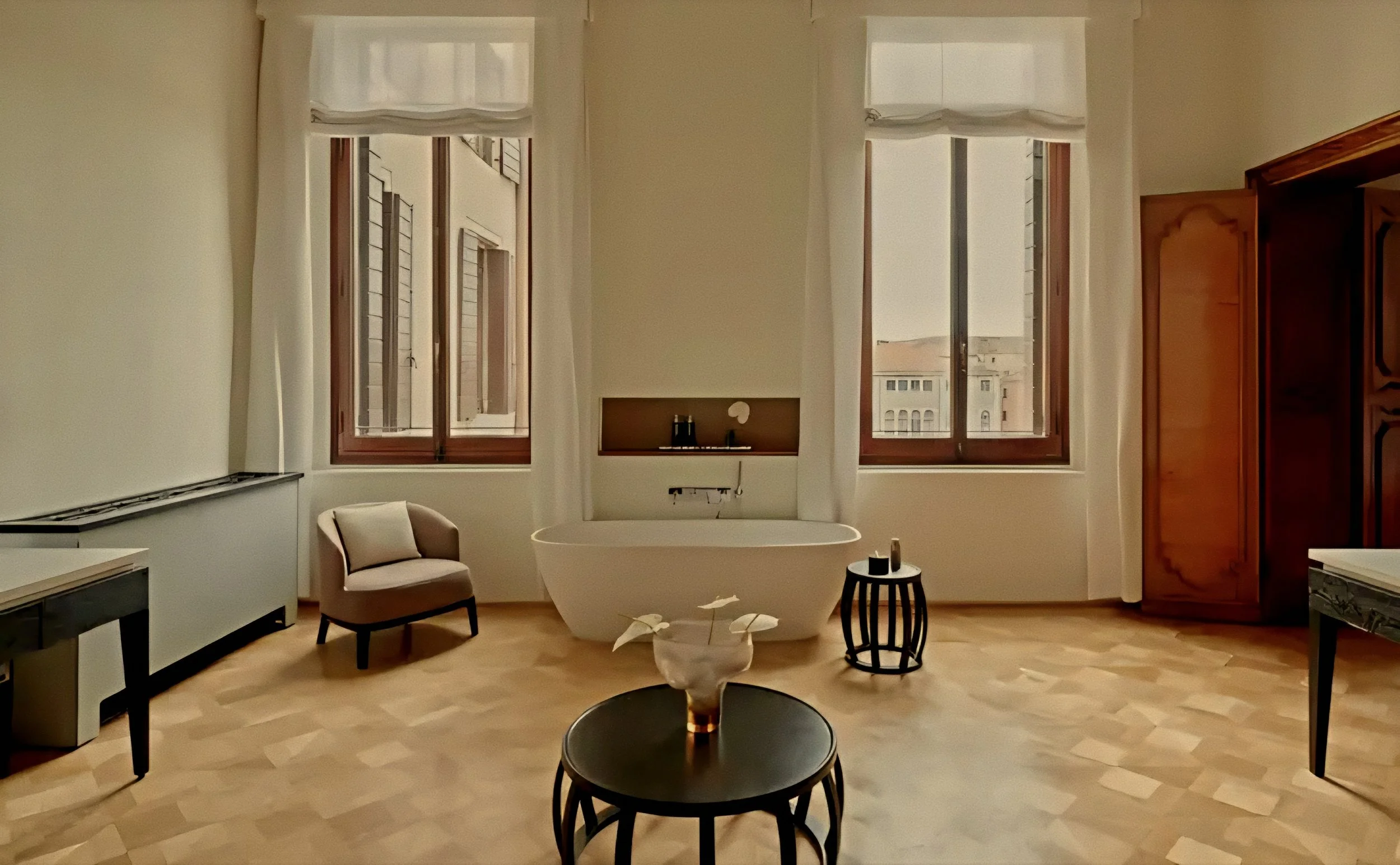
A matte-white monolithic soaking tub, geometric oak parquet, and sculpted dark-timber pedestals framed by sheer linen. Photo: Courtesy of Aman Venice
While the sleeping chambers celebrate centuries of Venetian decorative opulence, the bathing quarters are conceived as serene, light-filled sanctuaries of contemporary calm—clad in luminous cream and white Italian marble, honed limestone, and warm dark-wood cabinetry. In generous residential proportions that extend even to the entry-level chambers, twin marble vanities beneath broad illuminated mirrors, heated stone or parquet floors, and dedicated walk-in dressing areas lend daily rituals a quiet, unhurried grace.
At the heart of nearly every bath rests a deep freestanding soaking tub paired with a separate glass-enclosed rainfall shower—frequently positioned directly beside tall timber-framed windows gazing out over the Grand Canal, or beneath preserved baroque stucco ceiling reliefs as in the Alcova Tiepolo Suite. Filtered through sheer white drapery and softened by reflections rising off the lagoon, morning and evening light turns the act of bathing into a private Venetian meditation.
The Chinoiserie Salon
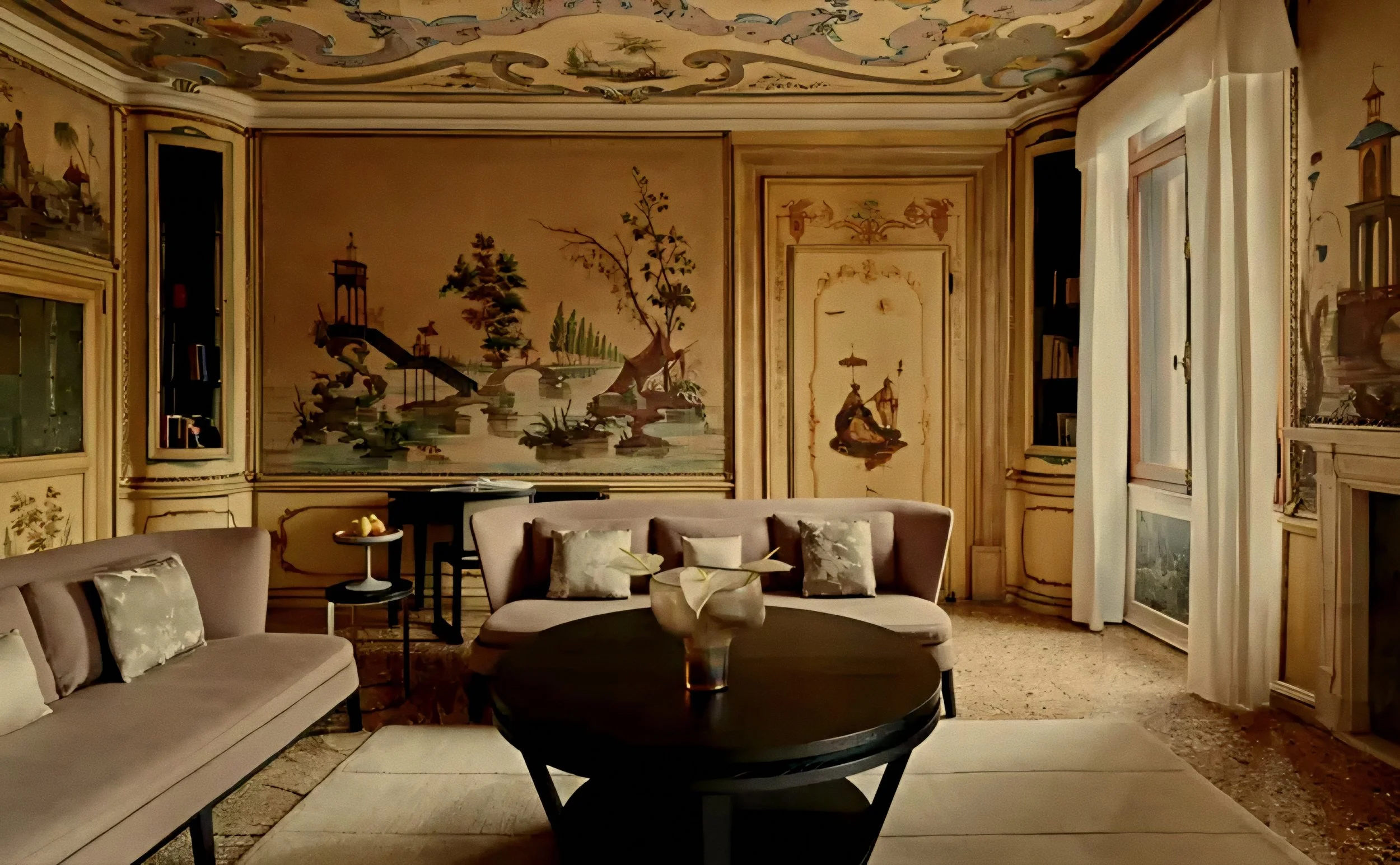
Eighteenth-century chinoiserie wall murals, painted ceiling arabesques, and terrazzo floors paired with canapés. Photo: Courtesy of Aman Venice
Across the sitting zones and formal parlors, original carved marble fireplaces, antique gilded mirrors, and Murano glass chandeliers enter an effortless dialogue with contemporary B&B Italia seating, dark-wood tables, and sheer linen curtains that diffuse the bright lagoon light. Lead architect and interior designer Jean-Michel Gathy of Denniston purposefully shunned imitation period pieces in favor of low-slung silhouettes, muted neutral palettes, and warm indirect illumination so the historic architecture remains undisputed protagonist—a philosophy he captures succinctly: "I'm always inspired by the location of my projects; I like to honour both the landscape and local tradition. As palaces and hotels, Venice and China couldn't be more different, yet I set out to achieve a similar aesthetic – to inject a contemporary haven within a culturally rich environment, one that offers guests an authentic yet dramatic experience."
That dialogue reaches its purest expression in the palace’s named Signature Rooms and flagship suites—from the canal-facing Palazzo Stanza Canal Grande, the grey silk-draped Maddalena Stanza Canal Grande, the frescoed Papadopoli Stanza Canal Grande, and the Sansovino Stanza anchored by its sixteenth-century fireplace attributed to Jacopo Sansovino, to the ninety-seven-square-meter Grand Canal Suite, whose picture-window bedroom and sitting salon centered on a filigree arched Venetian window look straight down the waterway. Beside it, the 103-square-meter Alcova Tiepolo Suite—once the private bedchamber of Count Gilberto Arrivabene’s ancestors—crowns its gilded alcove with an authentic eighteenth-century ceiling fresco by Giovanni Battista Tiepolo and pairs it with a sitting salon of rare hand-painted nineteenth-century chinoiserie murals overlooking the Garden Terrace.
At the summit of private living stand the palazzo’s two multi-bedroom apartments—the canal-front Grand Canal Apartment, uniting three bedrooms and private living salons along the main waterfront façade with eye-level vistas across the water, and the 290-square-meter Coccina's Apartment on the fourth floor. Reached by private elevator and welcoming up to six guests across three king bedrooms with en-suite marble baths, Coccina's Apartment centers on an extraordinary living salon set inside the palace’s former private chapel, surrounded by original frescoes, gilded stucco reliefs, and dual vistas over both the Grand Canal and the private Canal Garden—recreating the rare privilege of inhabiting a Venetian noble palace as one’s own home.
The Wainscoted Athenaeum
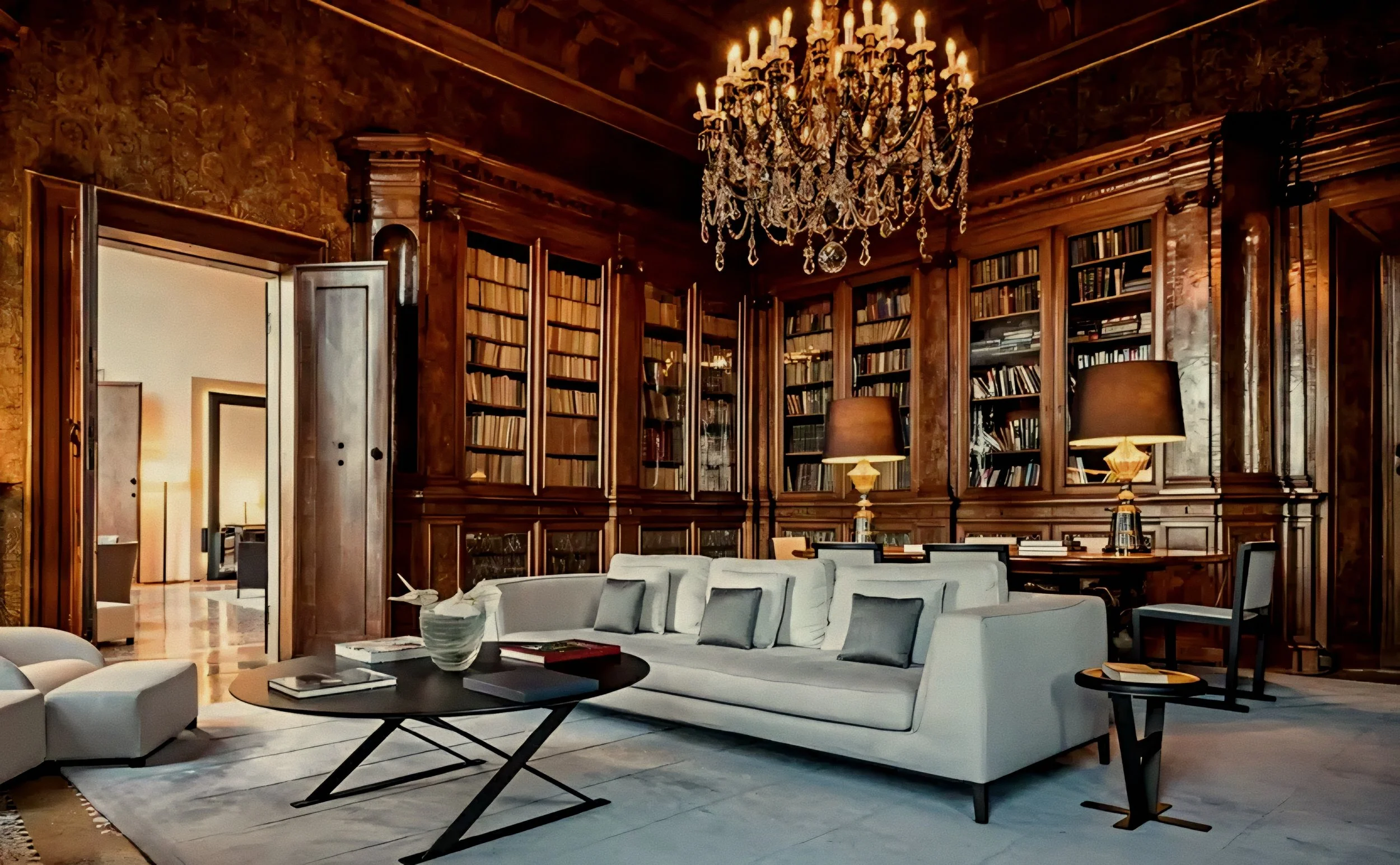
Floor-to-ceiling walnut bookcases, embossed Cordoba leather wallcoverings, and a crystal chandelier above a pale wool rug. Photo: Courtesy of Aman Venice
At the summit of the grand staircase, Palazzo Papadopoli unfolds as an intimate procession of aristocratic reception rooms—beginning on the piano nobile with the double-height Ballroom, where Cesare Rotta’s 1870s allegorical vault of classical goddesses, cupids, and musical instruments floats above gilded Corinthian pilasters, marble statues set in arched niches, three multi-tiered Murano crystal chandeliers, and Jean-Michel Gathy’s low-slung white sofas facing the Grand Canal balcony. Rising further to the fourth floor reveals quieter residential drawing rooms: the soaring coffered Main Salon, anchored by tall gilt mirrors and an antique Érard grand piano reputedly once played by Frédéric Chopin; the Tiepolo Room, where Giandomenico Tiepolo’s eighteenth-century frescoes of angels, swallows, and Venetian social life glow above powder-blue Rubelli silk walls and tables set for chess or backgammon; and the adjoining Stucco and Guarana Rooms, wrapped in Moises Michelangelo Guggenheim’s gilded Rococo plasterwork, chartreuse Rubelli silks, and ceiling frescoes by Tiepolo’s pupil Jacopo Guarana.
Tucked beside these salons with panoramic views across the water, the fourth-floor Library envelops readers in the burnished amber, gold, and espresso luster of original seventeenth- and nineteenth-century Cuir de Cordoue—embossed, hand-tooled, and gilded Cordova leather wall panels that carry the faint, aristocratic warmth of aged hide and wood. Floor-to-ceiling carved walnut bookcases house Count Arrivabene’s centuries-old private collection of leather-bound Venetian chronicles and art monographs beneath a dark timber ceiling, an intricate Murano crystal chandelier, and a monumental sixteenth-century Sansovino-style carved stone fireplace—grounded at the center by Gathy’s crisp cream-white sofa and a polished timber study table lit by shaded reading lamps.
The Terrazzo Triclinium
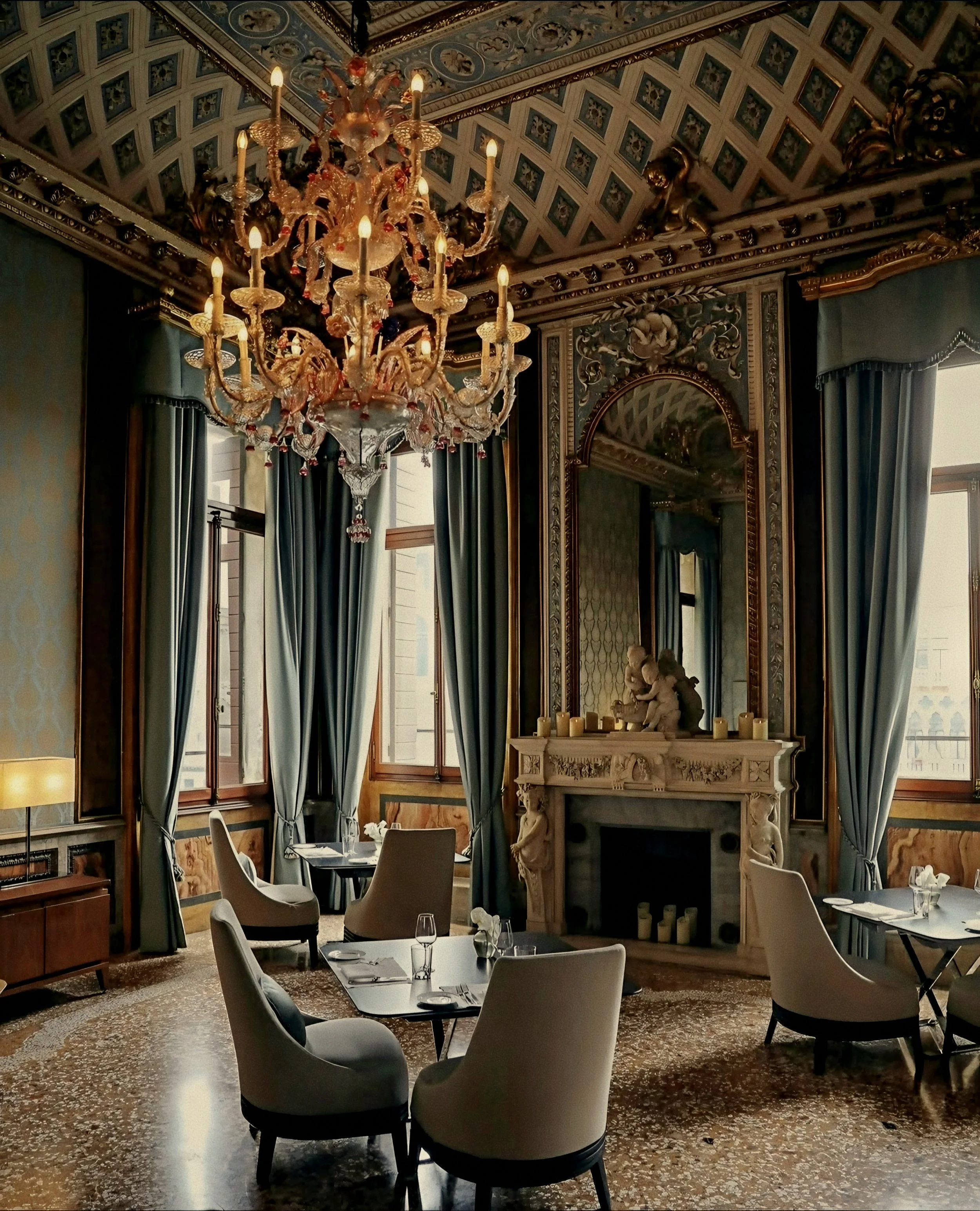
A polychrome Murano glass chandelier, coffered ceiling, and sculpted marble hearth framing blue-gray silk drapery. Photo: Courtesy of Aman Venice
Across the piano nobile and the quiet ground-floor garden threshold of Palazzo Papadopoli, gastronomy unfolds with the unhurried intimacy of a private banquet inside a Venetian noble house. Guided by Executive Chef Matteo Panfilio—whose early respect for seasonal harvests began in his family’s countryside produce business before sharpening inside Michelin-starred kitchens across Europe—the culinary program draws directly from a living lagoon larder. Just across the northern water, the medieval agricultural island of Sant'Erasmo serves as Venice’s storied vegetable garden, yielding Slow Food-presidium violet artichokes (carciofi violetti and tender castraure buds), lagoon asparagus, and cardoons, while morning boats bring the day’s Adriatic catch from the nearly thousand-year-old Mercato di Rialto alongside baked goods and artisanal provisions from family-run Veneto farms and social enterprises such as Pasticceria Giotto.
At the heart of the piano nobile, Arva—named for the Latin word for "harvest"—celebrates cucina del raccolto from morning through dinner and its celebrated Sunday Brunch across three jewel-toned eighteenth- and nineteenth-century reception salons and the grand Ballroom. Beneath Cesare Rotta’s 1870s allegorical ceiling frescoes, multi-tiered Murano crystal chandeliers, carved white marble fireplaces, and gilded stucco frames, walls upholstered in golden-yellow, crimson, and azure Venetian silk damask—restored by historic local weavers Rubelli and Luigi Bevilacqua—are hung with ancestral oil portraits of Maddalena Aldobrandini, Italian unification hero Silvio Arrivabene, and eighteenth-century Arrivabene forebears. Here, homemade pastas, lagoon risottos, turbot with preserved lemon and trombetta zucchini, and Rialto Market vegetables are served beside sweeping views of the Grand Canal—and from May through October, tables spill outdoors into the private Canal Garden for alfresco dining beneath the Venetian sky.
Downstairs on the ground floor, The Palazzo Kitchen Table—designed by Elastic Architects with hand-painted botanical murals mirroring the garden, traditional terrazzo floors, backlit wine vitrines, and a bespoke stainless-steel Marrone cooking suite—gathers just eight guests around an open counter Tuesday through Saturday evenings for a ten-course omakase-inspired journey uniting Sant'Erasmo artichokes, Cavallino coastal herbs, Adriatic seafood, and Venetian Alps meats with swift-heat Japanese teppanyaki and charcoal-fired yakiniku grilling. Guests may even cruise at dawn with an Aman chef to the Mercato di Rialto to hand-select the morning’s harvest before returning for a private cooking session and lunch—a discipline Chef Panfilio captures with quiet candor: "Michelin-starred restaurants teach you how to work. It's not just about making a good dish. They actually teach you the approach, the seriousness, the professionalism, the dedication, the manners. Cooking is like going into the army: order, precision, planning — you don't just go by instinct in the kitchen."
The Damask Salotto
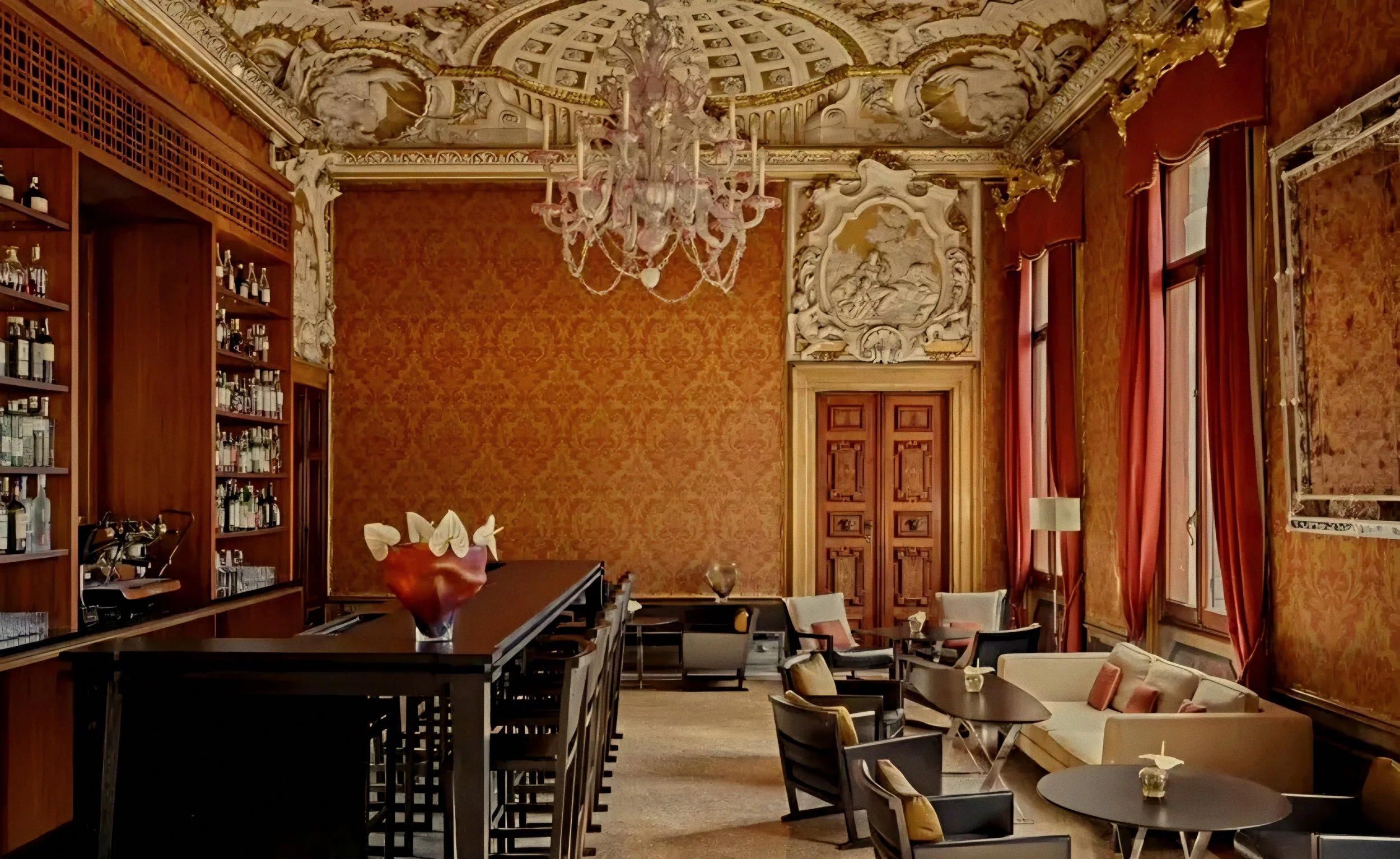
Crimson silk damask walls, ornate plaster cartouches, and a clear Murano chandelier illuminating a dark-timber salon. Photo: Courtesy of Aman Venice
Just off the Ballroom on the piano nobile, overlooking the leafy stillness of the private garden, The Bar and its tucked-away Cigar Lounge form the palazzo’s intimate social refuge from midday until midnight. Conceived in homage to Lord Byron—one of Venice’s most romantic nineteenth-century literary residents—the room drapes its walls in deep terracotta-red silk beneath a hand-painted Cesare Rotta ceiling fresco and a bespoke Murano crystal chandelier, pairing a sleek dark-timber counter and vintage velvet armchairs with symmetrical low-slung seating next door in the Cigar Lounge for rare spirits and aged cigars.
Bathed in golden afternoon sunlight filtering off the garden before deepening into a moody, clubby evening glow, the bar is orchestrated by Bar Manager Antonio Ferrara—whose team crafts theatrical, Venice-inspired cocktails and personalized creations alongside classic Italian aperitifs, Venetian cicchetti, and a deep cellar of Italian and international vintages. Guests can also join the resident bar team for private Silk Road spice-blending sessions—tracing the aromatic trade routes that once enriched the Serenissima while composing a custom spice blend and tasting spice-infused cocktails—or step outside between May and October to the Canal Garden’s fluted timber bar for aperitivo and late-evening digestifs beside the water.
The Apothecary Balneum
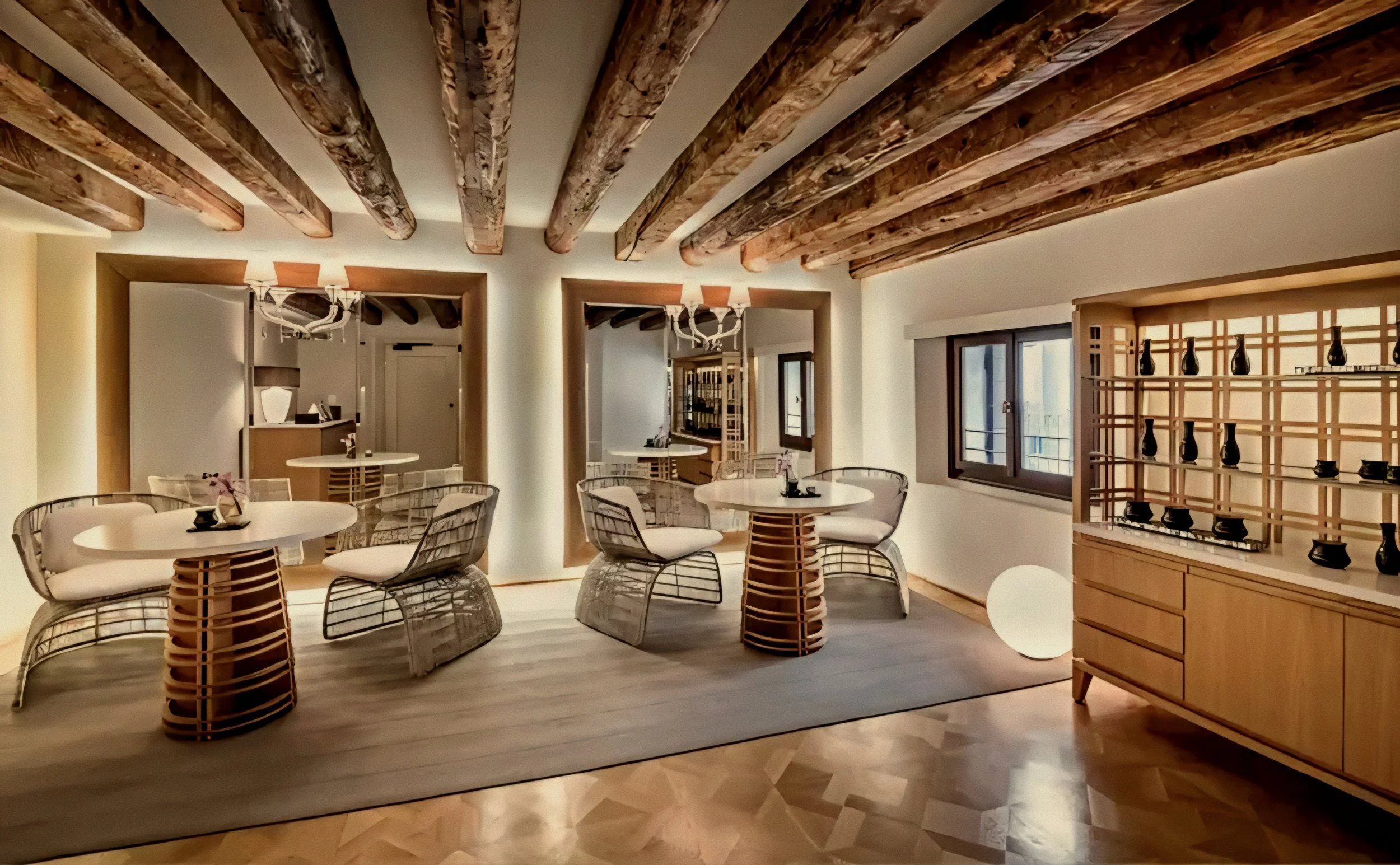
Exposed rustic timber ceiling beams, woven rattan fauteuils, and a shoji-style oak apothecary cabinet on geometric parquet. Photo: Courtesy of Aman Venice
Tucked discreetly into the third-floor mezzanine of Palazzo Papadopoli, the Aman Spa forsakes the scale of a sprawling resort complex for the hushed seclusion of a private sanctuary reserved exclusively for resident guests. Conceived by Jean-Michel Gathy as a cocoon-like counterpoint to the palace’s gilded Baroque salons, its three self-contained treatment suites—two single chambers and a couples’ sanctuary complete with its own dressing room, bath, relaxation lounge, and an en-suite wooden sauna and steam shower—guarantee complete, uninterrupted privacy from arrival to rest. Smooth dark walnut paneling, honed limestone, and cream marble are bathed in soft indirect cove lighting and gentle ambient sound, framing holistic facials by London facialist Alexandra Soveral alongside Aman’s botanical Grounding, Purifying, and Nourishing pathways—from crystal sound-bowl healing, lymphatic drainage, and jet-lag recovery rituals to the Venetian Lagoon Ritual blending sea salt from the historic Cervia salt pans, lagoon clay, and locally pressed olive oil, all equally available within the privacy of a guest’s own suite.
High above on the fourth floor, beneath historic exposed timber ceiling beams and arched windows framing the terracotta rooftops of San Polo, the sunlit Rooftop Fitness Studio remains open around the clock. Outfitted with Technogym cardiovascular apparatus, free weights, kettlebells, and resistance equipment alongside chilled water, fresh fruit, and towels, the rooftop enclave is complemented by private one-on-one yoga, mat Pilates, breathwork, and personal training sessions arranged either in-suite or in the dew-washed stillness of the Canal Garden at dawn.
Beyond the palace walls, movement draws its rhythm directly from the surrounding water and quiet stone calli. At first light, private trainers guide tailored early-morning runs and walks across Venice’s empty bridges before the city stirs, while on the lagoon, master oarsmen lead private standing-rowing lessons in Voga alla Veneta aboard a traditional wooden sandolo or gondola—gliding silently through hidden back canals and out across the open water.
The Obelisk Palazzo
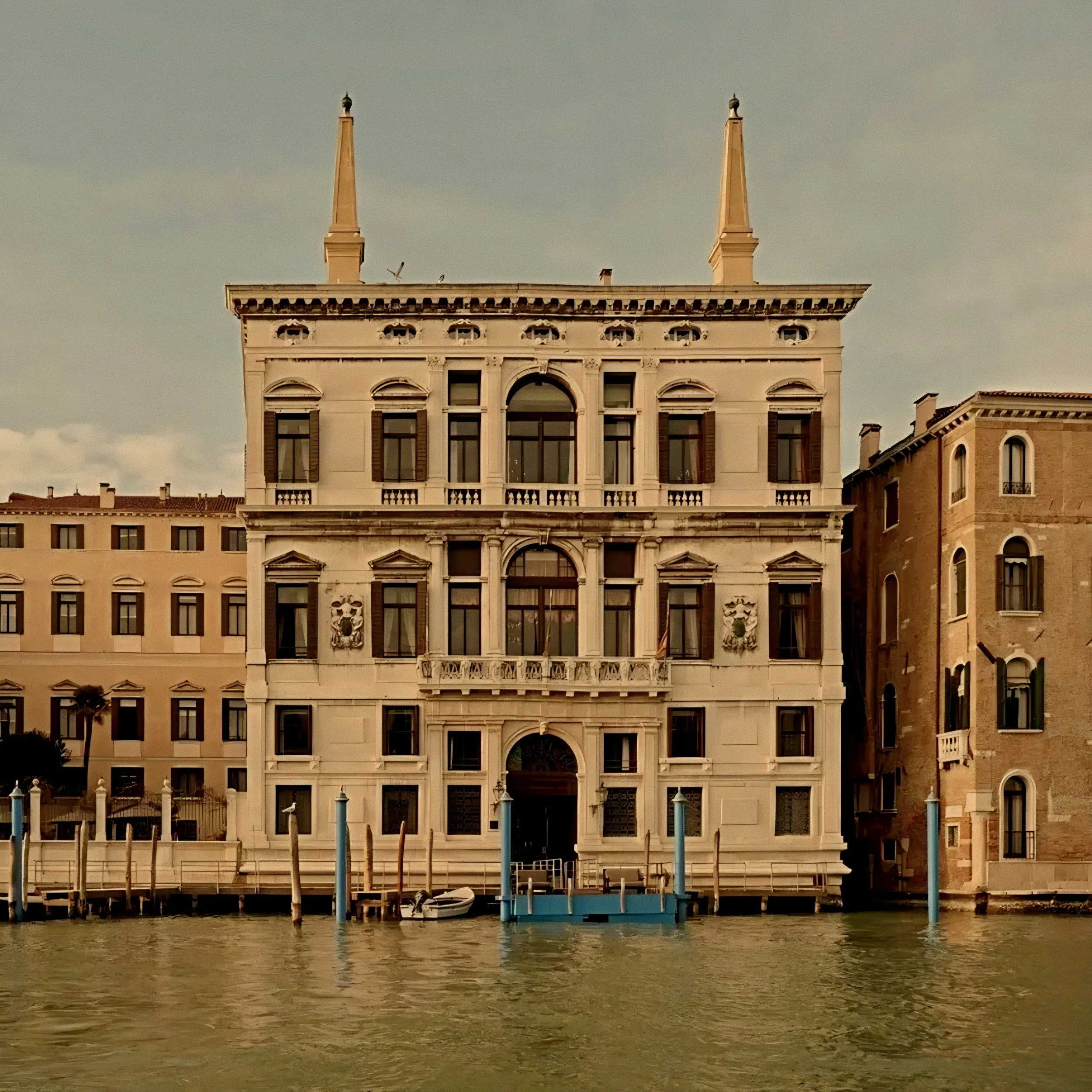
A sixteenth-century Istrian-stone Renaissance palazzo crowned by twin obelisks rising directly from the Grand Canal. Photo: Courtesy of Aman Venice
At the water’s edge of Palazzo Papadopoli, two rare private gardens—carved out in 1874–1875 when brothers Niccolò and Angelo Papadopoli demolished two neighboring buildings—offer an extraordinary hush along the Grand Canal. Behind an ornate wrought-iron fence and clipped hedges, the Canal Garden spreads a broad emerald lawn shaded by mature maritime pines, palms, wisteria, jasmine, and ivy, where cream parasols and teak tables invite unhurried morning coffee or twilight aperitivi as gondolas drift silently past. Tucked beside the landward threshold, the Pergola Garden frames a gravel-and-stone courtyard beneath a wisteria-draped arbor, boxwood parterres, and fragrant citrus planters—an intimate sanctuary for quiet reading, dawn meditation, or candlelit suppers beneath the vines.
From the palazzo’s private Grand Canal pier, a custom-built 1930s-style mahogany motor launch—handcrafted by local Venetian boatbuilders from a vintage photograph of the Arrivabene family’s historic royal vessel, and outfitted with soundproofing, climate control, supple leather seating, and a stocked bar—glides effortlessly onto the water. Alongside traditional wooden edolotto boats, Riva launches, and gondolas, it carries guests down the Grand Canal toward the Giudecca for late-afternoon aperitivi paired with Venetian cicchetti, or across the open lagoon on private half- and full-day voyages to the glassblowing ateliers of Murano, lace-makers of Burano, Torcello, Sant'Erasmo, San Francesco del Deserto, and San Lazzaro degli Armeni—complemented ashore by private, crowd-free behind-the-scenes access to Venice’s closed-door treasures.
High above the fifth-floor terracotta roof tiles, perched on timber stilts in the Venetian Renaissance tradition where noblewomen once gathered to catch the sea breeze, the palazzo’s intimate Altana rooftop terrace crowns the residence with an unobstructed 360-degree panorama across San Polo’s chimneys, campanili, and the sweeping curve of the Grand Canal. Furnished with low woven-rattan sofas, potted olive trees, and warm evening lanterns for up to ten or twelve guests, this elevated timber deck captures Venice at its most poetic—bathed in the amber glow of sunset or beneath a canopy of stars—bringing five centuries of patrician life, architectural grace, and quiet lagoon magic to a luminous close.
L'Ordre de Royaume
ESSENTIAL INFORMATION
To preserve your personal privacy, secure direct guest privileges, and ensure end-to-end data safety, luxury travelers are advised to book directly through the property's official portal.
(Note: Royaume maintains zero affiliate partnerships or booking commissions. We link exclusively to official brand channels for property verification and reader security.)