BY ROYAUME
November 2026
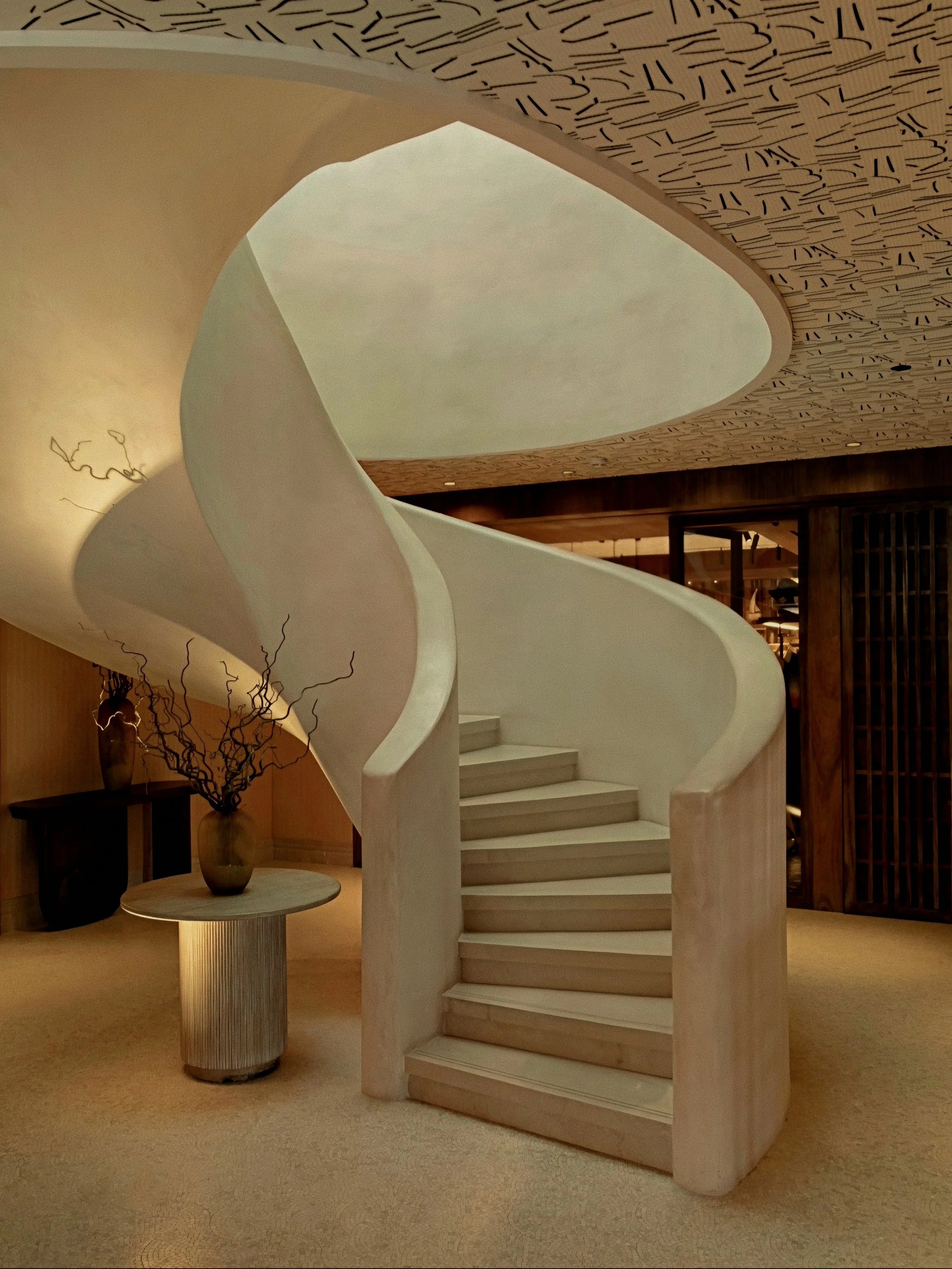
A monolithic tadelakt plaster spiral staircase rising beneath a geometric etched ceiling and a fluted travertine plinth. Photo: Courtesy of Royal Mansour Tamuda Bay
Stretching across ten sun-drenched hectares along Morocco’s northern Mediterranean shore between Tétouan and Tangier—near M'diq and Marina Smir, where the Rif Mountains descend toward the Alboran Sea—Royal Mansour Tamuda Bay unfolds along seven hundred meters of private beach as a serene coastal counterpoint to its celebrated sister estates in Marrakech and Casablanca. Wholly owned by King Mohammed VI—who maintains a private coastal residence nearby—and guided by Royal Mansour Collection General Manager Jean-Claude Messant alongside property General Manager Dominique di Daniel, the resort reimagines what was once a fleeting summer enclave into a year-round sanctuary of quiet Mediterranean poise. Following the 2010 inauguration of Marrakech and the April 2024 rebirth of Art Deco Casablanca, Tamuda Bay opened in July 2024 with fifty-five beachfront suites and villas before debuting Morocco’s first 4,300-square-meter Medi-Spa in 2025—uniting Amazigh, Arab-Andalusian, Mediterranean, and ancient Roman heritage on the very coast named for the classical settlement of Tamuda.
Rather than echoing the inward-turning medina walls of Marrakech, Barcelona’s GCA Architects—working from the project’s inception with Madrid landscape architect Luis Vallejo (LVEP)—sculpted the 50,000-square-meter estate as a low-rise dialogue between sand dunes, Cabo Negro’s silhouette, and the sea. Sand-colored stucco volumes open through shaded courtyards, pergolas, and bespoke moucharabieh latticework that filter Mediterranean sunlight into shifting geometric shadows across individual architectural villa doors, while Vallejo’s gardens weave mature olive trees, palms, aromatic herbs, native dune grasses, reflective water channels, and stone walkways down to the shore. At dusk, architectural lighting studio Anoche grazes the textured plaster and lattice screens in concealed, warm layers that preserve the clarity of the night sky over the Alboran Sea.
Inside, London’s Muza Lab—led by former art historian Inge Moore and Nathan Hutchins—and Parisian studio 3BIS Architecture, which exclusively crafted the 1,700-square-meter two-story Villa Royale, composed an intimate narrative between coastal nature and ancestral Moroccan maâlem mastery. Hundreds of master artisans from Tétouan, Fez, and Marrakech hand-cut geometric zellige tilework, carved gebs stucco plaster, hammered copper and brass, and inlaid cedar and Iroko ceilings—harmonizing with custom Roman-inspired marble mosaics, mother-of-pearl accents, organic handwoven linens, and Muza Lab’s shimmering reception mural created with BKI from beach-gathered shells.
The Zellige Peristyle
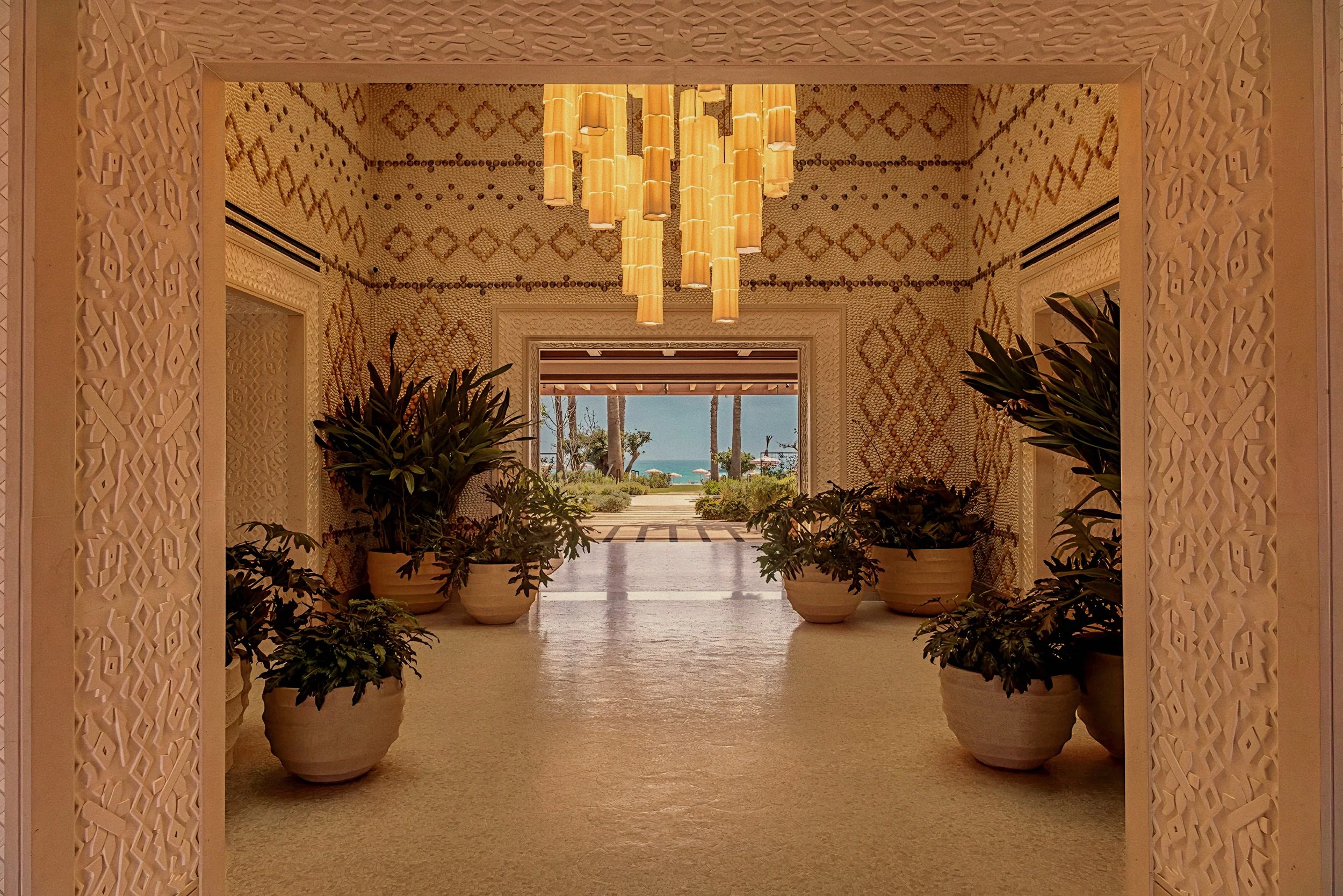
Hand-set seashell Berber murals and carved gebs arches crowned by a cascade of alabaster cylinders. Photo: Courtesy of Royal Mansour Tamuda Bay
Stepping across the threshold of Royal Mansour Tamuda Bay unfolds like the opening chapter of a coastal novel—monumental carved wooden doors set within scalloped Moroccan arches parting to reveal an uninterrupted axial perspective straight toward the Mediterranean. Conceived by London studio Muza Lab as an airy, sunlit gallery linking the arrival court to the shore, the reception hall is anchored by a shimmering floor-to-ceiling mural crafted with specialist studio BKI from more than 95,000 seashells—hand-gathered along the resort’s 700-meter beach and arranged into contemporary interpretations of classic Moroccan geometry. Overhead, an organic multi-tiered chandelier by Nulty Bespoke suspends cascading golden elements that catch the sea light and wash the shell-encrusted walls in an amber luminescence.
Beneath high ceilings, polished cream marble and sand-colored mosaic floors mirror the coastal sky, flanked by mature indoor palms in sculpted terracotta and ceramic planters. Intimate seating nooks gather low-slung organic sofas and carved wooden tables beside custom-embroidered sheer linen curtains by de Le Cuona that stir gently in the sea breeze—opening onto a tranquil open-air courtyard where stone arches, quiet water features, and moucharabieh latticework trace shifting patterns of light and shadow from morning until dusk.
Where the main lobby glows in sun-bleached sand tones, the adjoining Alboran Club—serving as the estate’s social living room—deepens the palette into rich ochre, warm timber, and earthy mineral finishes accented by intricate zellige tilework and a sculptural white spiral staircase. Tucked into a quiet wing, an illuminated timber-lined library houses curated volumes on Moroccan art, architecture, Mediterranean history, and literature amid plush armchairs and round stone tables—complemented for guests of the 1,700-square-meter Royal Villa by a second private library within their residence—before opening outward to a long cocktail bar, a dedicated cigar lounge, a boutique, and a panoramic terrace overlooking the bay where daily Merienda afternoon tea gives way to sunset aperitivos, sharing plates, and live evening piano.
The Tarsia Boudoir
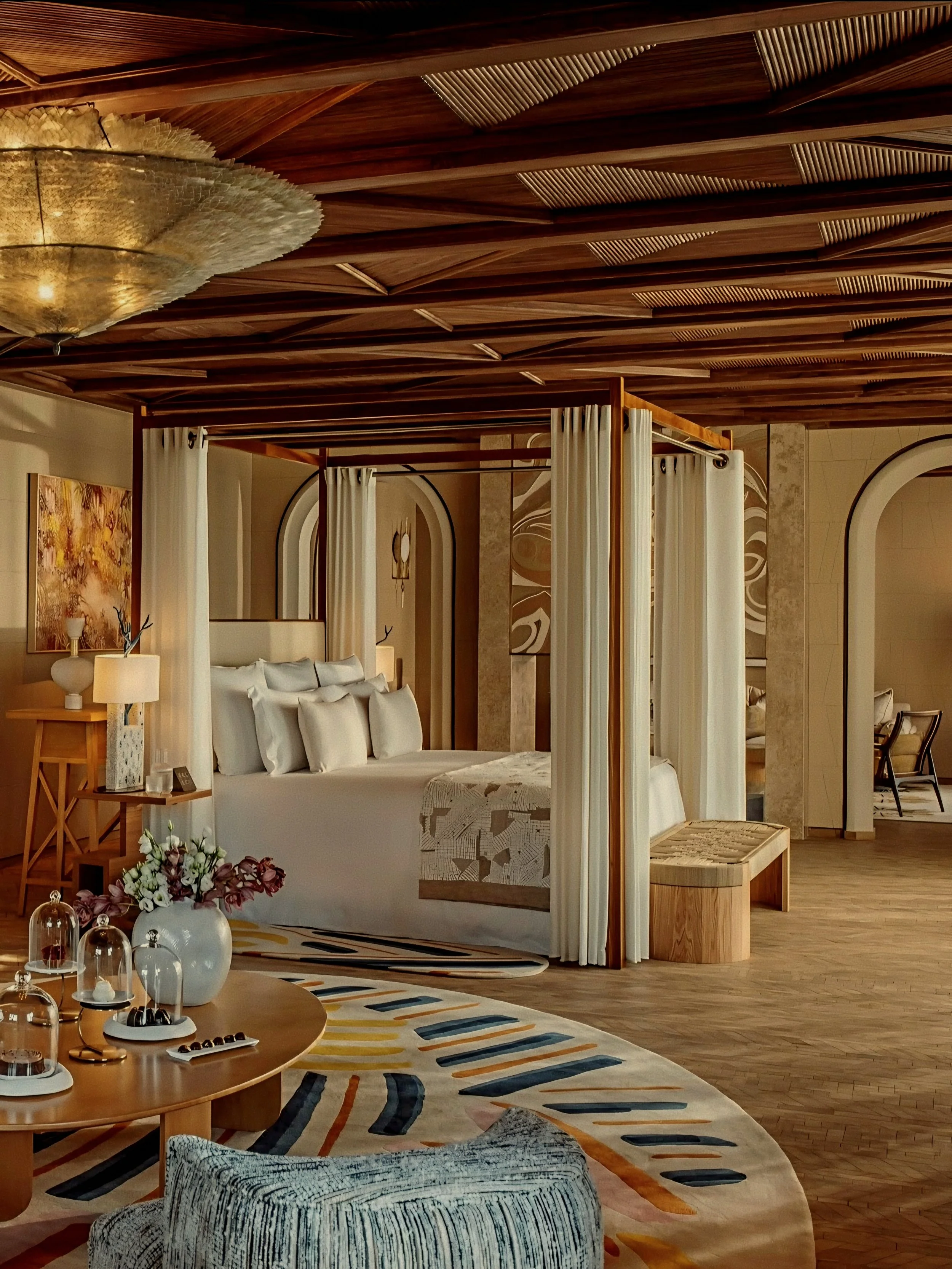
Inlaid cedar coffers, a scalloped glass chandelier, and a wool rug framing a four-poster bed. Photo: Courtesy of Royal Mansour Tamuda Bay
Across fifty-five accommodations—comprising forty-eight suites and seven beachfront villas spanning eighty to 1,700 square meters with dedicated butler service and views toward the Alboran Sea, Rif Mountains, or Mediterranean gardens—Royal Mansour Tamuda Bay trades inward-facing medina enclosure for an open, sun-washed dialogue with the coast. While Muza Lab shaped the forty-eight suites, five Prestige Villas—two-story beachfront residences complete with private elevators, full kitchens, roof terraces, private pools, and beach access—and the Princière Villa, Parisian specialists 3BIS Architecture crafted the flagship Royal Villa at the secluded northern tip.
Inside every sleeping chamber, plush king or twin beds—often framed by delicate timber four-poster canopies—are oriented directly toward the sea or garden terraces beneath warm cedarwood and Iroko paneling. Woven raffia and rattan bedside accents, custom brass lighting, sculpted gebs plaster walls, and generous walk-in dressing closets lend each room the quiet intimacy of a private seaside home rather than a conventional hotel suite.
Stepping inland into the hinterland roughly fifteen minutes away, Le Lodge—introduced in June 2026 as a standalone two-bedroom mountain chalet for up to four guests above Lake Smir and the Rif Mountains—extends the coastal narrative into the hills. Styled as a warm country-estate hunting retreat in local stone, terracotta, and dark timber with an on-site butler, seasonal farm-to-table dinners, and guided mountain hikes, it pairs fireside living with white multi-pane French doors opening onto olive groves, valleys, and mountain air.
The Intaglio Tepidarium
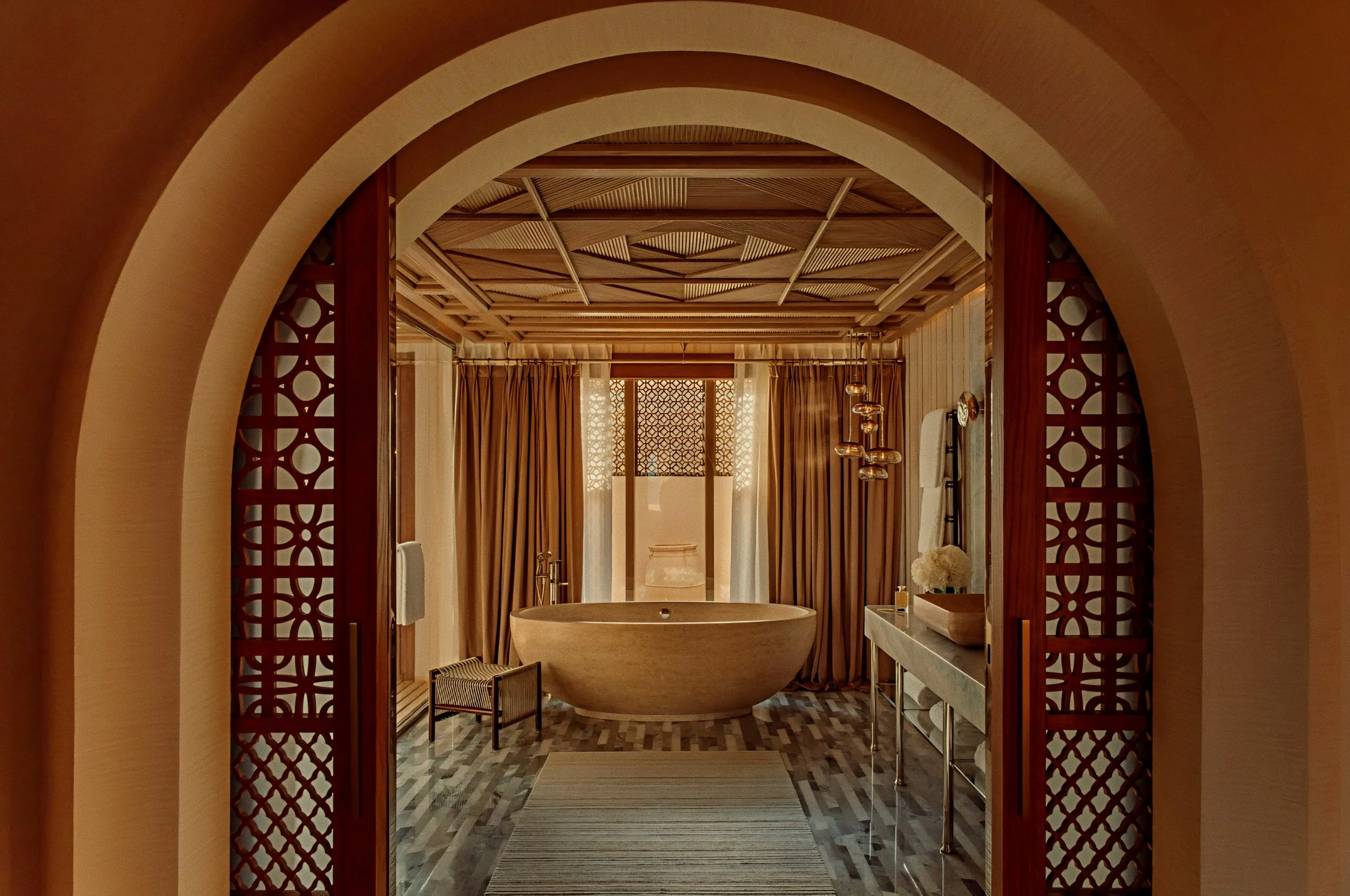
Carved cedar mashrabiya doors opening onto a limestone tub, bronze drapery, and stone floors. Photo: Courtesy of Royal Mansour Tamuda Bay
Clad in locally quarried cream and sand-toned marble with subtle geometric mosaic accents, every bathroom across the fifty-five suites and villas reads as a private spa sanctuary. Deep freestanding soaking tubs sit beside separate walk-in rainfall showers and expansive double marble vanities beneath arched backlit mirrors, finished with Dyson hairdryers, traditional Moroccan slippers, and custom-scented marocMaroc bath amenities.
Framed through carved moucharabieh latticework and warm timber arches, natural Mediterranean daylight filters across stone floors and draped linen into quiet stillness. For guests of the northern-tip Royal Villa, that bathing ritual expands into an entire private wellness wing with a heated indoor pool, traditional marble hammam, sauna, and dedicated massage suites allowing full Medi-Spa treatments without ever stepping beyond the residence.
The Astragal Divan
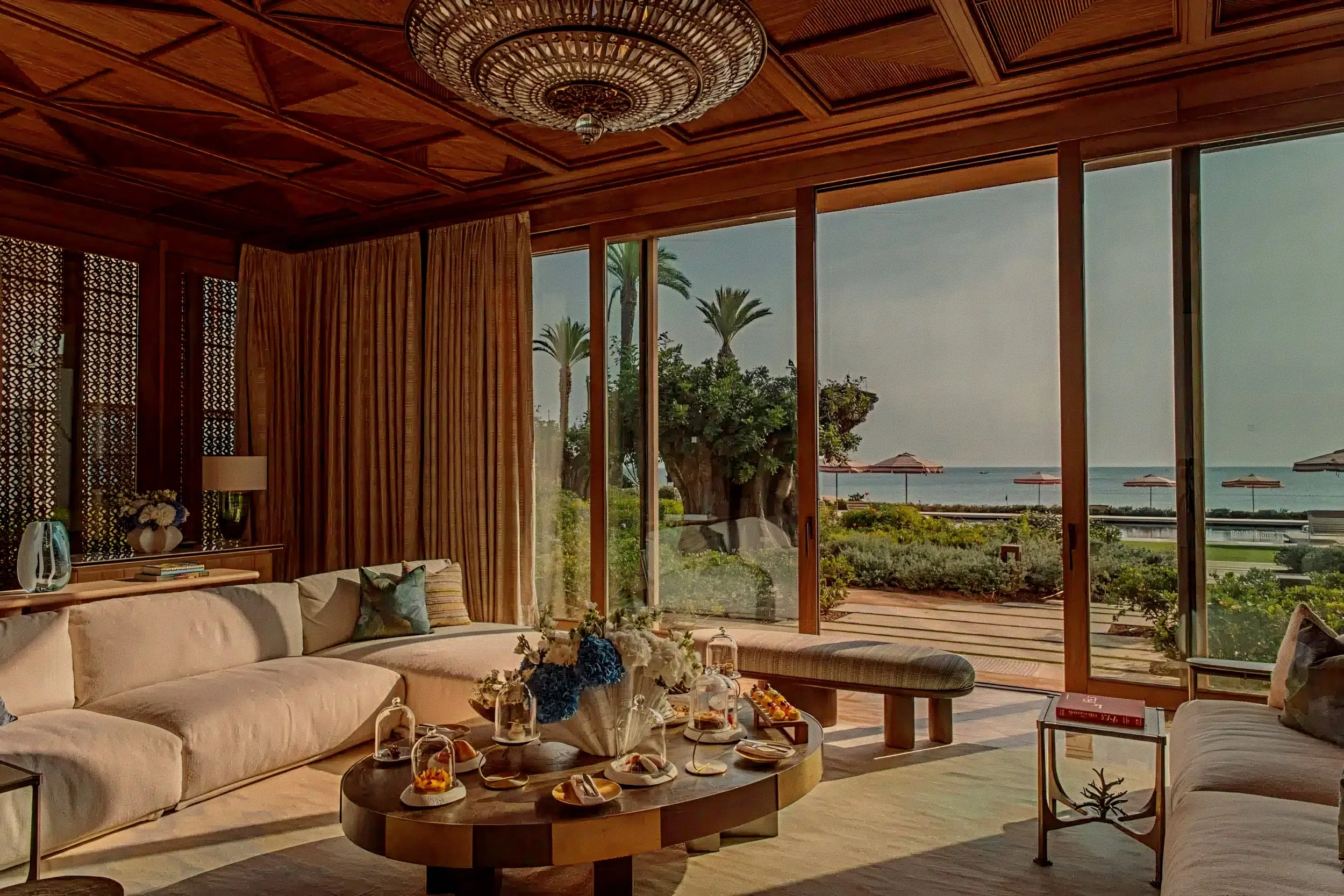
Geometric cedar coffers, a filigree chandelier, and raw linen seating beside a marquetry table. Photo: Courtesy of Royal Mansour Tamuda Bay
In the living salons, floor-to-ceiling sliding glass bay windows and carved moucharabieh shutters open seamlessly onto furnished terraces or private gardens, where custom low-slung sofas in sun-bleached organic linens rest over hand-knotted Berber rugs, pale stone, or inlaid wood. Sculpted gebs plaster walls, contemporary Moroccan artwork, and—in larger suites and villas—fireplaces, formal dining rooms, and full gourmet kitchens create an effortless coastal rhythm that Muza Lab co-founder Inge Moore describes as "a dialogue between nature and human craftsmanship".
At the summit of the estate, the 1,500-square-meter Princière Villa spans three elevator-connected floors for multi-generational gatherings—uniting three en-suite bedrooms, a ground-floor dining pavilion, a fourteen-meter heated garden pool, a rooftop pool looking toward Cabo Negro and the Rif Mountains, and an entertainment floor with a private cinema, music room, and game lounge.
Beside it, the 1,700-square-meter Royal Villa commands a secluded northern-tip enclave behind its own private gated entrance, pairing a beachfront garden pool and direct sand access with a private library, cinema, music and games salon, round-the-clock butler team, and private in-villa chef. Together, the two estates stand as self-contained coastal palaces where royal craft, architectural calm, and Mediterranean light converge.
The Scalloped Triclinium
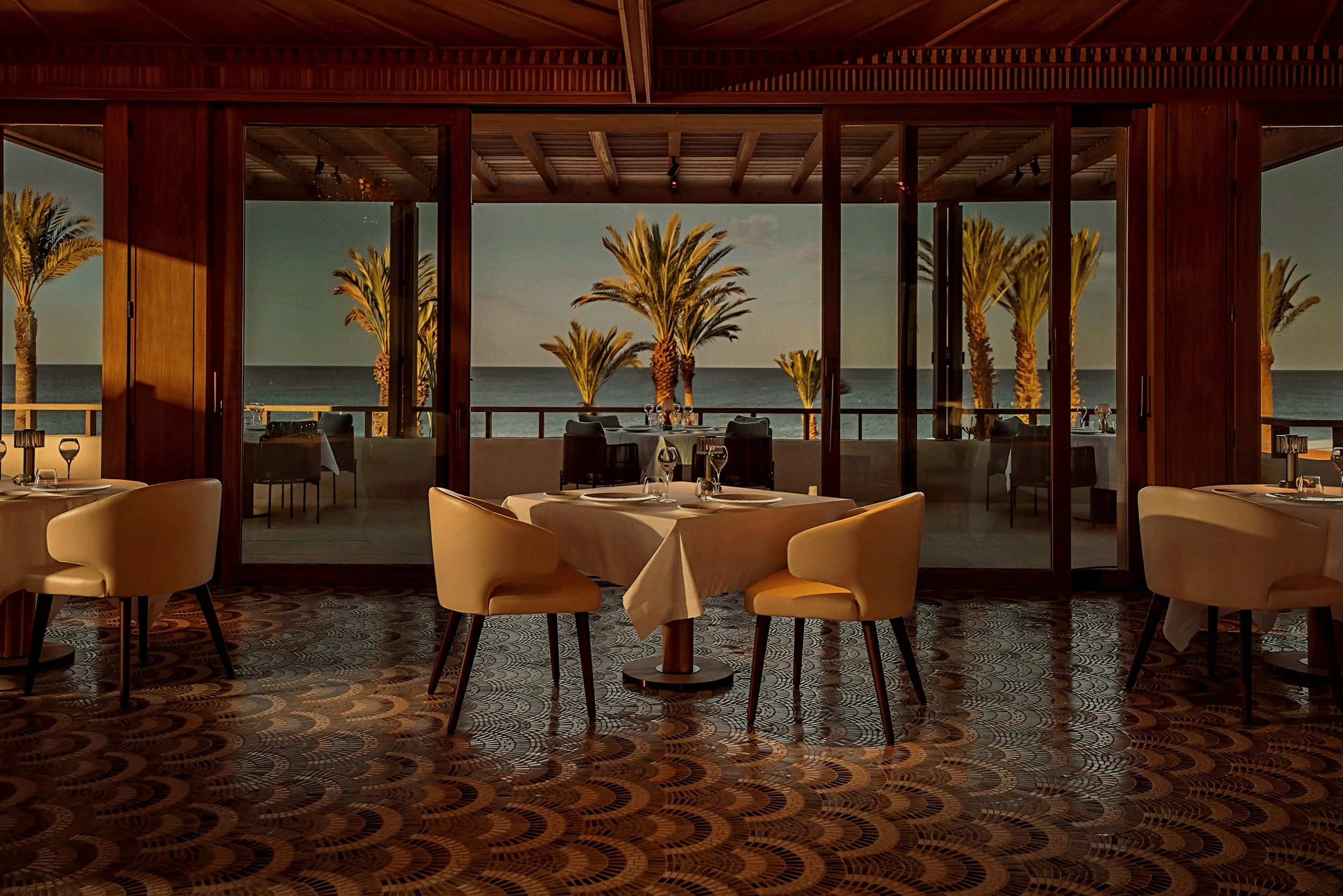
Hand-cut scallop-motif mosaic flooring, sculpted caramel-leather chairs, and slatted cedar framing an open-air loggia. Photo: Courtesy of Royal Mansour Tamuda Bay
Continuing the royal gastronomic lineage inaugurated in Marrakech in 2010—where multi-Michelin-starred masters took up enduring residencies alongside Moroccan artisanal craft—Royal Mansour Tamuda Bay unites three three-Michelin-starred luminaries, Éric Fréchon, Massimiliano and Raffaele Alajmo, and Quique Dacosta, supported on-site by Executive Chef Gildas Perin and Master Baker Yassine Boukantar. Across this historic maritime crossroads facing southern Spain, the trio set aside theatrical artifice in favor of honest, sun-drenched cooking anchored in aromatic mint, rosemary, and lavender from Luis Vallejo’s botanical gardens and daily harvests from M'diq fishermen and northern Moroccan cooperatives. When evening falls over Cabo Negro, Fréchon—a Meilleur Ouvrier de France—orchestrates dinner inside La Table, an intimate forty-eight-seat salon designed by Muza Lab in deep emerald greens, warm woods, golden lighting, and shimmering beaded curtains, where an open kitchen turns French coastal gastronomy—lightened with Mediterranean citrus, local shellfish, Moroccan spices, and subtle Japanese accents—into quiet nocturnal theater.
By day and into candlelit nights, Coccinella channels Massimiliano Alajmo’s philosophy of "cucina semplice"—rooted in emotional warmth, lightness, and reverence for raw ingredients—within a botanical green-and-ivory room dressed in carved moucharabieh screens, lush greenery, and hand-painted ceramic tiles by artist Michael Chandler. Here, families and couples gather across forty-eight indoor and garden seats for morning pastries, wood-fired pizzas, handmade pastas, risottos, and theatrical tableside tiramisu crafted with Moroccan olive oils and coastal herbs. Just beyond, beneath a ceiling intricately inlaid with shimmering mother-of-pearl, sculptural fishnet-inspired lighting, and crisp maritime blue-and-white tones, Valencian master Quique Dacosta celebrates his Dénia roots at Le Méditerranée—pairing a daily catch display with blue lobster paella, txangurro spider crab ravioli, and charcoal-grilled meats overlooking the surf.
Set on a natural timber deck between the infinity pool and the 700-meter beach under striped parasols and warm terracotta-and-wood bar seating, Pool Beach—also curated by Dacosta—captures the barefoot pulse of the Moroccan Riviera as afternoon lounging drifts into sunset music behind the Rif Mountains. Alongside sushi, ceviche, and Peruvian-Japanese Nikkei plates, Dacosta debuts his multi-compartment Palmas bento boxes—creations his team describes as "inspired by flavors from around the world that play out the chef's travels since his career began... blending Dacosta's traveller nature with excellent regional products like cheese, fish, and seafood". Beyond the dining rooms, private Moroccan mint tea ceremonies, regional olive oil and goat cheese tastings, and hands-on cooking and pastry masterclasses with the estate’s culinary and bakery teams complete an unhurried celebration of northern Moroccan terroir.
The Lattice Thermae
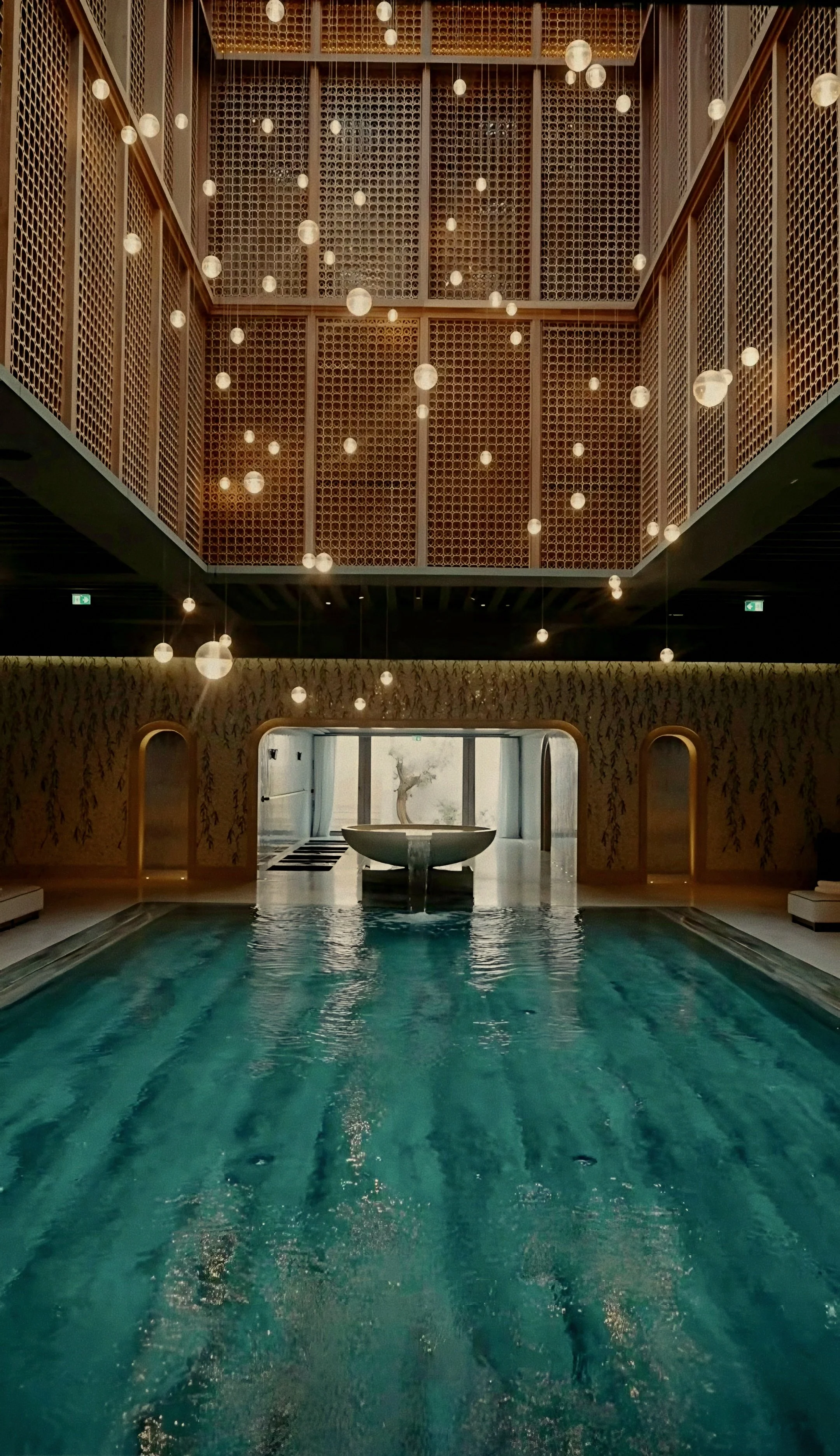
A soaring latticework atrium and floating glass-orb constellation suspended above a dark-tiled thermal basin. Photo: Courtesy of Royal Mansour Tamuda Bay
At the quiet heart of Royal Mansour Tamuda Bay, Barcelona’s GCA Architects sculpted Morocco’s first 4,300-square-meter Medi-Spa as two interconnected wings rising one and three stories—a tactile cedarwood refuge clad in warm Iroko timber, natural stone, mineral finishes, and subtle marine accents. Beneath a timber skylight and intricate moucharabieh latticework that casts shifting geometric reflections across the water, an adults-only saltwater pool anchors the sanctuary with an elevated cascading water basin, oversized relaxation daybeds, and an adjoining hot-and-cold vascular walking circuit. Flowing outward through five medical consultation and diagnostic rooms, eight holistic treatment suites—including a couple’s suite—relaxation lounges, a hair and barber salon, manicure and pedicure studios, and an herbal infusion and juice bar, the thermal circuit unites traditional marble Moroccan hammams, Finnish saunas, aromatic steam rooms, a halotherapy salt cave, experiential and Vichy showers, a heated Watsu® pool for floating aquatic bodywork, and a high-jet hydrotherapy vitality pool illuminated by suspended Bocci glass spheres.
Guided by a multidisciplinary circle of resident general practitioners, aesthetic doctors, Ayurvedic physicians, naturopaths, acupuncturists, nutritionists, and movement coaches, the sanctuary anchors four- to fourteen-day longevity immersions—Boost & Balance, Longevity Boost, Deep Recharge, and Total Reset—around 3D body imaging, sleep and stress diagnostics, and five foundational pillars spanning metabolic and functional equilibrium, bespoke nutritional menus crafted by the resort’s Michelin-starred chefs, physical vitality, restorative sleep, and emotional calm. Individual sessions range from three-minute cryotherapy, LED light therapy, acupuncture, Ayurveda, Shiatsu, Thai massage, and manual lymphatic drainage to heritage marocMaroc rituals including the Tekmida warm-towel energy treatment and Miel d'Ambre body scrubs.
Beyond the treatment rooms, athletic life continues inside a state-of-the-art fitness wing equipped with modern cardio machines, heart-rate monitors, free weights, and resistance stations alongside dedicated studios and outdoor garden decks for private or group yoga, Pilates, spinning, stretching, meditation, aerobics, aqua-aerobics, and personal training. Across the ten-hectare coastal grounds, on-site tennis courts, padel courts, and a multi-sports field welcome private coaching, while wicker-basketed resort bicycles trace sunlit coastal pathways and concierge-arranged rounds of golf unfold minutes away across Tamuda Bay and Cabo Negro.
The Coffered Impluvium
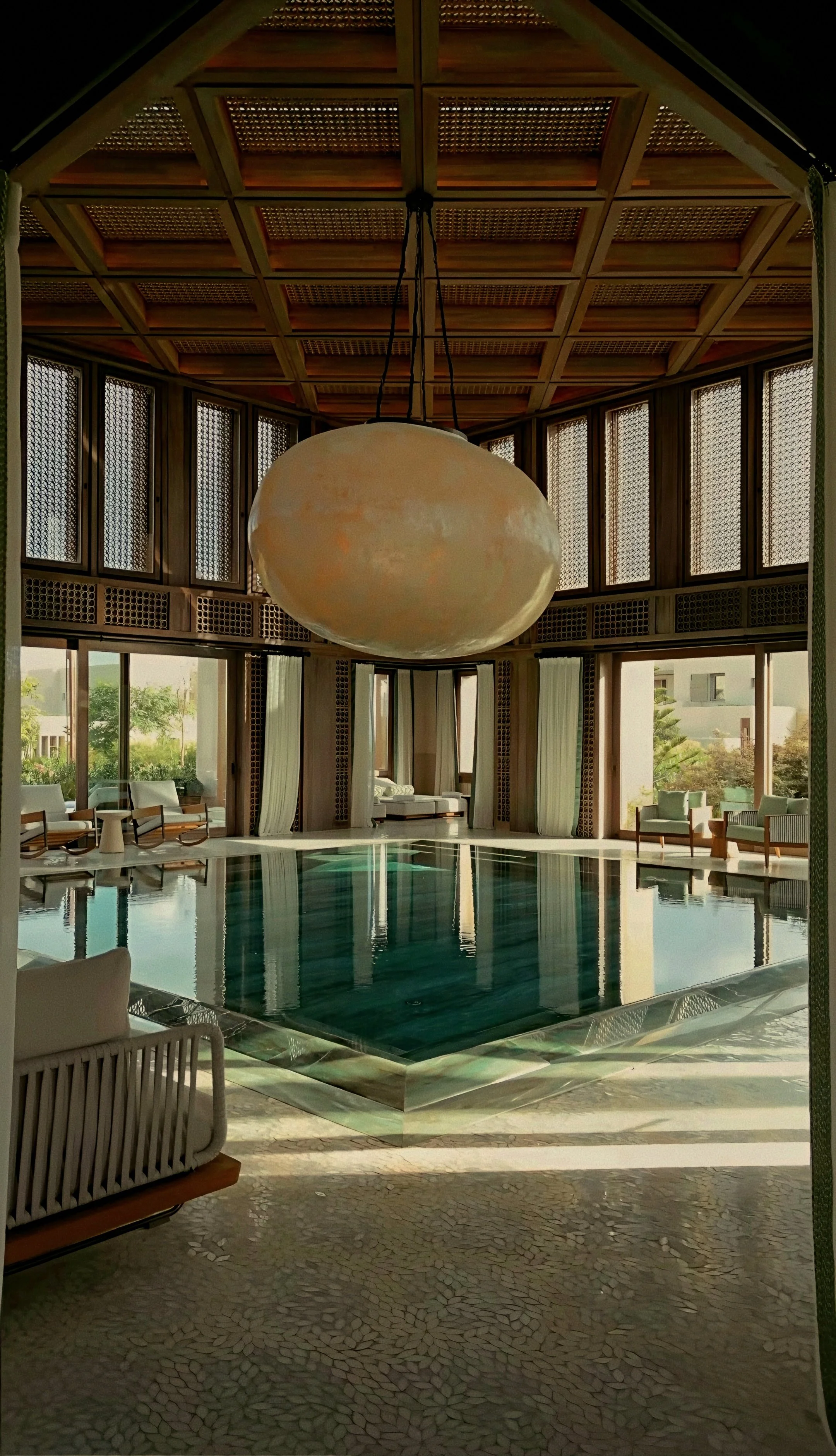
A luminous resin pendant beneath coffered cedar and latticework over a jade-tiled pool. Photo: Courtesy of Royal Mansour Tamuda Bay
Across the estate and its thermal pavilion, seven shared pools are complemented by thirteen private pools woven into four beachfront Privilege Suites, all five Prestige Villas, the two-pool Princière Villa, and the two-pool Royal Villa—allowing water to remain a constant, intimate presence from garden terrace to rooftop. Steps from the sand beside Pool Beach, the sweeping outdoor infinity pool overlooks the Alboran Sea amid natural timber decking, striped parasols, and plush loungers, while inside the wellness pavilion the family-friendly Quiet Pool glows beneath a dramatic moon-like chandelier and starry-sky fiber-optic lights twinkling beneath the surface after dark. Beyond the timber decks, 700 meters of golden sand—shielded naturally by a rocky headland on one flank and King Mohammed VI’s private coastal residence on the other—offer rare seclusion, dotted with 116 custom carved-wood sunbeds spaced generously apart beneath striped umbrellas for unhurried beachfront service of chilled water, sushi, ceviche, and cocktails against the distant silhouette of Cabo Negro and the Rif Mountains.
Anchoring the southern curve of the bay, an architectural Iroko-wood Boat House staffed by captains, sailors, and certified instructors launches seasonal voyages across the calm, crystal-clear waters of the Alboran Sea. Two iconic Italian mahogany Riva yachts—a Riva Aquariva and a Riva Dolceriva—set out for half-day, full-day, or sunset cruises toward Cabo Negro, Fnideq, and secluded coves, joined by stand-up paddleboarding, sea kayaking, canoeing, water-biking, wakeboarding, wakesurfing, water skiing, hydro-foiling, Seabob scooters, and guided snorkeling, night dives, and full PADI scuba excursions.
The Lambrequin Threshold
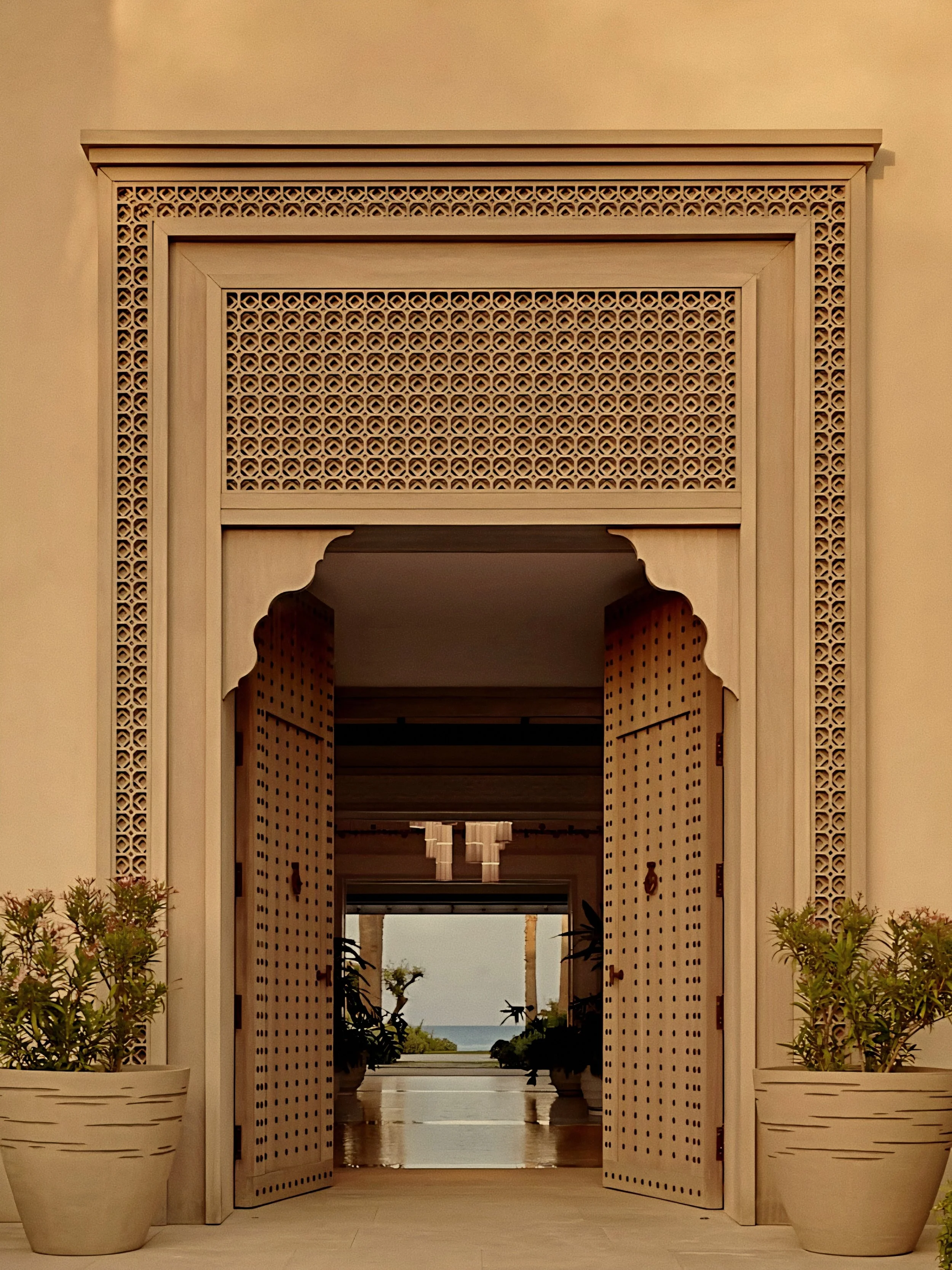
Pierced cedar mashrabiya transom and studded timber portal set into lime-washed plasterwork. Photo: Courtesy of Royal Mansour Tamuda Bay
Beyond the shoreline and the shaded courtyards, the soul of northern Morocco reveals itself through intimate, private ateliers with visiting maâlems—master artisans who invite guests to sit beside them and learn the patient geometry of Tétouani zellige mosaic assembly, delicate ceramic painting, and supple traditional leatherwork. In these unhurried sessions, the centuries-old dialogue between Tétouan, Fez, and the Mediterranean becomes tangible under the fingertips, transforming ancestral craft from something merely admired on a wall into a lived, tactile memory.
As dusk settles over the Alboran Sea and Anoche’s concealed warm light awakens the carved moucharabieh screens and olive groves, Royal Mansour Tamuda Bay reveals its truest achievement—a coastal sanctuary that feels less like a newly built resort than an heirloom estate shaped by tide, stone, and royal patronage. Framed between the Rif Mountains and the quiet horizon of Cabo Negro, it stands as a luminous ode to Moroccan grace—where time slows to the rhythm of the waves, and every threshold opens onto beauty meant to endure.
L'Ordre de Royaume
ESSENTIAL INFORMATION
To preserve your personal privacy, secure direct guest privileges, and ensure end-to-end data safety, luxury travelers are advised to book directly through the property's official portal.
(Note: Royaume maintains zero affiliate partnerships or booking commissions. We link exclusively to official brand channels for property verification and reader security.)