BY ROYAUME
November 2026
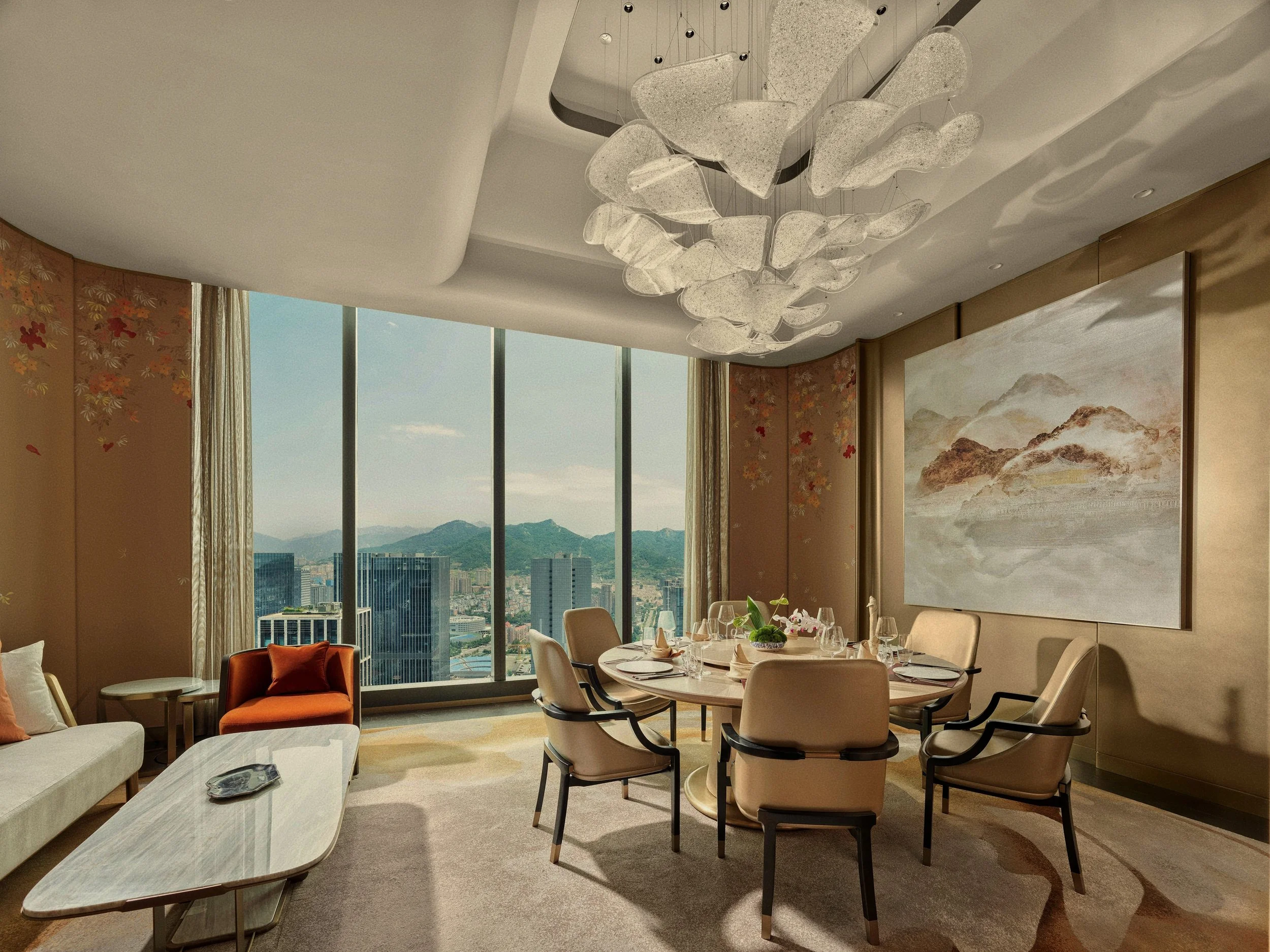
A suspended glass-petal mobile hovering over a circular travertine dining table and silk-upholstered salon. Photo: Courtesy of Diaoyutai Qingdao
Rising above the coastal horizon of Qingdao’s Laoshan District, where the misty peaks of Mount Lao meet the tides of the Yellow Sea, Diaoyutai Qingdao—also recognized under its refined co-branded identity, MGM Reserve Qingdao—reimagines eight centuries of Chinese imperial statecraft as an intimate, high-altitude sanctuary. Inaugurated in June 2023 as the flagship coastal jewel of Diaoyutai MGM Hospitality—the landmark 2007 joint venture uniting Beijing’s historic Diaoyutai State Guesthouse with MGM Resorts International—and developed by SID (Qingdao) Investment Development alongside SIIC, the property stands today as one of northern China’s premier ultra-luxury retreats and a graceful cultural ambassador for modern Chinese hospitality. Its lineage traces directly to western Beijing’s storied Diaoyutai State Guesthouse: named after the twelfth-century lakeside fishing terrace of Jin Dynasty Emperor Zhangzong, expanded into an imperial garden retreat by Emperor Qianlong in 1774, and transformed in 1959 into China’s highest-level diplomatic residence for visiting heads of state. Guided by the owners’ founding vision, "Light and Shadow – Making a Beautiful City Dream Come True," the hotel translates that diplomatic pedigree into a contemporary philosophy of gracious "master of the mansion" hospitality—welcoming global connoisseurs with quiet confidence and modesty.
Giving architectural form to this dialogue between ancient heritage and modern ambition, New York-based Kohn Pedersen Fox (KPF) sculpted the twin-tower Shangshi Center within the Qingdao Financial City as a pair of crystalline landmarks rising nearly two hundred meters above the bay. Composed of five stacked, jewel-like glass volumes, the stepped facade captures shifting coastal light while framing panoramic sightlines across the sea and mountains. While its companion MGM tower nods to Qingdao’s red-brick heritage through crimson-and-emerald glass gradients, the Diaoyutai tower grounds itself in classical Chinese architectural proportions—anchored at its base by serene water courtyards, terraced stone gardens, and tranquil podium landscaping that establish an immediate boundary between the financial district and the private world within.
Inside, Toronto-based Studio Munge, led by principal designer Alessandro Munge, conceptualized the entirety of the hotel’s interior architecture, bespoke furnishings, and custom lighting as a contemporary Royal Garden Pavilion suspended between ocean and sky. Eschewing literal historical pastiche, Munge distilled traditional Chinese garden motifs—scholar’s rockeries, lotus ponds, Suzhou latticework, and crimson lacquer—into bold, poetic volumes. That narrative begins at the discreet ground-floor arrival foyer, conceived as a private mansion domain where a white-bronze scholar’s rockery hovers above still water beside Qi Yun ("Rising Clouds"), a commanding crimson sculpture created specifically for the space by Shandong-born artist Sui Jianguo. Framed by up-lit mountain-mist murals and floating three-tiered linen lanterns glowing within imperial-red ceiling coves, guests ascend inside jewel-box elevator cabs wrapped in crimson embroidered raw silk, burl wood, and brushed bronze.
Emerging onto the fifty-first floor, the arrival culminates in a soaring, triple-height Sky Lobby that hovers like an aerial pavilion above the Yellow Sea. Floor-to-ceiling openwork display shelves—modeled after classical Suzhou garden window frames and curated with painted ceramics and jade-toned antiquities—frame the open ocean horizon like an unspooling landscape scroll. Overhead, dramatic palace-red lacquer coves and translucent cloud-patterned glass screens cast a warm glow across timber columns and interlocked black granite floors subtly inlaid with abstract lotus-leaf motifs. Furnished with low-slung ivory seating clusters, dark marble tables, a circular bronze hearth, individual dark-stone reception podiums set against double-height windows, and a sculptural folded-metal and timber staircase linking the upper mezzanines, the Sky Lobby sets an unforgettable stage for coastal art de vivre.
The Coved Boudoir
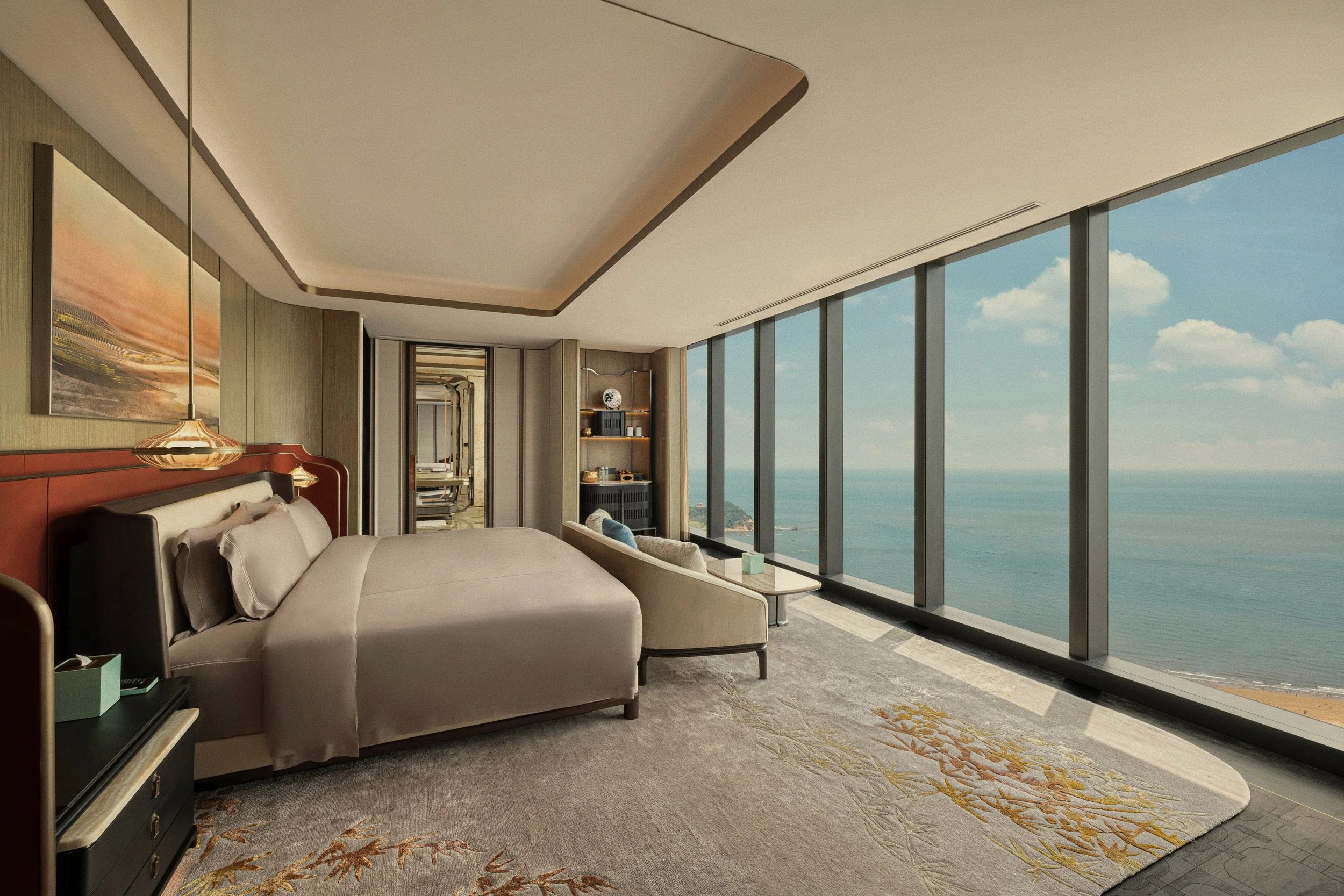
A cinnabar-lacquered headboard and tray ceiling grounding a wool-carpeted bedchamber above the open sea. Photo: Courtesy of Diaoyutai Qingdao
Occupying floors thirty-two through thirty-nine of the KPF-designed crystalline tower, the 116 residences and suites of Diaoyutai Qingdao are conceived as intimate, sky-bound private estates hovering between Mount Lao and the Yellow Sea. Even the threshold sequence sets a ceremonial cadence: dark granite borders meet ombré burgundy carpets woven with abstract lotus motifs, leading past illuminated art niches to imperial-red lacquered entry doors. Within, Toronto-based Studio Munge replaced conventional hotel layouts with cohesive residential architecture—uniting dark walnut paneling, luminous beige plaster, brushed bronze trim, and expansive glass curtain walls that frame the shifting moods of the Shandong coastline.
Across the sleeping quarters, custom-crafted by Golden Phoenix Furniture Group, Studio Munge orchestrated two distinct chromatic narratives—deep oceanic marine blue and warm golden sunset—punctuated by soulful brick-red accents that pay subtle homage to Qingdao’s historic tiled rooftops. Behind each oversized bed, upholstered fabric walls trimmed in dark timber and brushed bronze anchor large-scale botanical studies or misty mountain landscapes. In upper-tier suites, these feature walls elevate into hand-stitched silk and woven textile panels, lending the private chambers a softer, couture-like tactile warmth.
Every architectural detail overhead and underfoot reinforces this mood of hushed coastal retreat. Rather than flat ceilings, the bedrooms are crowned by deep, stepped coffered planes infused with concealed warm cove lighting, while cylindrical suspended pendant lamps cast an intimate glow over dark-wood floating nightstands finished with bronze hardware. Wide-plank and herringbone dark timber floors are anchored by bespoke, plush area rugs patterned with painterly brushstrokes in charcoal, ivory, and terracotta—evoking both the rhythmic tide of the Yellow Sea and classical Chinese ink-wash landscapes.
The Filigree Lavatorium
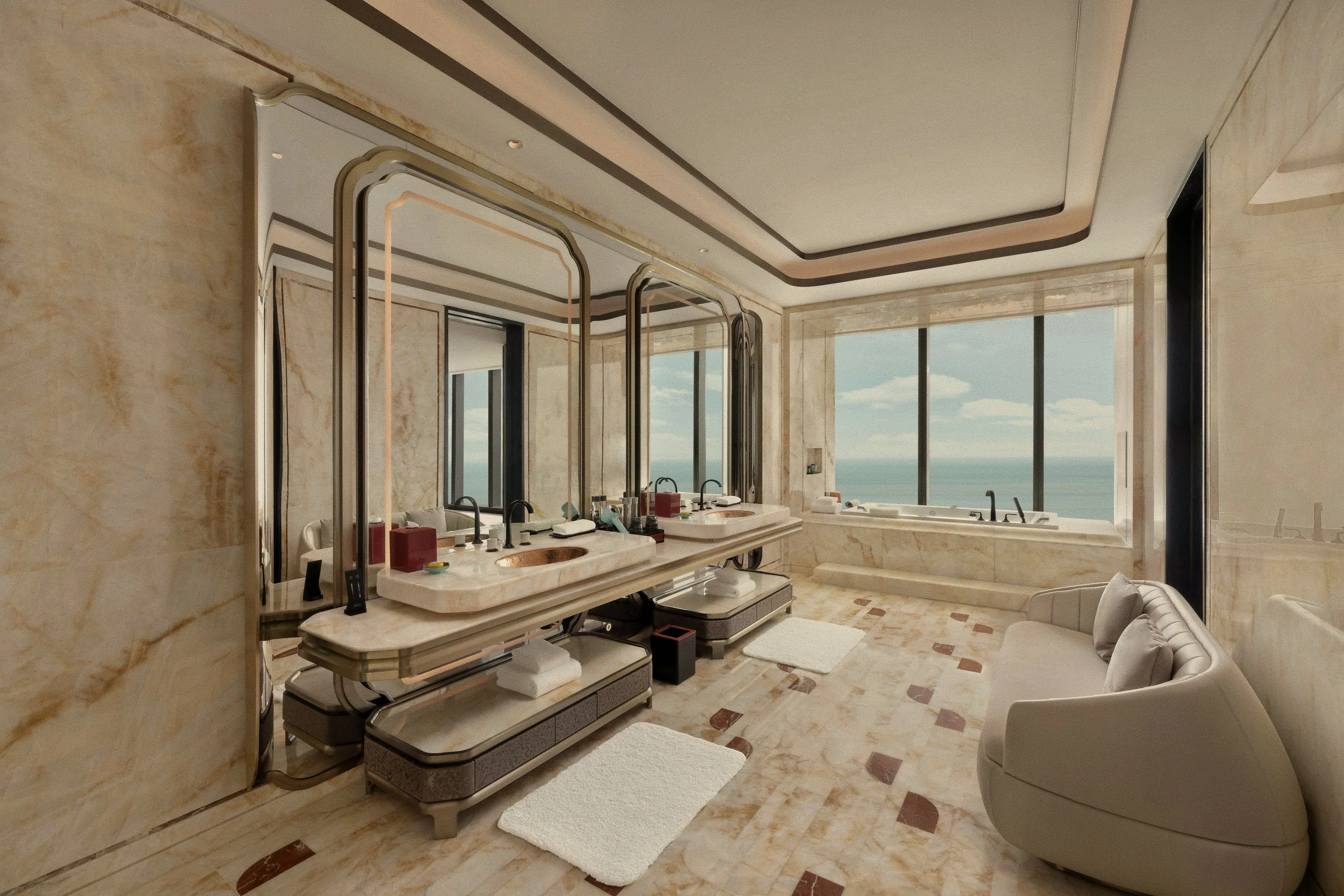
Bookmatched honey onyx, brass-trimmed arched mirrors, and a curved bouclé chaise framing a sunken coastal bath. Photo: Courtesy of Diaoyutai Qingdao
Rather than isolating the bath behind narrow doors, Studio Munge dissolved the boundary between sleeping and bathing through wide, sliding timber-and-glass pocket partitions—allowing natural coastal daylight and uninterrupted sea horizons to pour deep into the private sanctuaries. Anchored by thick, veined marble walls, warm walnut millwork, and backlit halo mirrors framed in brushed bronze, each bathing suite centers on a sculptural freestanding oval soaking tub paired with floor-mounted gunmetal or bronze gooseneck fillers—while select specialty residences elevate the ritual with sunken circular tubs framed beside traditional moon-gate windows.
A bold museum-grade signature defines the composition: beside the soaking tub rests a bespoke imperial-red lacquered side table inspired by Ming and Qing altar forms, introducing a striking sculptural counterpoint against the cool, luminous stone. Thick marble double vanities with integrated basins and suspended cylindrical glass pendants complete the dressing zone, balanced by separate enclosed wet chambers housing oversized rainfall showers and automated TOTO fixtures.
The Scrollwork Salon
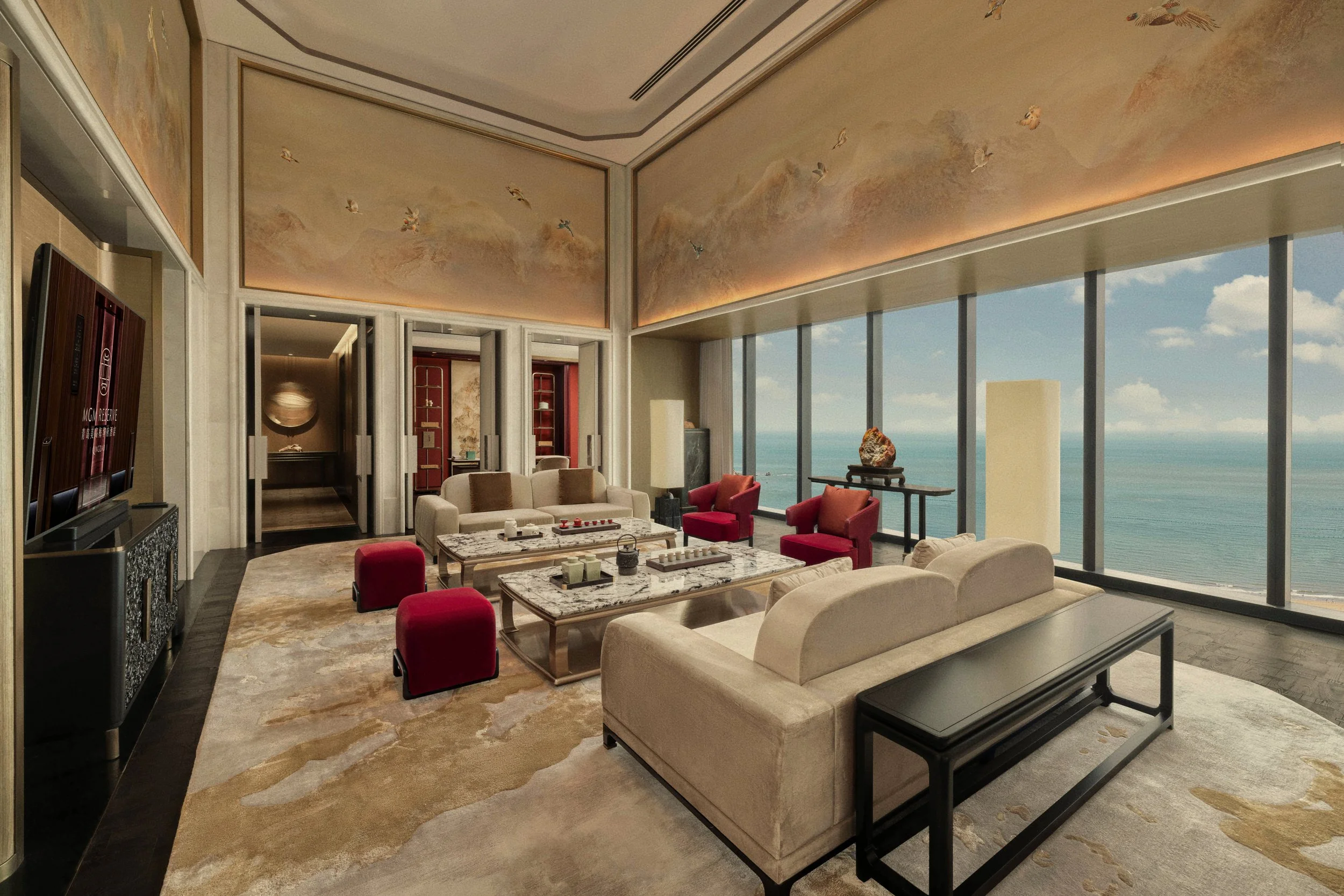
Double-height ink-wash landscape murals and ebonized Ming-style consoles anchoring a crimson-and-ivory drawing room. Photo: Courtesy of Diaoyutai Qingdao
In the corner residences and multi-room suites, living parlors unfold directly along floor-to-ceiling glass walls so that every seating arrangement communes with the Yellow Sea horizon. Outfitted with bespoke pieces fabricated by Golden Phoenix and Decca, these residential salons balance low-slung sofas in marine blue or sunset terracotta with curved lounge armchairs, leather-strapped ottomans, and veined marble coffee tables. Openwork bronze shelving, curated ceramic vessels, and silk-screened decorative partitions subtly delineate the living, formal dining, and window-side study zones without interrupting daylight—recreating the layered spatial depth of a classical Chinese garden pavilion.
"Our ambition was never merely to decorate high-altitude rooms, but to compose private sky-bound mansions where eight centuries of Diaoyutai poise meet the quiet poetry of the Shandong coast," notes Studio Munge founder Alessandro Munge of the property’s residential vision. By filtering imperial Chinese architectural grammar—axial symmetry, framed vistas, and lacquered accents—through a contemporary, light-filled sensibility, the studio ensured that each living salon feels effortlessly lived-in yet ceremonially composed, allowing shifting coastal daylight and evening lantern light to animate the natural woods, rich textiles, and bronzed surfaces throughout the day.
This architectural philosophy reaches its zenith across the hotel’s signature collection—ascending from the thirty-sixth-floor Ocean View and corner Skyline Ocean View Suites to the 313-square-meter Lifestyle Connoisseur (Chairman) Suite on floor thirty-seven, envisioned as a private collector’s residence curated with exhibition-grade works by GZ Art Co.. Crowning the thirty-eighth floor, the 470-square-meter Presidential ("Fishing Platform") Suite commands the tower like a sovereign diplomatic estate—divided into ceremonial, entertaining, study, and private residential wings complete with custom dark-wood millwork, bronze screens, a dedicated butler’s pantry, a primary suite wrapped in hand-stitched silk and botanical wallcoverings, a private library, a panoramic bath, and round-the-clock butler service versed in state etiquette.
The Vermilion Refectory
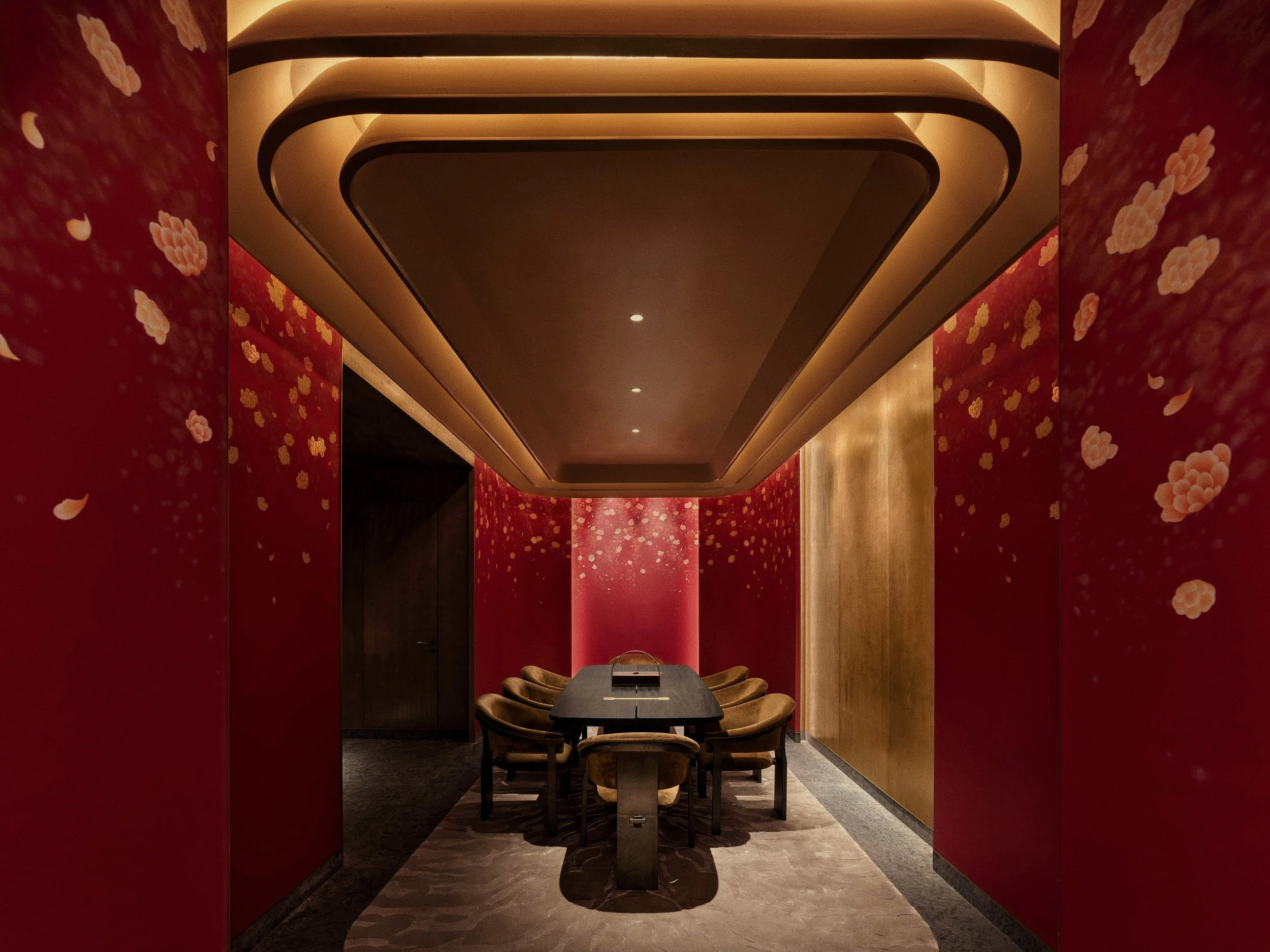
A concentric tiered ceiling coffer and gold-leaf wall panel enveloping a vermilion floral-silk dining chamber. Photo: Courtesy of Diaoyutai Qingdao
Suspended across the fiftieth and fifty-first floors above Qingdao Bay and Mount Lao, the culinary program at Diaoyutai Qingdao translates more than six decades of Beijing state-banquet pedigree into an atmospheric coastal ritual. Guided by state-banquet-trained executive chefs rather than individual celebrity bravado, the kitchens uphold the historic Diaoyutai credo—"fresh and elegant, harmonious and everlasting"—alongside a refined cross-cultural mastery of applying Western techniques to Chinese flavors and Chinese artistry to Western ingredients. "True state-banquet gastronomy never relies on heavy oils or overpowering spice to command attention; it is an exercise in clarity, patience, and balance, allowing wild Yellow Sea catches and pure Mount Lao spring water to speak with quiet authority," shares the hotel’s executive culinary leadership. Sourcing directly from certified Shandong organic estates and daily coastal fishing boats, every dish—from slow-simmered Buddha Jumps Over the Wall to delicate steam-pot hot and sour cuttlefish roe soup—honors natural umami and diplomatic grace.
Each dining venue unfolds as a distinct chapter of Studio Munge’s indoor garden narrative. On the fiftieth floor, Royal Court draws inspiration from the mythical Penglai Fairyland—pairing floor-to-ceiling coastal vistas with imperial-red lacquered walls, warm copper accents, and a poetic ceiling installation of hand-blown golden winter jasmine petals drifting above bespoke lacquerware and museum-grade private dining chambers. One level higher on the fifty-first floor, Fangfei Garden Lounge serves as a triple-height living room in the clouds, anchored by deep blue marble floors, midnight-hued walls, white winter-flower motifs, and a circular bronze fireplace set within a shimmering resin wall evoking rippling water and mountain mist. By day, sunlight illuminates morning Qingdao millet porridge, seafood wontons, and bespoke afternoon teas; by night, soft lantern light transforms the space into an intimate cocktail salon.
Completing this aerial gastronomic sanctuary is Fangfei Teahouse, a meditative refuge wrapped in warm timber and delicate latticework where rare regional harvests—including prized local Laoshan green and black teas—are brewed with mountain spring water alongside delicate imperial pastries. When a livelier social rhythm calls, guests also enjoy seamless passage to the connected MGM sister tower for flame-grilled Italian fare at Fiamma, live music at HONG Bar, Festival, and artisanal confections at MGM Patisserie—ensuring every mood, from ceremonial state-banquet intimacy to vibrant evening revelry, is effortlessly answered.
The Celadon Sanctum
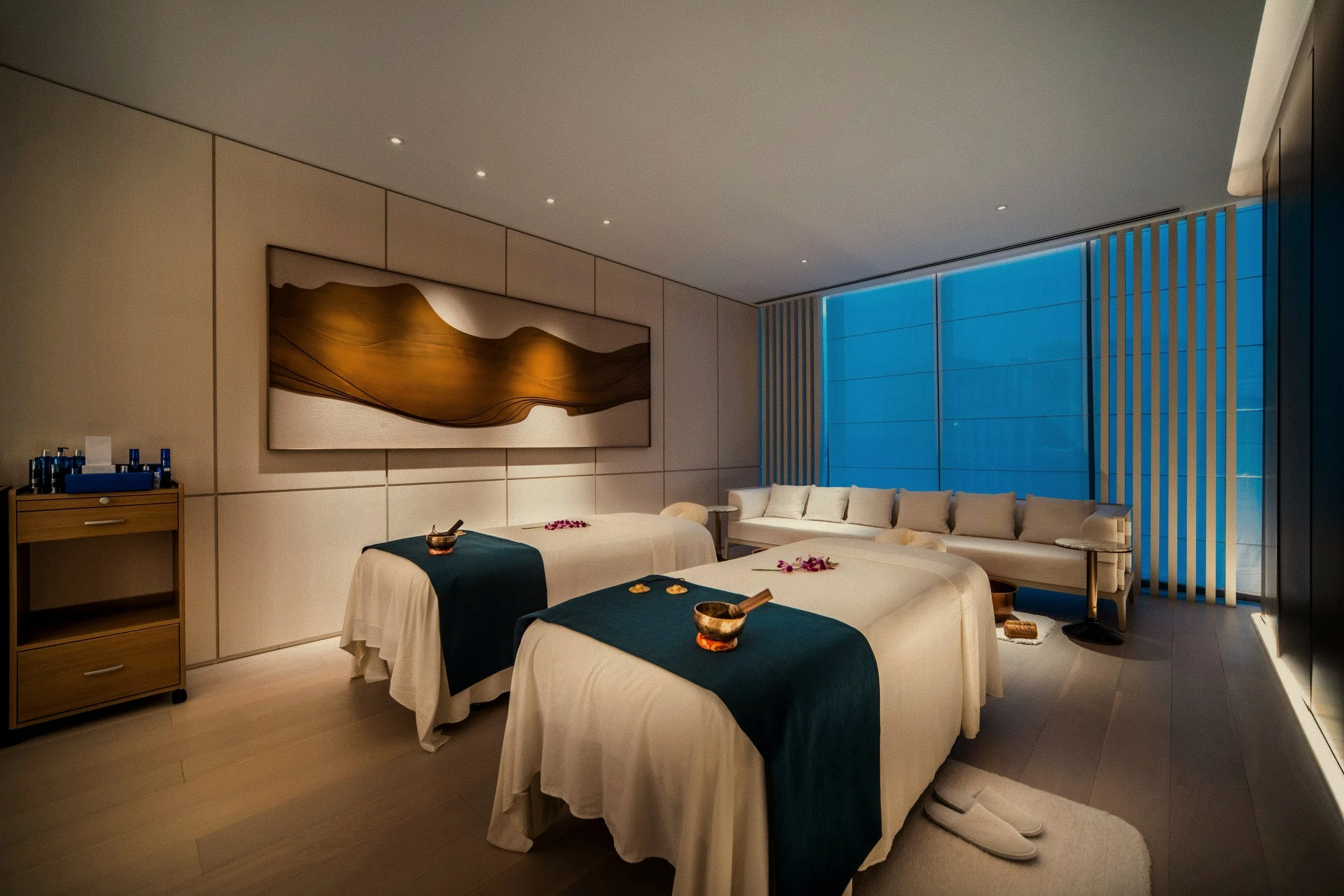
An undulating bronze bas-relief and slatted indigo window screens framing a serene dual-suite sanctuary. Photo: Courtesy of Diaoyutai Qingdao
Suspended on the thirty-first floor above the rhythmic sweep of the Yellow Sea, the wellness sanctuary at Diaoyutai Qingdao translates Studio Munge’s residential tranquility into an immersive realm of physical and sensory renewal. Anchored by TRIA Spa—structured around the pillars of wellness, beauty, and vitality—the enclave unfolds across eight hushed treatment chambers, including a private couples’ sanctuary and a dedicated VIP water-therapy suite. Here, ancient Chinese healing philosophies converge with global spa traditions through mineral-rich seawater baths, Turkish hammam-inspired bathing rituals, botanical wraps, deep-tissue bodywork, and bespoke facials—all accompanied by the resonant stillness of singing bowls and diffused coastal twilight.
Extending this ritual of restorative solitude, separate men’s and women’s thermal sanctuaries pair dry timber saunas and aromatic steam rooms with bubbling Jacuzzi hot tubs and quiet relaxation lounges. Steps away, a light-filled movement studio provides an intimate setting for restorative yoga, stretching, and guided breathwork, while the adjacent sea-facing fitness gallery—outfitted with sculptural Technogym apparatus, strength stations, and private coaching—allows movement to unfold against an unbroken marine horizon at any hour.
Beyond the tower’s crystalline envelope, the wellness experience expands into the landscaped grounds of the Qingdao Financial City, where residents enjoy privileged access to open-air athletic courts—including a full-sized tennis court, a basketball court, and a manicured football pitch—seamlessly uniting high-altitude stillness with open-sky vitality.
The Tessellated Basin
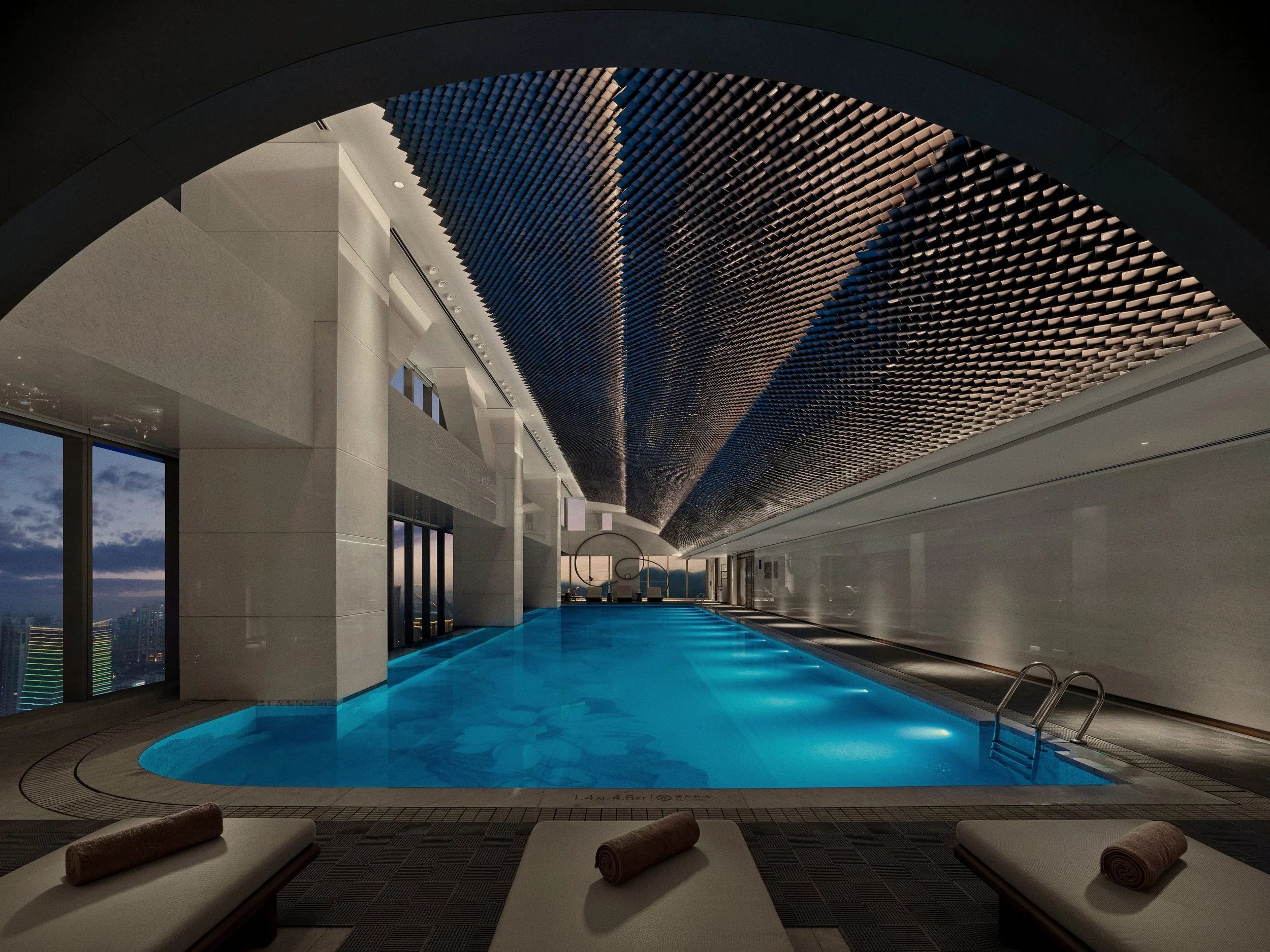
An arched latticework barrel vault and monolithic limestone piers mirrored in a sapphire lap pool. Photo: Courtesy of Diaoyutai Qingdao
Poised on the thirty-first floor where architectural geometry meets the open horizon, the indoor heated sky infinity pool at Diaoyutai Qingdao offers a gallery-like sanctuary of luminous stillness. Spanning twenty-five meters across three serene swimming lanes, the temperature-controlled basin is bordered along its seaward edge by floor-to-ceiling glass curtain walls—allowing the water’s surface to visually dissolve into the tides of the Yellow Sea. Crafted by Studio Munge, the soaring hall pairs sculptural white curved planes and dark stone decking with warm metallic bronze accents, bespoke water features, and plush daybeds arranged for quiet contemplation, while offering seamless access to private swim coaching and adjoining thermal suites.
Beyond the water’s edge, the hotel’s cultural calendar invites guests to inhabit China’s artistic heritage through intimate, hands-on ateliers. Connoisseurs can explore millennia-old decorative traditions—from adorning plain white fans in the thousand-year-old technique of Ming Dynasty lacquerware to mastering gold-leaf painting, brilliant cloisonné enamel, mother-of-pearl inlay, bamboo boat weaving, and Song Dynasty brocades. In moments of quieter reflection, private sessions revive the Song Dynasty’s "four leisurely pursuits" through ceremonial tea-whisking and the meditative art of incense seal carving—pressing fragrant powder into intricate copper molds as delicate ribbons of smoke rise—while curated styling in exquisite Song Dynasty Hanfu attire allows guests to step directly into the poetic grace of imperial history.
Rising effortlessly between the storied peaks of Mount Lao and the shifting expanse of the Yellow Sea, Diaoyutai Qingdao stands as far more than a coastal landmark—it is a living architectural dialogue between eight centuries of diplomatic poise and contemporary residential serenity. By uniting Kohn Pedersen Fox’s crystalline precision with Studio Munge’s tactile garden poetry, state-banquet gastronomy, and restorative sky-bound rituals, the property elevates modern Chinese hospitality into an enduring study of grace, restraint, and coastal poise.
ESSENTIAL INFORMATION
To preserve your personal privacy, secure direct guest privileges, and ensure end-to-end data safety, luxury travelers are advised to book directly through the property's official portal.
(Note: Royaume maintains zero affiliate partnerships or booking commissions. We link exclusively to official brand channels for property verification and reader security.)