BY ROYAUME
November 2026
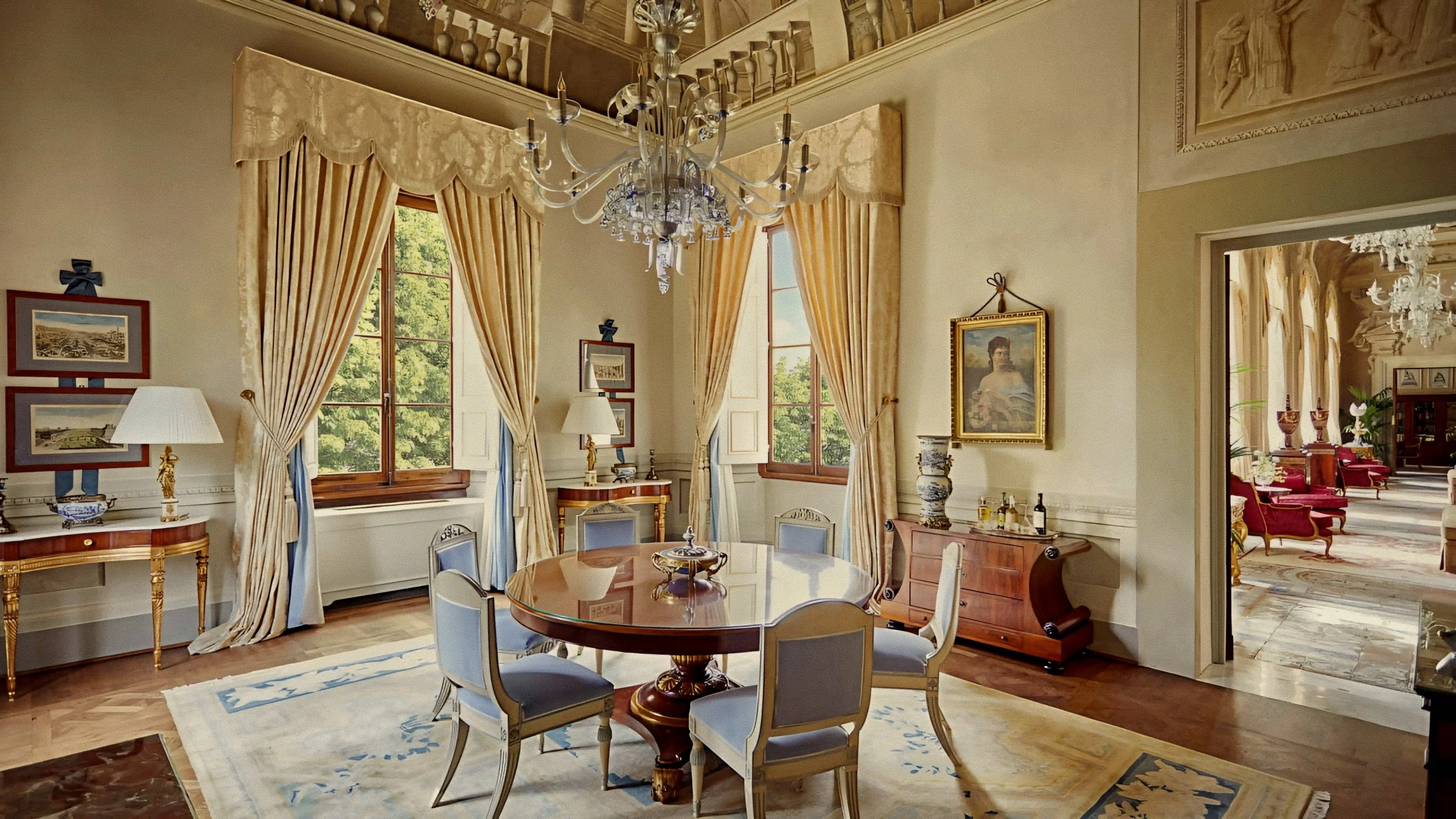
A circular mahogany pedestal table and pale-blue medallion chairs set beneath silk pelmets and a crystal chandelier. Photo: Courtesy of Four Seasons Hotel Firenze
Hidden behind high stone walls at Borgo Pinti 99—a quiet ten-minute stroll from Brunelleschi’s Duomo—Four Seasons Hotel Firenze stands as an extraordinary living monument to more than five centuries of Florentine art, humanist philosophy, and aristocratic life. Rather than merely evoking the grandeur of the Italian Renaissance, the estate inhabits two genuine architectural treasures united by the 11-acre Giardino della Gherardesca, the largest private walled botanical park in central Florence. Across this rarefied urban sanctuary, centuries-old trees, neoclassical follies, and an Ionic temple designed by Giuseppe Cacialli frame distant glimpses of the Duomo’s terracotta dome, creating a secluded resort rhythm entirely removed from the bustle of the historic city beyond its gates.
The main residence, the 15th-century Palazzo della Gherardesca, was commissioned in 1473 by Bartolomeo Scala, Chancellor of the Florentine Republic and close confidant of Lorenzo de' Medici. Guided by Leon Battista Alberti’s humanist ideals on suburban retreats and realized by Lorenzo’s favored architect, Giuliano da Sangallo, the palace was conceived around a proportional, arcaded central courtyard inspired by classical Roman antiquity. Over subsequent centuries, the estate passed through the hands of Cardinal Alessandro de' Medici—later elected Pope Leo XI—and into the ancient Della Gherardesca dynasty, who enriched its salons with Baroque frescoes, grand stuccoes, and intricate Capodimonte ceramic floors. Later, Count Guido Alberto della Gherardesca reimagined the formal grounds into an English romantic landscape garden, before the palazzo briefly sheltered exiled Egyptian Khedive Isma'il Pasha during Florence’s tenure as the capital of unified Italy.
Across the park stands a second historic landmark, the 16th-century Palazzo del Nero—affectionately known as La Villa or Il Conventino. Originally owned by Florence’s powerful Wool Guild (Arte della Lana), transformed into a noble residence by Baron Filippo del Nero, and later inhabited by the Ruspoli family before serving as a convent for the Suor Maria Riparatrice order, this wing anchors thirty-six refined rooms and suites alongside Mediterranean dining at Onde and Tuscan vermouth rituals at Bar Berni. Together, the two palazzos house 121 individual guest rooms and suites where original 15th-to-17th-century frescoes, Giovanni Stradano’s Mannerist bas-reliefs, and ornamental coffered ceilings coexist effortlessly with discreet modern technology.
Rescued from decades of closure by the Fratini family’s Fingen Group and brought to life through a meticulous seven-year conservation overseen by Italy’s Ministry of Cultural Heritage—led by restoration architects Studio Noferi and Studio Magris & Partners alongside lighting specialist Massimo Iarussi—the estate opened under Four Seasons stewardship in 2008 before its acquisition by Qatari royal interests in 2013. Today, guided by the ongoing creative direction of Parisian interior master Pierre-Yves Rochon—who returned in 2024 to reimagine the public salons and Palazzo del Nero—Four Seasons Hotel Firenze endures as one of the world’s premier heritage sanctuaries, where living museum architecture and contemporary art de vivre meet in quiet equilibrium.
The Cortile Peristyle
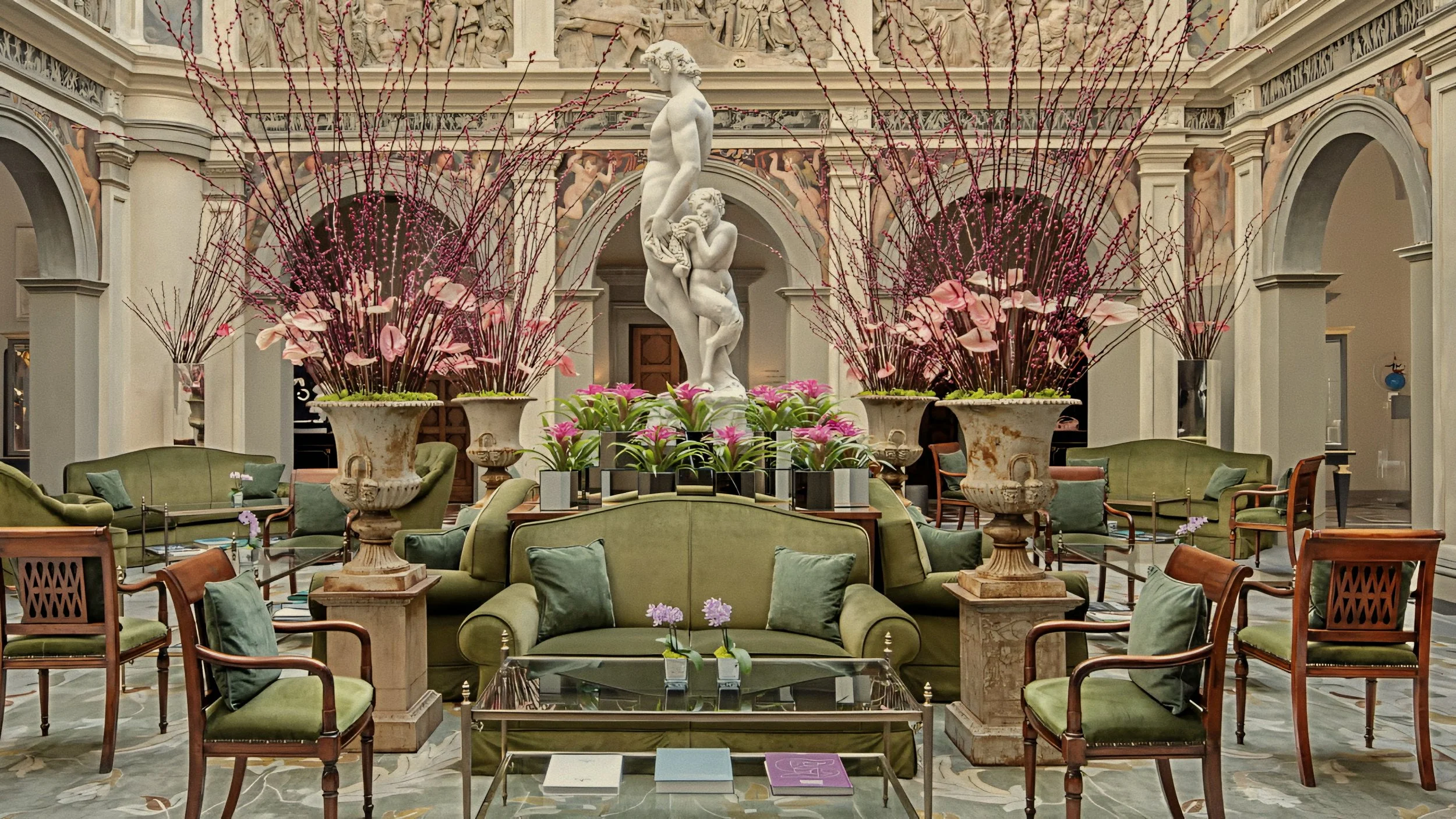
Carved stone urns and olive-velvet seating arrayed beneath neoclassical frescoed arcades. Photo: Courtesy of Four Seasons Hotel Firenze
Behind the understated, ochre-plastered facade of Borgo Pinti 99—punctuated by stone-framed windows and heavy timber doors—the arrival sequence unfolds as an immediate revelation of Renaissance theater. Passing through a vaulted stone vestibule floored in intricate black-and-white patterned marble beneath a custom hand-painted leaded glass ceiling, guests emerge into the original 1473 cortile of Palazzo della Gherardesca. Conceived by Giuliano da Sangallo as a classical Roman atrium, the three-story courtyard is now crowned high above by a custom-engineered glass-and-iron skylight canopy. Natural Tuscan daylight pours down through the glazing—shifting from luminous clarity at midday to warm, sculptural intimacy after dusk—illuminating symmetrical ground-floor loggias supported by monolithic pietra serena columns with finely carved capitals.
Rising above the perimeter arches, the upper walls display twelve monumental Mannerist stucco and terracotta bas-reliefs executed around 1585 by Flemish master Giovanni Stradano. Framed by classical pilasters and garlands, these preserved panels depict mythological allegories, pastoral landscapes, and courtly hunting scenes in extraordinary sculptural detail. Beneath them, wide vaulted corridors wrap the courtyard like an aristocratic cloister, guiding the eye toward intimate reception salons, the Michelin-starred dining room of Il Palagio, and the sunlit greenery of the botanical park beyond.
Rather than treating this historic quadrangle as a static gallery, interior designer Pierre-Yves Rochon furnished the cortile as a warm, residential Florentine drawing room. Anchoring the exact center of the space, a classical white marble sculpture rises from a stone pedestal encircled by towering seasonal arrangements of flowering branches, hydrangeas, and botanical urns. Surrounding this focal point, conversational clusters of deep-seated sofas and carved timber armchairs dressed in rich Italian velvets, damasks, and patterned silks in olive green, warm gold, and jewel tones rest atop custom-woven Abetone Jacquard wool carpets—softening the ancient terracotta and stone paving while inviting unhurried contemplation beneath centuries of art.
The Frescoed Boudoir
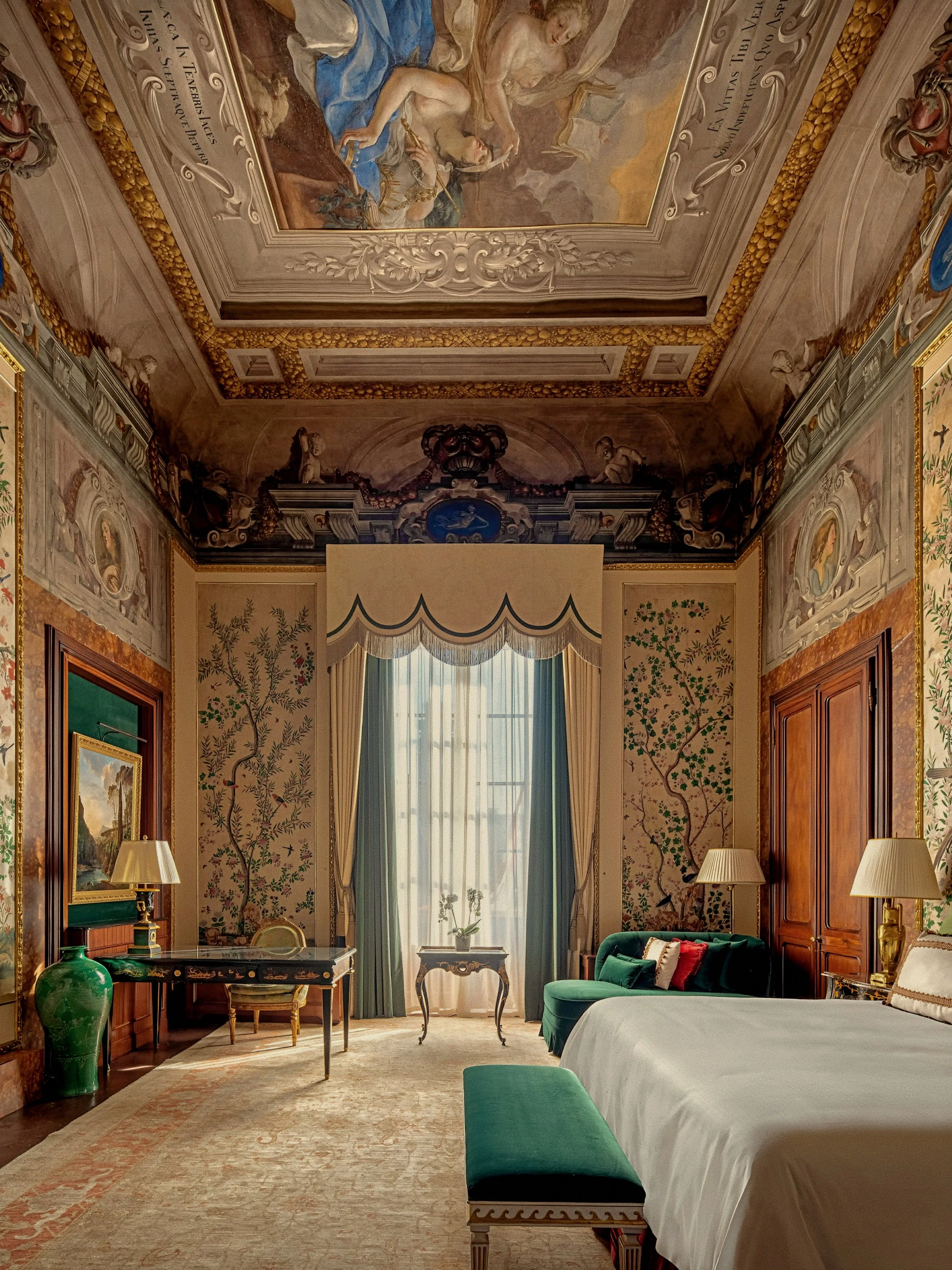
Chinoiserie silk wall panels and emerald velvet upholstery beneath a polychrome frescoed coffer. Photo: Courtesy of Four Seasons Hotel Firenze
Comprising 121 individual residences—seventy-six guest rooms and forty-five suites—the accommodations at Four Seasons Hotel Firenze unfold across two distinct historic wings united by eleven acres of walled botanical parkland. Within the 15th-century Palazzo della Gherardesca, eighty-five rooms and suites immerse guests in noble Florentine grandeur, while thirty-six quieter retreats occupy the 16th-century Palazzo del Nero (La Villa), a former convent complete with its own private reception and garden threshold. Guided by Parisian interior architect Pierre-Yves Rochon, the aesthetic narrative divides intentionally between the two landmarks: Palazzo della Gherardesca embraces an aristocratic palette of soft creams, warm golds, ochre yellows, and sage greens paired with Renaissance antiques, whereas Rochon’s late-2024 reimagining of Palazzo del Nero introduces a brighter, Tuscan-Riviera sensibility defined by botanical wallcoverings and bold geometric Italian textiles.
Because the underlying structures date to the Quattrocento and Cinquecento, no two sleeping chambers share an identical footprint or decorative program. Across every key, however, bedrooms are crowned by soaring proportions—many adorned with original 15th-to-18th-century frescoes, hand-painted timber beams, or classical soffitto a cassettoni wood coffering. Plush beds are framed by bespoke upholstered or hand-carved headboards, dressed in crisp Italian linens, and flanked by sumptuous silk draperies that fall across herringbone parquet or antique terracotta floors softened by custom Abetone Jacquard wool carpets.
In select Gallery and Renaissance suites, historic wall coverings transform the sleeping quarters into intimate decorative jewel boxes—ranging from 19th-century embossed Spanish leather in the Granducato Suite to rare, hand-painted Chinese silk panels depicting exotic birds in the Volterrano Suite. Throughout every chamber, contemporary conveniences—including automated blackout drapery, wireless charging, and intuitive lighting controls—remain discreetly concealed within period cabinetry, preserving the undisturbed tranquility of a private Florentine residence.
The Carrara Lavatorium
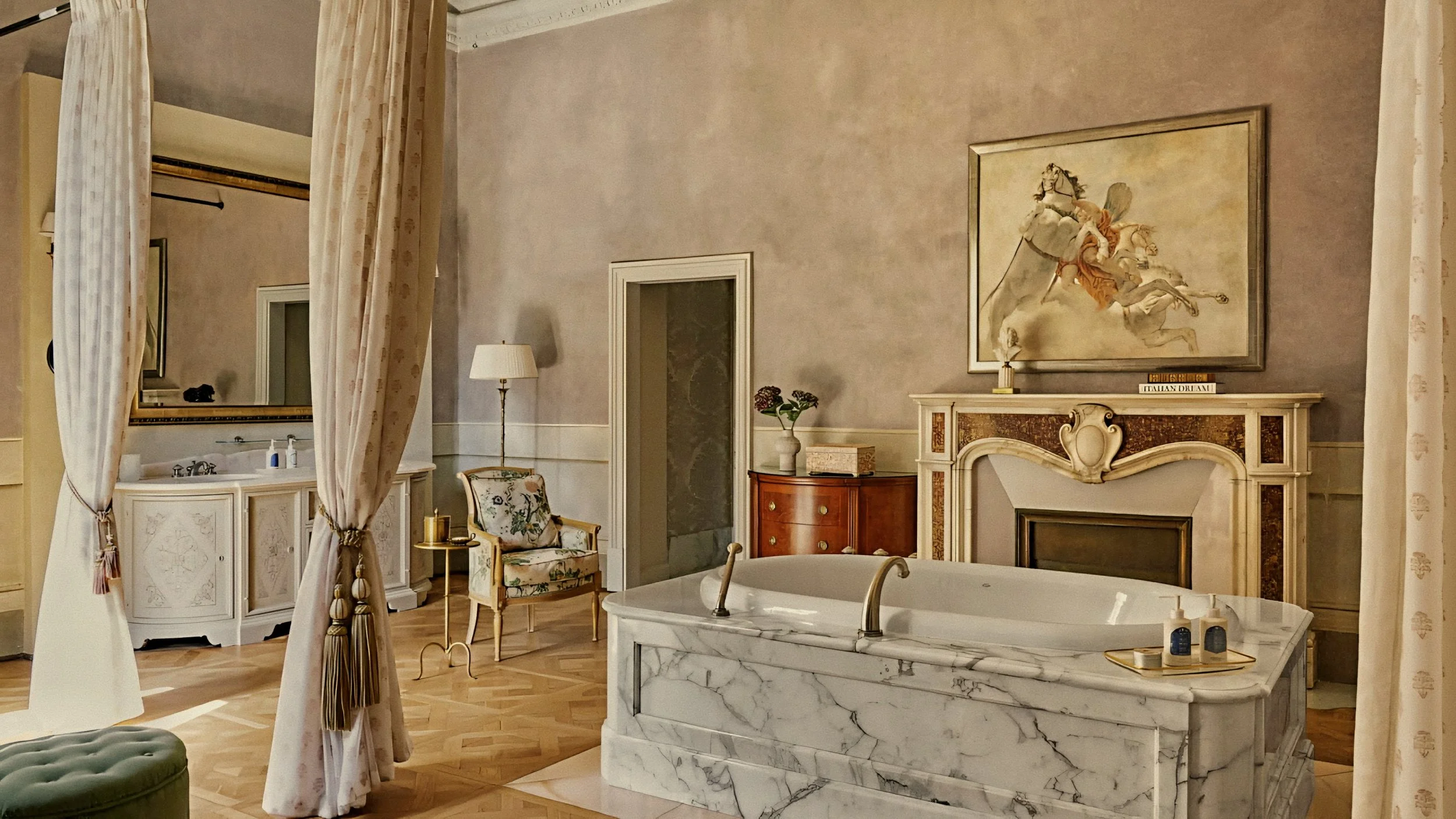
Calacatta marble casing and tasseled sheer drapery framing a hearthside bathing salon. Photo: Courtesy of Four Seasons Hotel Firenze
Conceived as sunlit, residential-scale sanctuaries, the bathrooms across both palazzos showcase the enduring luminosity of Tuscan Carrara and Calacatta marble. Double vanities topped with gilded mirrors, heated towel racks, and glass-enclosed rain showers sit alongside deep European soaking tubs—often sculpted as freestanding centerpieces in suites—bathed in natural daylight from tall French windows. In the most storied quarters, bathing spaces retain extraordinary architectural provenance of their own, from antique carved marble fireplaces and herringbone parquet flooring to the delicate frescoes depicting the Temple of the Seven Virtues inside the Conti Suite bath.
Daily cleansing rituals are anchored in centuries-old Florentine botanical heritage through bath amenities crafted by the historic Officina Profumo-Farmaceutica di Santa Maria Novella. Surrounded by soft natural light, hand-finished plaster walls, and bespoke Italian millwork, each bathing enclave balances museum-grade craftsmanship with effortless contemporary indulgence.
The Medallion Salon
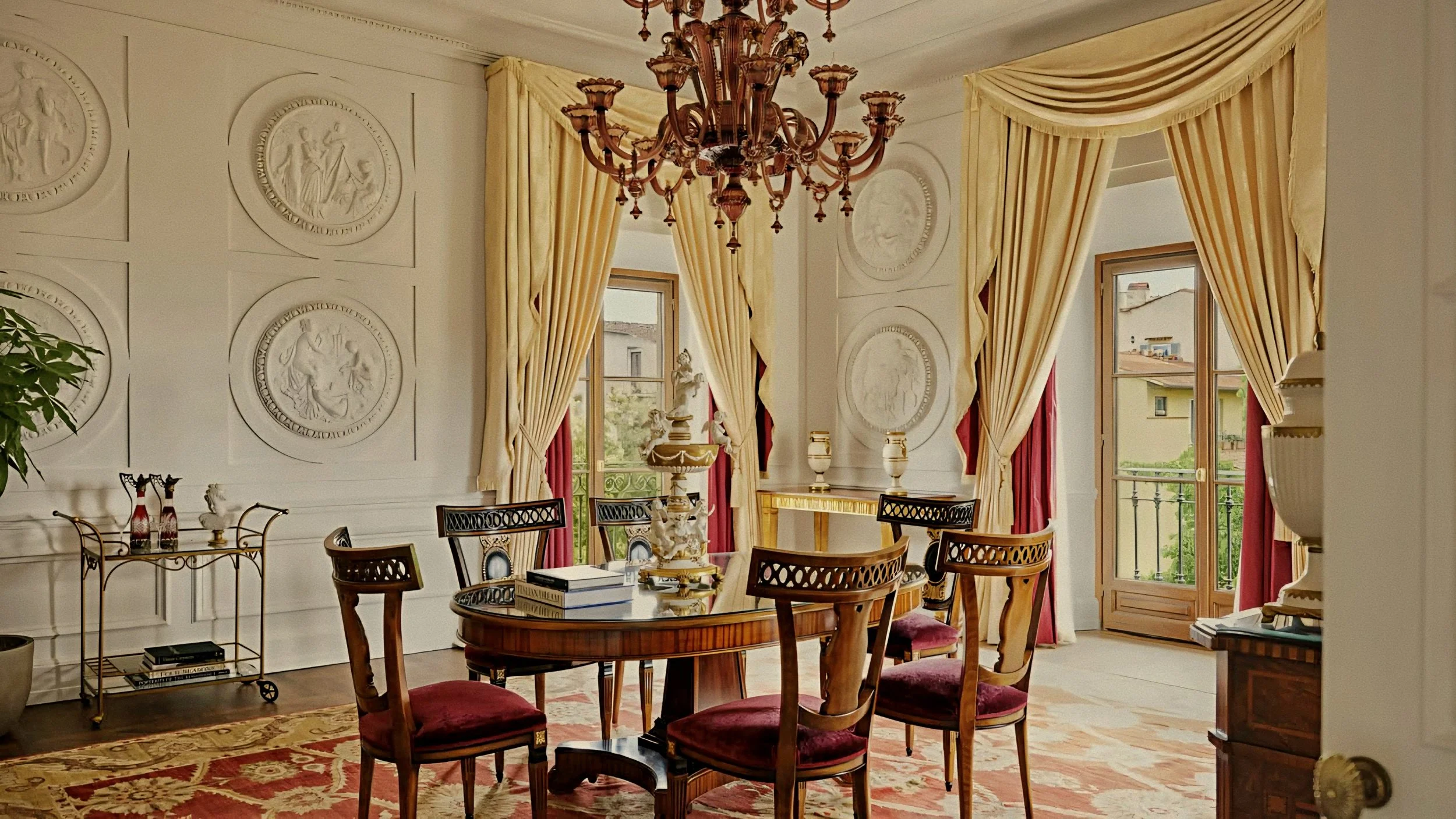
Plaster bas-relief medallions and swagged silk drapery framing a formal inlaid dining salon. Photo: Courtesy of Four Seasons Hotel Firenze
Within the suites and corner quarters—spanning the bi-level Duomo View Suite with its upstairs panoramic window framing Florence’s terracotta rooftops, alongside the bespoke Renaissance and Gallery Suite collections—living salons recapture the intimate rhythm of private aristocratic reception rooms. Velvet and damask sofas, inlaid walnut writing desks, Murano glass chandeliers, and curated antique oil paintings are arranged beside tall French doors opening onto vistas of the botanical park, the inner cortile, or Brunelleschi’s Duomo. Reflecting on his approach to harmonizing contemporary living with centuries-old heritage, lead designer Pierre-Yves Rochon observed: "The building itself dictates the design—our role is to listen to the history, restore its dignity, and bring effortless modern comfort without ever competing with the original art."
Crowning the estate’s residential portfolio are the piano nobile Historical Suites—monumental apartments once inhabited by Medici cardinals, popes, and Florentine nobility. Spanning 234 square meters inside Palazzo della Gherardesca, The Royal Suite stands as the property’s undisputed jewel, uniting a formal dining room for eight, a private study, a frescoed master bedroom, and an optional three-bedroom configuration reaching 372 square meters. Nearby, the 205-square-meter Presidential Suite de' Medici pairs Renaissance coffered ceilings uncovered during the restoration with a private garden terrace overlooking the historic 16th-century carriage path.
Across the park inside Palazzo del Nero, the Presidential Suite unfolds beneath a soaring ceiling fresco by Faentine artist Pasquale Saviotti alongside dark walnut paneling and a private balcony framing direct views of the Duomo. Completing the collection at ground level, the Garden Suite inhabits the former 16th-century limonaia citrus greenhouse—offering high timber-beamed ceilings, a private terrace, and a secluded seasonal plunge pool set directly amidst the ancient trees of the park.
The Grotesque Enfilade
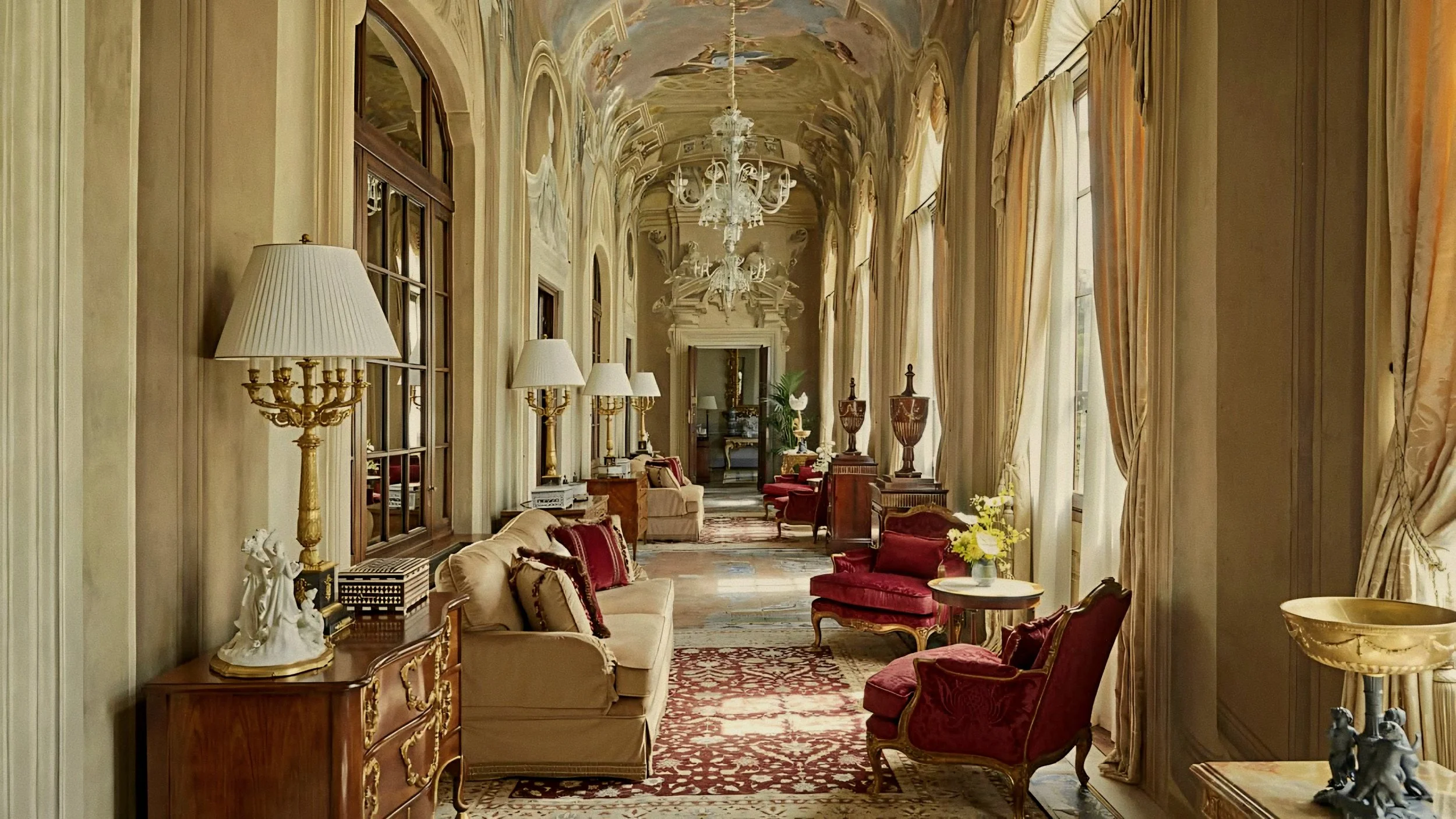
A barrel-vaulted frescoed gallery lined with crimson silk bergères and blown-glass chandeliers. Photo: Courtesy of Four Seasons Hotel Firenze
To walk through Four Seasons Hotel Firenze is to inhabit an unbroken continuum of Italian decorative arts spanning more than five centuries. Preserved through seven years of meticulous conservation under Italy’s Ministry of Cultural Heritage, the estate’s ceilings, walls, and floors form a museum-grade anthology of Renaissance, Baroque, and 19th-century Neoclassical mastery. Overhead, vaulted galleries and piano nobile salons reveal extraordinary painted narratives—from 17th-century frescoes of pagan deities and mystical allegories in the Royal Suite’s grand hall to Rubens-inspired cherubs celebrating the triumph of spring in the Scala Suite, and 16th-century chronicles of the Della Gherardesca family’s settlement in Pisa. Even the 19th-century chapter of the estate leaves its artistic signature overhead, from allegorical virtues of Hospitality, Courtesy, and Decorum in Palazzo del Nero to a ceiling honoring railway pioneer George Stephenson, commissioned during the Italian Southern Railway Company’s ownership.
Beneath these luminous vaults, rare architectural surfaces anchor the interiors in tactile authenticity. In the Royal Suite gallery, guests tread upon an original 18th-century Neapolitan maiolica ceramic floor hand-painted by master Ignazio Chiaiese, while crisp white-and-gold soffitto a cassettoni ceilings—mirroring those of Palazzo Vecchio—crown the San Gallo Suite. From classical plaster bas-relief medallions and Mannerist stucco work to bespoke Florentine antiques, every surface transforms the simple act of residence into an intimate encounter with Florence’s enduring artistic soul.
The Damier Refectory
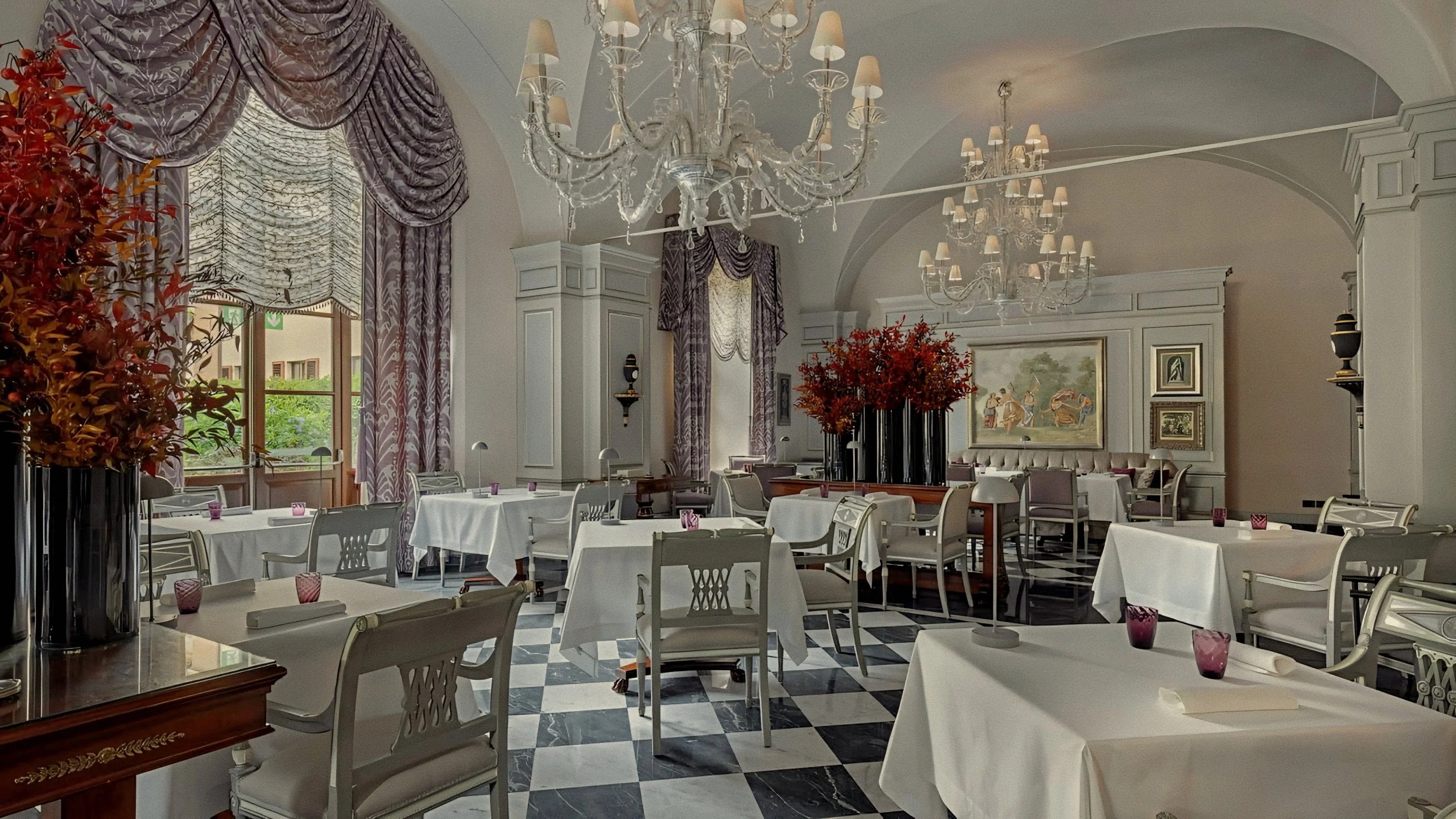
Chequered marble floors and cascading silk valances beneath blown-glass chandeliers. Photo: Courtesy of Four Seasons Hotel Firenze
At the helm of the estate’s culinary universe stands Executive Chef Paolo Lavezzini, a native of Emilia-Romagna whose decade leading kitchens in Brazil and training across Europe’s finest dining rooms inform a philosophy he describes simply as "Italian by heart, Brazilian by soul." Anchored by Orto—a dedicated working kitchen garden tucked into a sunny corner of the estate where basil, rosemary, sage, wild mint, and heirloom citrus are harvested daily—Lavezzini’s menus draw directly from small family farms across the Mugello valley, Chianti hills, and Tyrrhenian coast. Within the historic reception halls of Palazzo della Gherardesca, the Michelin-starred Il Palagio unfolds beneath soaring vaulted ceilings, original stone columns, and shimmering chandeliers, spilling out onto an elevated garden terrace during warmer months and hosting a celebrated Sunday brunch. Supported by a subterranean cellar housing over 400 Italian and international labels, Lavezzini elevates Tuscan heritage through signature creations such as dischi volanti pasta, saor pumpkin risotto, buckwheat-flavored Criollo dark chocolate, and a whimsical chocolate chessboard.
Across the park inside the 16th-century Palazzo del Nero, Onde—reimagined by Pierre-Yves Rochon in late 2024—brings the sunlit spirit of Tuscany’s Versilia coastline into the heart of Florence. Framed by whitewashed arches, maritime blues, warm terracotta, and custom botanical textiles, this contemporary fish osteria pairs the freshest Mediterranean catch with a glamorous, convivial energy heightened by nightly DJ sets. Throughout the grounds, lighter culinary rituals punctuate the rhythm of the day—from house-made artisanal gelato churned fresh each morning and bespoke gourmet picnics beneath the trees to a hidden, late-night self-serve pantry tucked discreetly inside Palazzo del Nero.
Beyond its dining salons, Four Seasons Hotel Firenze elevates private gastronomy into unforgettable architectural theater across Florence’s most coveted vantage points. Within the estate, intimate candlelit dinners unfold beneath the sprawling canopy of the Faggio Pendulo—the garden’s oldest weeping beech tree—inside the mother-of-pearl and frescoed Renaissance Chapel, or high atop the private Altana rooftop terrace as sunset illuminates the Florentine skyline. For rarefied moments beyond the gates, the culinary team orchestrates private tasting menus overlooking the Arno on a reserved terrace atop the Ponte Vecchio, as well as candlelit evenings inside a 15th-century Florentine mansion near Palazzo Vecchio rumored to be where Leonardo da Vinci first conceived La Gioconda.
The Burlwood Nocturne
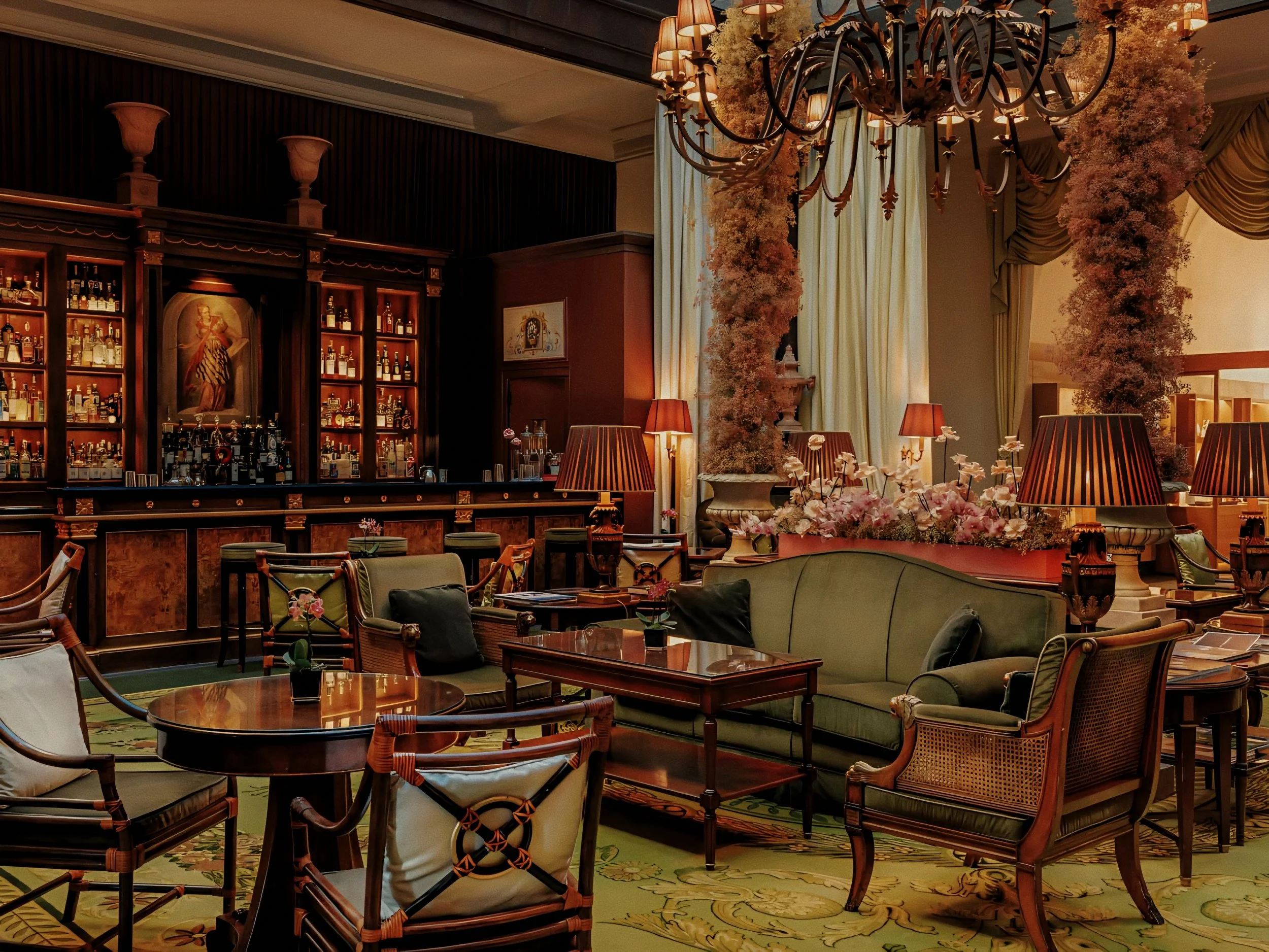
Burl-wood millwork and pleated silk lampshades casting an intimate glow across moss-velvet salon seating. Photo: Courtesy of Four Seasons Hotel Firenze
Positioned just off the glass-roofed cortile beneath Giuliano da Sangallo’s stone loggias, Atrium Bar—crafted by Pierre-Yves Rochon with forty indoor seats and forty more spilling into the courtyard—serves as the social heartbeat of Palazzo della Gherardesca. Framed by dark walnut paneling, plush olive-velvet armchairs, and Murano glass lighting, the salon moves effortlessly from morning espresso and tiered afternoon tea with champagne into a glamorous evening cocktail sanctuary accompanied by live grand piano music. Under the direction of Head Mixologist Edoardo Sandri—who notes, "I like to use unconventional and unique ingredients to create innovative cocktails and surprise our guests"—the bar pairs vintage Negronis poured from an iconic drinks trolley with The Tasting Globe, an evocative cocktail menu translating Executive Chef Paolo Lavezzini’s global culinary memories into avant-garde pours such as Bagel & Lox, Yuja, Huître Bretonne, and Brigadeiro.
Across the park inside Palazzo del Nero, Bar Berni pays playful homage to noble founder Bernardo del Nero within a botanical-inspired parlor of deep velvet seating, warm brass accents, and curated Italian vermouths and bitters overlooking the manicured Italianate gardens. Beneath centuries-old cedar and sequoia trees beside the swimming pool, Trattoria Al Fresco and the Pool Tree Bar capture the sun-drenched ease of a private Tuscan country estate—pairing Josper-grilled meats, handmade pastas, and evening wood-fired Neapolitan pizzas under wrought-iron pergolas with garden-infused summer cocktails. Extending this liquid heritage beyond the estate walls, dedicated sommeliers and concierges curate private viticultural journeys through Chianti Classico, Bolgheri, and Val d’Orcia—unlocking intimate tastings at generational family estates, architecturally striking cellars, and historic Florentine enotecas.
The Fenestrated Orangery
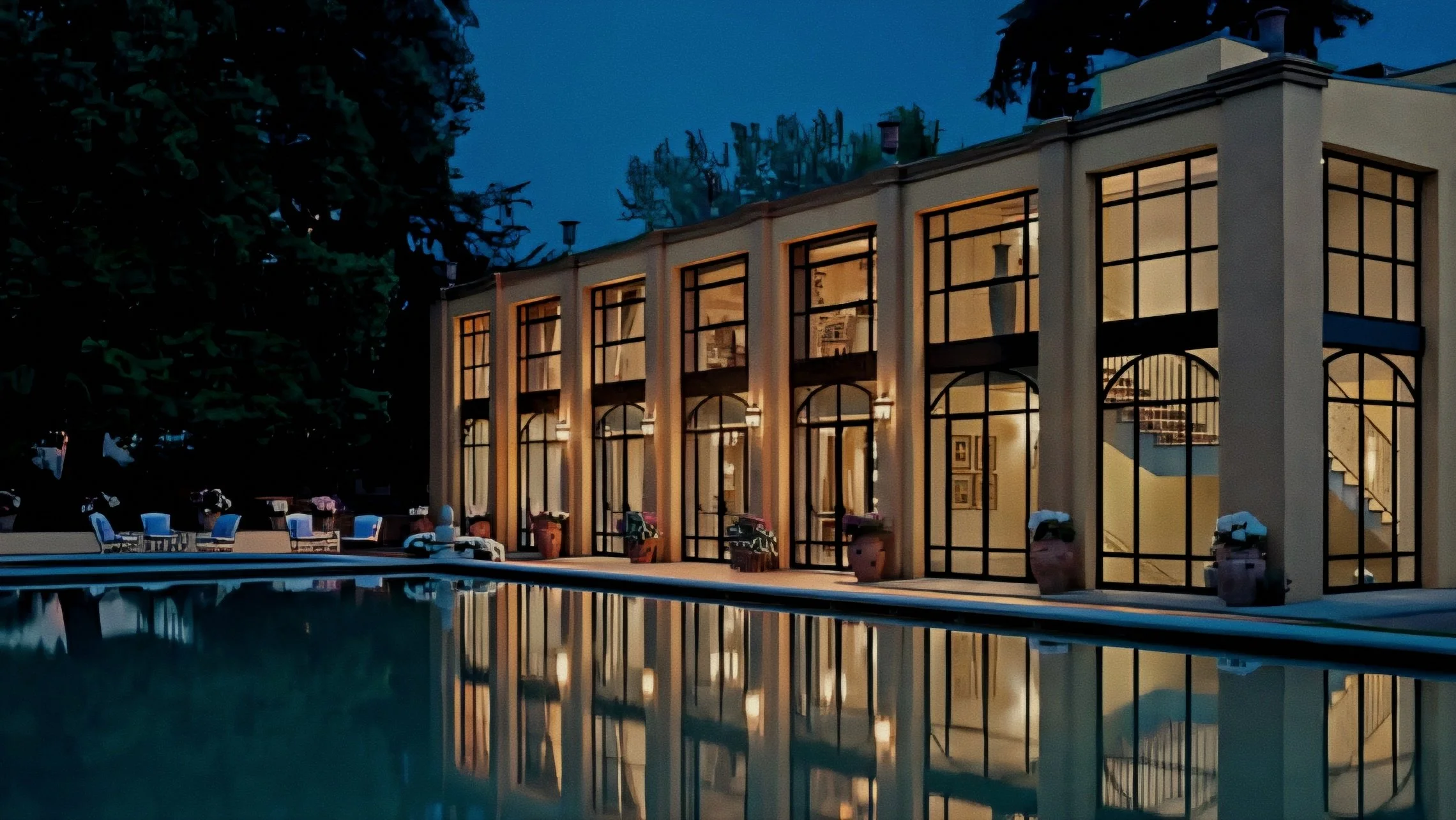
Arched steel-mullioned fenestration reflecting across a still nocturnal basin at twilight. Photo: Courtesy of Four Seasons Hotel Firenze
Tucked deep within the 11-acre botanical sanctuary of the Giardino della Gherardesca, the 790-square-metre spa unfolds as a freestanding, two-story architectural pavilion designed by Pierre-Yves Rochon with pavilion concepts by Studio Vincenzo de Cotiis. Warm Tuscan stone, rich timber accents, and soft cream-and-gold tones frame floor-to-ceiling vistas of ancient parkland, leading into a serene relaxation lounge anchored by white-and-gold daybeds bathed in gentle, diffused illumination. Across ten treatment rooms—including a dedicated couples suite and an adjacent full-service beauty salon—the spa pairs advanced scientific skincare from Rephase with centuries-old Florentine botanical formulas crafted exclusively by the 13th-century apothecary Officina Profumo-Farmaceutica di Santa Maria Novella alongside holistic Sodashi rituals. Signature treatments range from Tuscany Essences featuring Chianti wine oil brushing and cypress scrubs to Renaissance Flowers and the Holistic Oud & Sounds journey, which harmonizes natural fragrance oils with medium-pressure technique and the meditative frequencies of Tibetan singing bowls.
For complete seclusion, guests reserve the standalone Spa Suite—an intimate private sanctuary featuring two treatment beds, a cozy fireplace lounge, a walk-in shower, and a freestanding soaking tub carved from a single block of local pietra serena sandstone that opens directly onto its own private garden. Within this private realm, curated signature experiences such as the Rhythmic Escape by Sodashi pair graceful movement with music, while the Florentine Experience by Santa Maria Novella unfolds through a traditional foot purification ritual, exfoliating body treatment, massage, and bespoke facial.
Complementing the treatment suites, separate men's and women's thermal circuits provide an immersive restorative journey complete with 90°C Finnish saunas, 45°C eucalyptus-infused Turkish steam baths, chromotherapy LED lighting, ice fountains, lemon-scented cold rain showers, and mint-infused cold mists. Upstairs, the 2,206-square-foot fitness center occupies the historic footprint of the gamberaia—a 18th-century freshwater pond built between 1746 and 1759 to farm crustaceans for noble tables—now transformed into a high-performance wellness salon equipped with Italian Technogym machinery, WellBack and Body Slimmer systems, and six certified personal trainers. Beyond indoor movement studios and private training, active wellness extends outdoors into tailored yoga and Pilates sessions on the shaded lawns, mindful meditation climbs atop the historic Collinetta hill, and guided running excursions tracing Florence’s ancient architectural landmarks.
The Pietra Basin
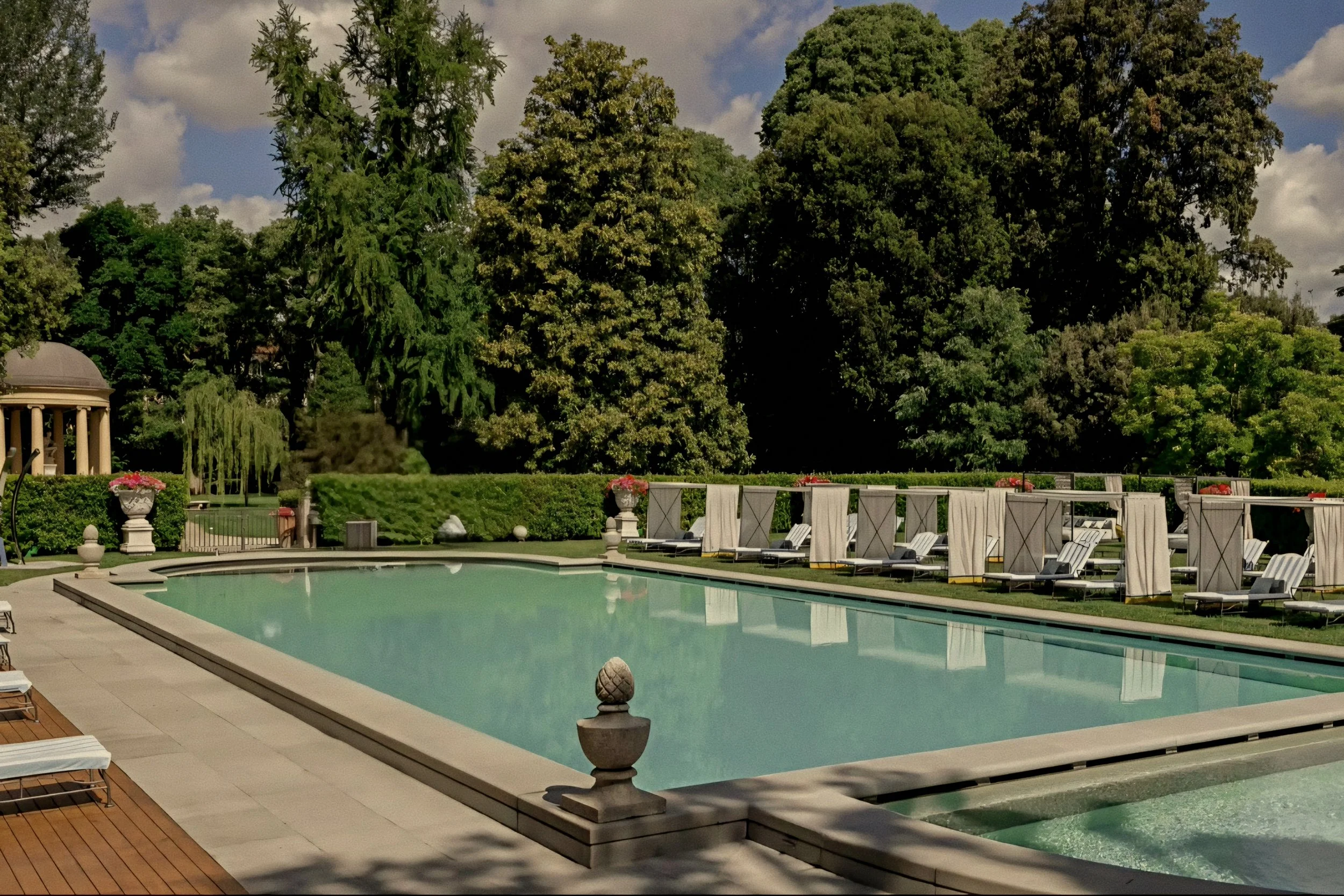
Limestone coping, carved stone urns, and linen-draped cabanas bordered by manicured yew hedges. Photo: Courtesy of Four Seasons Hotel Firenze
Set within a sunlit clearing of the 11-acre Giardino della Gherardesca, a 19-meter rectangular outdoor swimming pool and an adjacent year-round heated hydromassage whirlpool establish an unhurried, resort-like sanctuary in the center of Florence. Framed by white stone paving, cream-draped cabanas, and cushioned loungers, the pool is oriented so swimmers can gaze upward through ancient boughs toward the distant terracotta cupola of Brunelleschi’s Duomo—while dedicated attendants circulate with chilled fresh fruit and wood-fired fare from the neighboring trattoria. Beyond the water’s edge, the surrounding park unfolds as an extraordinary living museum of 19th-century aristocratic botanical curiosity, where rare North American sequoias, aromatic Lebanese cedars, and a nearly two-century-old Magnolia soulangeana cast dappled shade across manicured lawns.
Meandering paths reveal layers of architectural theater tucked beneath the foliage, from the secluded Bellosguardo Terrace—once a quiet reading perch for the Della Gherardesca family—to the southern Duomo View Lawn, where Florence’s cathedral rises cleanly above the skyline. Scattered throughout the grounds are romantic follies and conservatories crafted by L'Officina dei Giardini alongside historic monuments: a 19th-century Viennese-inspired Kaffeehaus adorned with mythological bas-reliefs, a neoclassical Ionic Temple overlooking the garden’s historic axis, and an 18th-century Baroque grotto arch sculpted between 1755 and 1762 by Agostino Fortini in textured stonework reminiscent of the Boboli Gardens.
The Medici Bastion
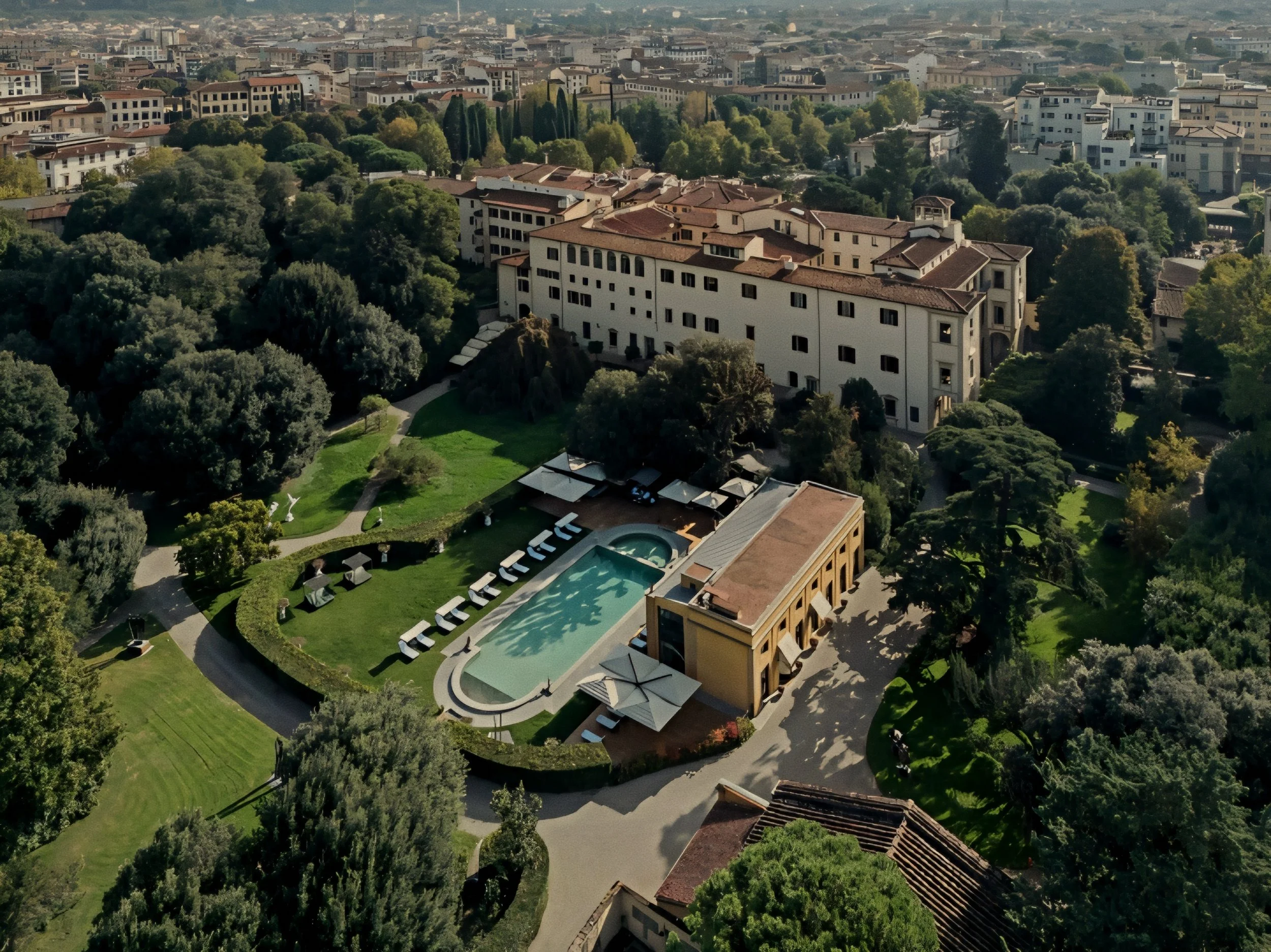
A Renaissance palazzo and private walled botanical gardens rising amid terracotta rooftops. Photo: Courtesy of Four Seasons Hotel Firenze
Beyond the walled serenity of Borgo Pinti, the estate’s cultural stewardship extends into intimate encounters with Tuscany’s living decorative traditions. Private ateliers invite guests to master the centuries-old discipline of traditional fresco and tempera painting alongside Florentine restorers, while exclusive studio visits unlock the storied workshops of Ginori 1735—illuminating nearly three centuries of porcelain artistry just outside the city—and historic Florentine cashmere mills, where master artisans transform raw fibers into heirloom garments by hand.
Outdoors, the surrounding Tuscan landscape unfolds through equally rarefied perspectives—whether drifting quietly along the Arno River aboard a private wooden vessel beneath Florence’s historic bridges, rising at dawn in a private hot-air balloon above misty Chianti vineyards, or venturing deep into ancient oak woods with seasoned tartufai in pursuit of prized Tuscan truffles. Each immersion mirrors the humanist curiosity that first shaped this estate, connecting residents directly to the land, craft, and heritage of the Renaissance capital.
Rising from more than five centuries of aristocratic history, Four Seasons Hotel Firenze stands not merely as an address in the cradle of the Renaissance, but as a living sanctuary of Italian art de vivre. Here—where Giuliano da Sangallo’s classical proportions, museum-grade frescoes, and eleven acres of botanical stillness converge with contemporary culinary and restorative craft—every threshold preserves the confidential elegance of a private noble residence, enduring as Florence’s most poetic architectural legacy.
L'Ordre de Royaume
ESSENTIAL INFORMATION
To preserve your personal privacy, secure direct guest privileges, and ensure end-to-end data safety, luxury travelers are advised to book directly through the property's official portal.
(Note: Royaume maintains zero affiliate partnerships or booking commissions. We link exclusively to official brand channels for property verification and reader security.)